
EV Problems & Fixes
EV Range Loss in Cold Weather: Why It Happens and 9 Ways to Get Miles Back
EV range loss in cold weather surprises many new electric car owners. On the first cold week of winter, the range estimate drops, the battery seems to drain faster and DC fast charging takes longer. It isn’t a fault: lithium-ion batteries work less efficiently in the cold, and heating the cabin takes a lot of energy that a gas car gets for free from engine waste heat.
Quick answer
- Expect a noticeable range drop in freezing weather; AAA testing found 41% at 20°F with the heater on.
- Cabin heating and a cold battery are the two biggest causes.
- Precondition while plugged in to warm the battery and cabin on grid power.
- Use seat and steering wheel heaters; they use far less energy than heating the air.
In this guide
The good news is that you can win back a significant share of those miles with a few habits. Here’s how much range to expect, why EVs lose it, and the practical steps that make the biggest difference. For background, see FuelEconomy.gov’s guide to cold-weather driving.
How Much Range Do EVs Lose in Winter?
It depends on temperature, trip length, speed and how you use the heater. Short trips in very cold weather are hardest, because the car spends energy warming the cabin and battery each time. AAA’s widely cited 2019 testing found an average range reduction of about 41% at 20°F when the heater was used, compared with mild weather. Real-world losses for most owners are often smaller, especially with heat pumps, preconditioning and longer trips.
| Factor | Effect on winter range |
|---|---|
| Cabin heating | Large; resistive heaters use a lot of power |
| Cold battery | Higher internal resistance; limited regen and power |
| Short trips | Repeated warm-up costs energy each time |
| Winter tires | Slightly higher rolling resistance |
| Snow, slush and wind | More drag and rolling resistance |
| Low tire pressure | Increases rolling resistance |
Why EV Range Loss in Cold Weather Happens
There are two main reasons. First, lithium-ion batteries rely on chemical reactions that slow down in the cold, so the battery can’t release or accept energy as efficiently until it warms up. That’s also why regenerative braking may be limited and fast charging slower on a cold morning. Second, heating the cabin takes energy straight from the battery. Heat pumps are much more efficient than resistive heaters, but they also lose efficiency in very low temperatures.
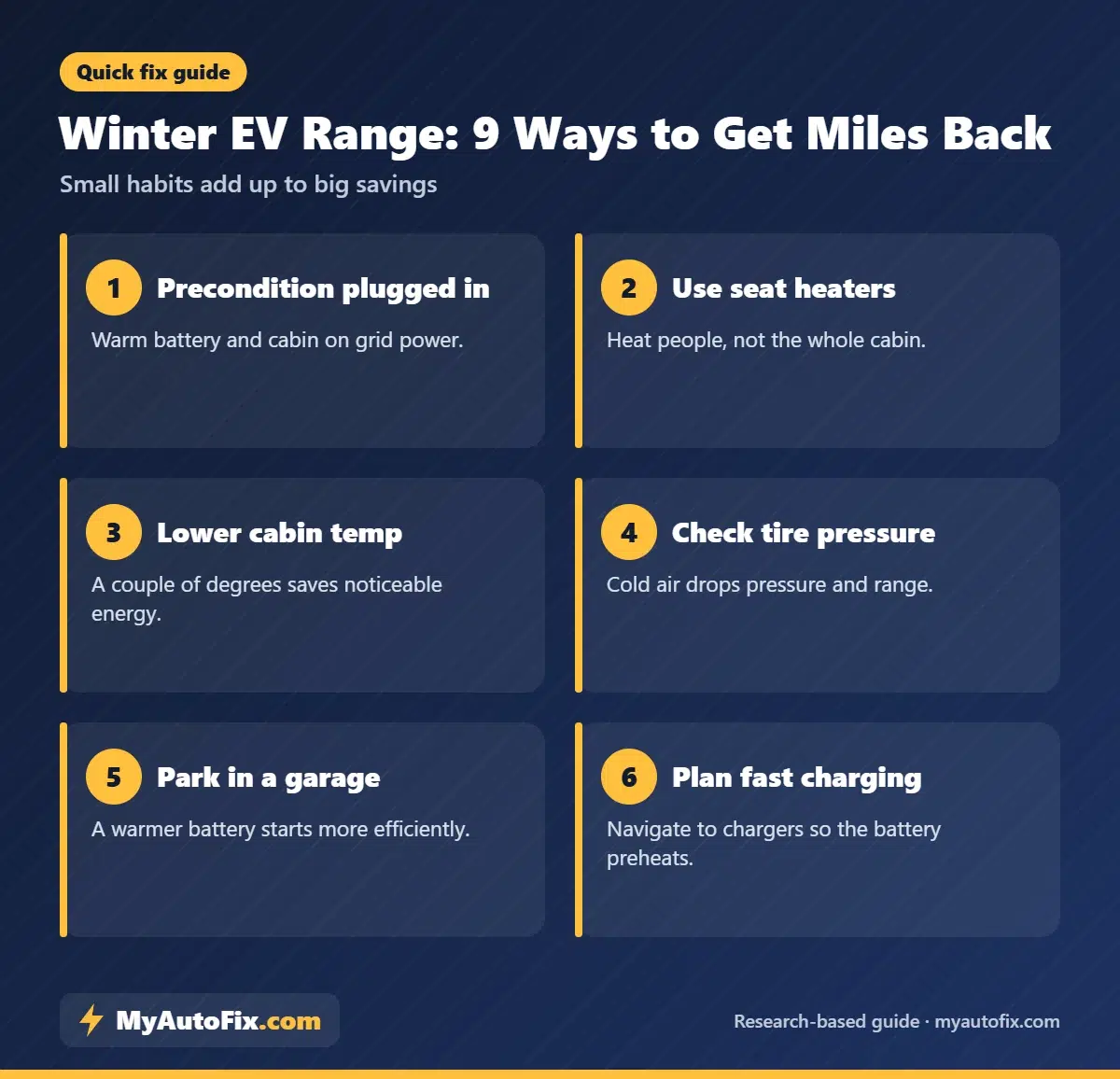
9 Ways to Reduce EV Range Loss in Cold Weather
- Precondition while plugged in. Use a scheduled departure time or the app to warm the battery and cabin 20–30 minutes before leaving, using grid power instead of the battery.
- Use seat and steering wheel heaters. They warm you directly with far less energy than heating all the cabin air.
- Turn the cabin temperature down slightly. A couple of degrees lower saves energy, especially on short trips.
- Keep tires properly inflated. Pressure drops about 1 psi for every 10°F. Check weekly in winter.
- Park in a garage when possible. Even an unheated garage keeps the battery warmer than outside.
- Navigate to fast chargers. Many EVs automatically precondition the battery when you set a charger as the destination, so it charges faster on arrival.
- Drive a little slower. Aerodynamic drag rises sharply with speed, and winter air is denser.
- Combine short trips. Once warm, the car is far more efficient than repeatedly heating from cold.
- Use eco or chill modes. Smoother acceleration and climate settings save energy.
The Tricky Part: “Missing” Range Overnight
Owners often notice range dropping while the car is parked in the cold. Some of that is real energy use: the car may keep the battery above a minimum temperature, run security cameras or wake for app checks. Some is the estimate recalculating because a cold battery has less usable energy until it warms. Turning off camera monitoring at home, reducing app checks and leaving the car plugged in all help. See our guides to EV battery drain overnight and the best dash cam for Tesla for how camera recording affects energy use.
Charging in Cold Weather
A cold battery charges slowly at DC fast chargers until it warms. Use the car’s navigation to route to the charger so it preheats the battery, or charge right after driving when the battery is warm. At home, charging overnight and scheduling departure keeps the battery warm when you leave. If the charge port itself freezes, see our guide to an EV charge port that’s frozen.
When to Worry
- Range drops sharply even in mild weather.
- The heater blows cold or the car warns about the heat pump; see EV heat pump not working.
- The car shows reduced power warnings that don’t clear as it warms; see EV reduced power warnings.
- Range doesn’t recover in spring.
The Bottom Line
EV range loss in cold weather is normal, temporary and largely manageable. Precondition while plugged in, heat yourself rather than the whole cabin, keep tires inflated and plan charging so the battery is warm. With those habits, most drivers recover a good share of their winter miles, and the range comes back as temperatures rise in spring.
Frequently Asked Questions
How much range does an EV lose in cold weather?
It varies, but AAA testing found about 41% at 20°F with the heater on. Many drivers see less with heat pumps, preconditioning and longer trips.
Does cold weather permanently damage EV batteries?
Normal winter use doesn’t cause meaningful permanent damage. Battery management systems protect the pack. Avoid leaving the car at very low charge in extreme cold for long periods.
Do heat pumps help winter range?
Yes. Heat pumps are much more efficient than resistive heaters, though their advantage shrinks in extreme cold.
Should I charge to 100% in winter?
Follow your manufacturer’s guidance. Charging higher before a long winter trip is reasonable; daily charging limits are usually still recommended.
Why is my EV charging slowly in winter?
A cold battery limits charging speed until it warms. Precondition by navigating to the charger or charge right after driving.
More EV Guides
Best J1772 Extension Cables (2026): Safe Picks, Code Limits and Better Alternatives
The best J1772 extension cables from Lectron and EVDANCE, plus portable charger alternatives, plus the safety facts most listings skip: certification, NEC…

6 Best Tesla Model Y Floor Mats (2026): All-Weather Picks for Pre-Refresh and Juniper
The best Tesla Model Y floor mats: 3D MAXpider, WeatherTech, TuxMat and value TPE sets, plus how to get the right fit…
Best Dash Cam for Tesla (2026): TeslaCam Storage vs VIOFO, Vantrue & Garmin
The best dash cam for Tesla: when the built-in TeslaCam is enough, the best USB storage for Sentry Mode, and the best…