
EV Charging · Buying Guide
Best J1772 Extension Cables (2026): Safe Picks, Code Limits and Better Alternatives
As an Amazon Associate I earn from qualifying purchases. We may earn a commission if you buy through links on this page, at no extra cost to you. Learn more.
The best J1772 extension cables solve a common problem: your Level 2 charger is on the garage wall, but the car is parked in the driveway, at the curb or on the wrong side of the garage. An extension can add 16 to 40 feet of reach without moving the charger. But there are important safety and code questions that many listings gloss over, from certification to cable-length limits in the National Electrical Code. We compared the most popular J1772 extension cables, explain what the certifications actually mean, and show when a longer charger cable or relocating the charger is the smarter fix.
How we chose: we compared amp ratings, lengths, weatherproofing, temperature protection, stated certifications, warranties and owner feedback, and reviewed the National Electrical Code language on EV cord length. We haven’t tested each extension ourselves for this guide, so our picks are research-based. For general home-charging guidance, see the U.S. Department of Energy’s guide to charging at home.
Key takeaways
- Match the extension’s amp rating to your charger (40A, 48A or more).
- Use the shortest length that reaches; heat and resistance rise with length.
- There’s no unified UL listing for complete EV extensions; look for certified cable and temperature protection.
- If you’d use it every day, move the charger or buy one with a longer cable.
Our Top J1772 Extension Cable Picks at a Glance
- Best OverallLectron J1772 Extension Cable (40A, 20 ft)Check Price
- Best Safety FeaturesEVDANCE J1772 EV Extension Cord (40A, 21 ft)Check Price
- Best High-AmpEVDANCE J1772 Extension Cord (50A, 21 ft)Check Price
- Budget Portable ChargerELEGRP Portable Level 1/2 EV Charger (16A, J1772, 16 ft)Check Price
- Longest ReachLectron J1772 Extension Cable (40A, 40 ft)Check Price
- Alternative: Portable ChargerWOLFBOX Portable Level 1 and 2 EV Charger (40A, J1772)Check Price
In this guide
J1772 Extension Cable Comparison
| Product | Max current | Length | Notable feature | Best for |
|---|---|---|---|---|
| Lectron 20 ft | 40A | 20 ft | Trusted brand, manageable length | Most owners |
| EVDANCE 40A | 40A | 21 ft | Temperature sensors | Safety-focused |
| EVDANCE 50A | 50A | 21 ft | Above-48A rating | 48A chargers |
| ELEGRP portable | 16A charger | 16 ft | Travel/backup charger | Trips, second spot |
| Lectron 40 ft | 40A | 40 ft | Long reach | Occasional use |
| WOLFBOX portable | Charger (40A) | Check listing | No extra joint | Daily use, travel |
Which J1772 Extension Is Right for You?
- You need a few extra feet on a 40A charger: Lectron 20 ft.
- You want temperature monitoring: EVDANCE 40A, 21 ft.
- Your charger runs at 48A: EVDANCE 50A, or turn the charger down to 40A.
- You sometimes charge at the curb or a friend’s house: Lectron 40 ft, used occasionally.
- You’d need it every day: skip the extension and get a charger with a longer cable, like the WOLFBOX portable 40A charger, or have the charger moved.
The Best J1772 Extension Cables, Reviewed
1. Lectron J1772 Extension Cable (40A, 20 ft)
Lectron is one of the best-known EV charging accessory brands in the U.S., and its J1772 extension cable is among the most popular on the market. It supports up to 40 amps, which covers most home Level 2 chargers, and works with both Level 1 and Level 2 chargers that have a J1772 connector. Lectron advertises ETL and FCC certification with multi-layer electrical protection.
- RatingUp to 40A
- Length20 ft (40 ft also offered)
- WeatherproofingOutdoor-rated
- Certifications (claimed)ETL, FCC
We recommend the shorter 20-foot version for most people. Shorter extensions are lighter, easier to store, generate less heat and keep the total cord length closer to the National Electrical Code’s 25-foot guideline, which we explain below. The cable is weatherproof for outdoor use, and the connector has a protective cap for when it’s not in use.
Reviews on retailer sites are strongly positive, with owners praising the heavy-duty cable. Lectron also sells a 40-foot version, which is useful for curbside parking but heavier, harder to store and further outside the code’s length guidance.
Who should buy it: J1772 EV owners (or Tesla owners with a J1772 adapter) who need modest extra reach on a 40A or smaller charger. Skip it if: your charger delivers 48A or more.
What we like
- Trusted EV accessory brand
- 20 ft length stays manageable
- Works with L1 and L2 J1772 chargers
- Strong owner feedback
Watch out for
- Limited to 40A
- Not a substitute for a properly placed charger
Verdict: The best all-round J1772 extension for typical 40A home charging.
Check Price on Amazon2. EVDANCE J1772 EV Extension Cord (40A, 21 ft)
EVDANCE offers J1772 extensions in 32A, 40A and 50A versions and in 21-foot and 40-foot lengths, with an IP66 weatherproof rating. The 40A, 21-foot model supports up to 9.6 kW, matching most home chargers.
- Rating40A (32A and 50A also offered)
- Length21 ft (40 ft also offered)
- ProtectionTemperature sensors, surge protection
- WeatherproofingIP66
What stands out is EVDANCE’s focus on heat. The company says its extensions use UL-Recognized cable and silver-plated inlet terminals for better conductivity, built-in temperature sensors and surge protection, and that they’ve passed freeze, heat, drop and drive-over tests. Heat at connections is the main failure risk for any extension, so those features are reassuring.
EVDANCE is also refreshingly honest that there is currently no unified UL certification for EV extension cables as complete products; the UL recognition applies to the cable. It offers a 12-month warranty.
Who should buy it: owners who want temperature protection and a choice of amp ratings. Skip it if: you want a longer warranty.
What we like
- Temperature sensing
- Choice of amp ratings
- IP66 weatherproof
- Transparent about certification
Watch out for
- 1-year warranty
- Heavier than adapters
Verdict: A thoughtfully protected extension for everyday Level 2 use.
Check Price on Amazon3. EVDANCE J1772 Extension Cord (50A, 21 ft)
Many newer home chargers can deliver 48 amps when hardwired on a 60-amp circuit. A 40A extension can’t safely carry that current, so you either limit the charger to 40A in its settings or use a higher-rated extension.
- Rating50A
- Length21 ft
- Use48A chargers with margin
- WeatherproofingIP66
EVDANCE’s 50A version is one of the few J1772 extensions rated above 48A, giving a margin over a 48A charger. It shares the brand’s temperature sensing and weatherproofing.
Higher current means more heat at every connection, so keeping the cable uncoiled, dry and well seated matters even more. If your charger allows it, there’s no harm in dialing it down to 40A when using any extension; you’ll lose only a little charging speed.
Who should buy it: owners of 48A Level 2 chargers. Skip it if: your charger tops out at 40A or less.
What we like
- Rated above 48A
- Temperature sensing
- Weatherproof
- Avoids derating your charger
Watch out for
- Heavier, thicker cable
- Needs extra care with heat
Verdict: The pick when your charger runs at 48A.
Check Price on Amazon4. ELEGRP Portable Level 1/2 EV Charger (16A, J1772, 16 ft)
The ELEGRP is not an extension cable: it is a compact portable J1772 charger. We include it because many people shopping for an extension really need a second charger, for example to keep in the car for trips, or for a second parking spot where a 240V outlet already exists.
- TypePortable Level 1/2 charger
- Max current16A
- Cable16 ft
- ConnectorJ1772
It charges at up to 16A and works on Level 1 (a standard household outlet) or Level 2 (a suitable 240V outlet), depending on the plug and adapter on the listing. At 16A on 240V that is roughly 3.8 kW, much slower than a 40A or 48A wall charger, but plenty for overnight top-ups.
Its 16-foot cable is shorter than most home chargers, so it will not solve a reach problem on its own. Use it with an outlet close to the car, and never add an extension between the charger and the wall unless both are rated for it.
Who should buy it: drivers who want an inexpensive travel or backup charger. Skip it if: you need more reach from your existing wall charger; a certified 40A extension such as the Lectron is the right tool.
What we like
- Doubles as a travel charger
- Low cost
- Works on Level 1 and Level 2
Watch out for
- Not an extension; short 16 ft cable
- 16A is slow next to wall chargers
- Check plug type and adapters
Verdict: A compact way to add a few feet without giving up 48A charging.
Check Price on Amazon5. Lectron J1772 Extension Cable (40A, 40 ft)
Some situations call for real distance: charging at a relative’s house, parking at the curb, or reaching a car on the far side of a long driveway. Lectron’s 40-foot extension covers those cases.
- RatingUp to 40A
- Length40 ft
- WeightAbout 18.7 lb
- WaterproofIP66 (per retailer)
It shares the 40A rating and weatherproof construction of the 20-foot version. Retailer reviews are very positive, with owners describing it as heavy-duty and solid.
At about 18 lb, it’s heavy, and a 40-foot run adds resistance and heat. Combined with a charger’s own cable, it far exceeds the NEC’s 25-foot guideline, so treat it as an occasional-use tool rather than a permanent setup.
Who should buy it: owners who sometimes need long reach. Skip it if: you need a daily, permanent solution; move the charger instead.
What we like
- Very long reach
- Heavy-duty cable
- Weatherproof
- Trusted brand
Watch out for
- Heavy and bulky
- Well outside NEC length guidance
Verdict: For occasional long-distance charging, not everyday use.
Check Price on Amazon6. WOLFBOX Portable Level 1 and 2 EV Charger (40A, J1772)
If you find yourself reaching for an extension cable every night, the safer fix is a charger whose own cable reaches your car, so there is no extra connection to heat up or wear out. The WOLFBOX is a portable J1772 charger that works at up to 40A on a suitable 240V circuit (Level 2) and can also run from a standard household outlet (Level 1) when you are away from home.
- TypePortable Level 1 and Level 2 charger
- Max current40A (on a suitable circuit)
- ConnectorJ1772
- UseHome and travel
That flexibility makes it useful as both a home charger and a travel unit. Before buying, check the cable length on the listing against the distance from your outlet to your charge port, and make sure the plug type matches your outlet.
Running at 40A requires a properly rated circuit, typically a 50A breaker for continuous charging, installed by a licensed electrician. If your outlet or circuit is rated lower, set the charger to a lower current.
Who should buy it: drivers who would otherwise use an extension daily, or who want one charger for home and travel. Skip it if: your current charger is fine and you only need extra reach a few times a year; a certified extension is cheaper.
What we like
- No extra cable joint
- Works on Level 1 and Level 2
- Portable for travel
- Replaces a daily extension habit
Watch out for
- Costs more than an extension
- 40A needs a properly rated circuit
- Check cable length and plug type
Verdict: The smartest fix if you’d need an extension every day.
Check Price on AmazonNeed a few more feet tonight? The Lectron 20-foot extension supports up to 40A and stays light and manageable. Check that it matches your charger’s output.
What the Code and Certifications Really Say
This is the part most listings skip. The National Electrical Code (NEC) Article 625 covers EV charging equipment. It requires electrical materials and equipment to be listed (certified by a recognized testing lab), and it limits the overall usable length of the cord and cable to 25 feet unless the charger has a listed cable management system.
J1772 extension cables sit in a gray area. Manufacturers such as EVDANCE state openly that there’s currently no unified UL certification for EV extension cables as complete products; brands instead use UL-Recognized or UL-certified cable and certify connectors or electronics separately. That doesn’t mean extensions are unsafe, but it does mean you should treat them as a convenience accessory, inspect them regularly and avoid making them a permanent part of your charging setup. Some local inspectors and insurers take a stricter view, so if you’re unsure, ask a licensed electrician.
What Is a J1772 Extension Cable, Exactly?
A J1772 extension cable has a J1772 inlet on one end, which accepts the plug from your charger, and a J1772 connector on the other end, which plugs into your car. In effect, it lengthens your charger’s cable. It doesn’t change the charging speed, the electrical supply or how the car and charger communicate; the charger and car still “talk” through the pilot and proximity signals that pass through the extension.
J1772 is the standard Level 1 and Level 2 AC connector used by most non-Tesla EVs in North America, and CCS1 cars use the same upper section for AC charging. Tesla and other NACS cars can use J1772 equipment with an adapter. As more automakers switch to NACS ports, you’ll also see NACS extension cables, which follow the same principles.
How Much Does It Cost to Move a Charger Instead?
Relocation costs vary widely with distance, wall construction, panel location and local labor rates. Moving a hardwired charger a few feet along the same garage wall is often a small job; running a new circuit to the far side of a garage or out to a driveway post is bigger. Get quotes from two licensed electricians, ask whether a permit is needed, and compare that to the long-term convenience and safety of not relying on an extension. Some utilities and states offer rebates for home charging installations; the U.S. Department of Energy’s Alternative Fuels Data Center lists incentives by state.
How to Choose a J1772 Extension Cable
1. Amp rating
Check your charger’s maximum output, usually printed on the label or in its app. The extension must be rated at or above that current. Many chargers let you lower the output, which is a good idea when using any extension.
2. Length
Measure the real distance from the charger’s connector, at full stretch, to your car’s charge port, then add a couple of feet for slack. Buy the shortest extension that covers it. Longer cables are heavier, store poorly and add more resistance.
3. Heat protection and build
Look for thick conductors, quality terminals (silver-plated contacts help conductivity), temperature sensing and a sturdy, weatherproof housing for the joint between charger and extension.
4. Weatherproofing
An IP66 or similar rating means the connectors resist dust and powerful water jets. Still, avoid leaving the joint lying in standing water or snow.
5. Warranty and support
Most extensions carry a one-year warranty. Buy from brands that publish specifications clearly and answer questions about certification honestly.
How to Measure the Length You Need
- Park where you normally park. Use your real parking spot, including how you park in winter or when a second car is home.
- Find your charge port. Note which side and corner of the car it’s on. Many EVs have it at the rear left; others at the front.
- Stretch the charger cable. Pull the existing cable along the route it would actually take, without crossing walkways.
- Measure the gap. Measure from the end of the charger’s connector to the charge port.
- Add slack. Add 2–3 feet so there’s no tension on the connectors.
- Choose the shortest extension that covers it. If the gap is over about 20 feet, consider moving the charger instead.
Charging Speed: What Amps Mean in Miles
| Charger output | Power (240V) | Approx. miles added per hour* |
|---|---|---|
| 16A | 3.8 kW | About 12–15 |
| 32A | 7.7 kW | About 25–30 |
| 40A | 9.6 kW | About 30–37 |
| 48A | 11.5 kW | About 35–44 |
*Approximate, for a typical efficient EV; your car’s onboard charger may limit the rate. Many EVs accept 11 kW or less on AC, so a 48A extension won’t always charge faster than a 40A one. Check your car’s maximum AC charging rate before paying for a higher-rated extension.
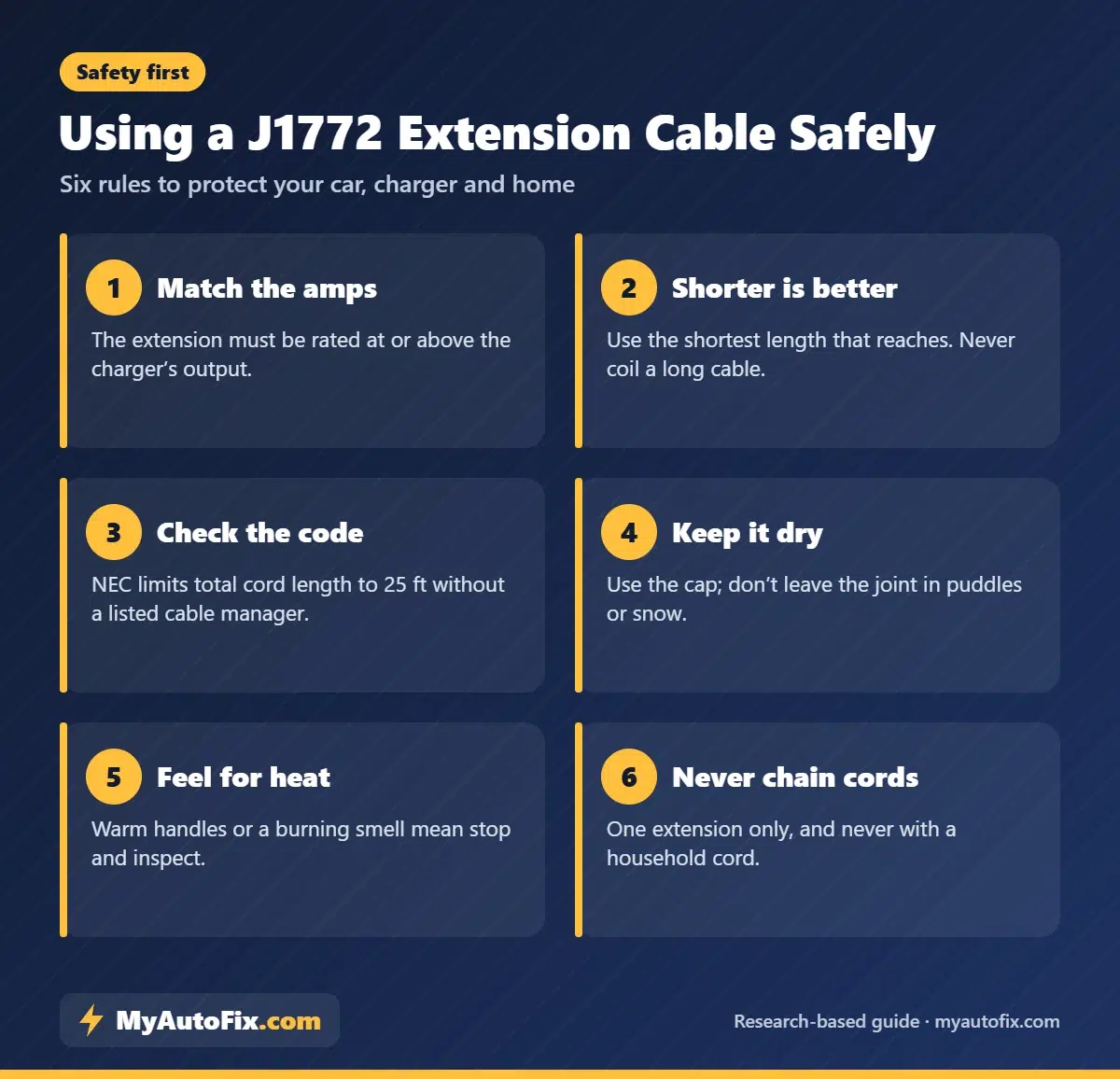
How to Use a J1772 Extension Cable Safely
- Check ratings first. Confirm the extension’s amp rating meets or exceeds your charger’s output, or turn the charger down.
- Inspect before each use. Look for cuts, crushed sections, bent pins or discoloration at the connectors.
- Connect charger to extension, then extension to car. Push each connector fully home until it latches.
- Lay the cable flat and uncoiled. Coiled cables trap heat. Route it so it won’t be driven over or tripped on.
- Check for heat during the first session. After 20–30 minutes, carefully feel the connectors. Warm is normal; hot is not.
- Disconnect in reverse order. Stop charging from the car or app, unplug at the car, then separate the extension.
- Store it dry with caps on. Hang the cable loosely rather than in a tight coil.
Stop immediately if you notice a burning smell, discolored plastic, melted pins or connectors too hot to hold. Don’t reuse a damaged extension.
Better Alternatives to an Extension Cable
- Relocate the charger. An electrician can often move a wall charger a few feet or install it on a post near the driveway.
- Buy a charger with a longer cable. 24- and 25-foot cables are common; see our outdoor Level 2 charger picks.
- Back in or park differently. Check where your car’s charge port is and park so it faces the charger.
- Add a cable management system. A retractable or overhead cable manager keeps a long cable off the ground and can be part of a listed system.
- Use a portable charger for visits. For occasional charging away from home, a portable Level 1 charger may be simpler.
Extensions in Hot and Cold Weather
Temperature extremes affect extension cables. In winter, cold cable jackets stiffen and can crack if bent sharply, and ice or snow in the connector pins can prevent a good connection. In summer, a black cable lying on hot pavement in direct sun starts warmer, leaving less headroom before temperature protection kicks in. To manage both:
- Store the cable indoors when not in use, especially in very cold weather.
- Keep connector caps on to stop snow and debris getting in.
- Don’t bend a frozen cable sharply; let it warm up first.
- Route the cable in shade where possible in summer.
- Lower your charger’s current on very hot days if you notice warm connectors.
Level 1 Charging and Extensions
J1772 extensions also work with Level 1 portable chargers that have a J1772 connector. Because Level 1 runs at only 12–16 amps, heat is less of a concern, and an extension can be a handy way to reach the car from a single outdoor outlet. What you should never do is plug a Level 1 charger into a household extension cord at the wall end; most manufacturers prohibit it, because ordinary cords and plugs aren’t designed for hours of continuous load and can overheat at the outlet.
Using an Extension With a Tesla or NACS Car
Tesla and other NACS-port vehicles can use J1772 chargers and extensions with a J1772-to-NACS adapter at the car end. The adapter must be rated for the charger’s current; see our guide to the best NACS to J1772 adapters. Avoid stacking multiple adapters and extensions, as every connection adds resistance and a potential heat point.
Troubleshooting Extension Cable Problems
| Symptom | Likely cause | What to do |
|---|---|---|
| Charging won’t start | Connector not fully latched | Reseat both connections; check the latch button |
| Charging stops or restarts | Poor contact or temperature protection tripping | Inspect pins; reduce the charger’s current |
| Connector gets hot | Undersized cable or worn contacts | Stop using it; check the rating |
| Breaker trips | Charger or circuit issue | See our guide to an EV charger tripping the breaker |
| Slow charging | Charger limited or car setting | See why your EV is charging slowly |
How to Inspect and Care for an Extension Cable
- Check the pins monthly. Look for discoloration, pitting or bent pins on both ends. Brown or black marks suggest overheating.
- Run your hand along the jacket. Feel for cuts, flattened spots from being driven over, or stiff, cracked sections.
- Test the latch. The release button and latch should click firmly; a loose latch can cause poor contact.
- Clean gently. Use a dry brush or compressed air to remove dust and debris from connectors. Never use water or solvents on the pins.
- Store it loosely. Hang it in large loops off the floor, out of sun and away from chemicals.
- Retire damaged cables. If you see heat damage or exposed conductors, stop using the extension and replace it.
A few minutes of inspection each month catches most problems before they become dangerous, and keeps your charging reliable.
Real-World Tips
- Label the cable with its amp rating so nobody uses it with a more powerful charger.
- Use a ground protector if the cable crosses a path.
- Keep pets away; chewing is a common cause of cable damage.
- Check connectors in winter; ice in the pins can stop a connection. See adapter connection problems for similar troubleshooting.
J1772 Extension Mistakes to Avoid
- Underrating the extension for a 48A charger.
- Using the longest cable just in case.
- Leaving it coiled while charging.
- Chaining adapters and cables.
- Making it permanent when moving the charger would be better.
- Ignoring heat or damage.
Frequently Asked Questions
Are J1772 extension cables safe?
Quality extensions used within their amp rating, kept dry and uncoiled, are widely used without problems. But there is currently no unified UL certification for complete EV extension cables, and every extra connection is a potential heat point. Inspect regularly and avoid daily use if you can relocate the charger.
Does the electrical code allow EV charger extension cords?
The National Electrical Code requires EV equipment to be listed and limits the overall usable cord length to 25 feet unless a listed cable management system is used. Local inspectors interpret this differently, so check with an electrician.
Will an extension cable slow down charging?
A correctly rated extension shouldn’t noticeably reduce speed. Long or undersized cables add resistance and heat, so match the amp rating to your charger.
Can I use a J1772 extension with a Tesla?
Yes, with a J1772-to-Tesla (NACS) adapter at the car end. Make sure both the extension and the adapter are rated for your charger’s current.
What amp rating do I need?
At least your charger’s output. A 40A charger needs a 40A or higher extension; a 48A charger needs a 48A or higher extension, or you can lower the charger’s output setting.
Can I use a household extension cord for EV charging?
Not for Level 2, and it’s generally discouraged for Level 1 too. Household cords often aren’t rated for continuous high current and can overheat.
Can I leave a J1772 extension outdoors?
Many are weatherproof, but leaving the joint in puddles, snow or direct sun shortens its life. Use the protective cap and store it when not needed.
Is it better to move my charger?
For daily use, yes. A charger installed where you park, or one with a longer cable, avoids an extra connection and stays within code.
How many miles per hour does a 40A charger add?
A 40A, 240V charger delivers about 9.6 kW, roughly 30–37 miles of range per hour for an efficient EV, depending on the car’s onboard charger and efficiency.
The Bottom Line
For occasional extra reach on a 40A home charger, the Lectron 20-foot J1772 extension is the best balance of brand reputation, rating and manageable length. If you want built-in temperature monitoring, choose EVDANCE, and step up to the EVDANCE 50A for 48A chargers. Above all, remember that extensions are a convenience: if you’d use one every day, relocating your charger or buying one with a longer cable, like the WOLFBOX portable 40A charger, is the safer long-term fix.
Best Overall: Lectron 20 ft Temp-Protected: EVDANCE Alternative: WOLFBOX
More EV Guides
EV Range Loss in Cold Weather: Why It Happens and 9 Ways to Get Miles Back
EV range loss in cold weather explained: how much range electric cars lose in winter, why it happens, and 9 practical ways…

6 Best Tesla Model Y Floor Mats (2026): All-Weather Picks for Pre-Refresh and Juniper
The best Tesla Model Y floor mats: 3D MAXpider, WeatherTech, TuxMat and value TPE sets, plus how to get the right fit…

Best Dash Cam for Tesla (2026): TeslaCam Storage vs VIOFO, Vantrue & Garmin
The best dash cam for Tesla: when the built-in TeslaCam is enough, the best USB storage for Sentry Mode, and the best…