
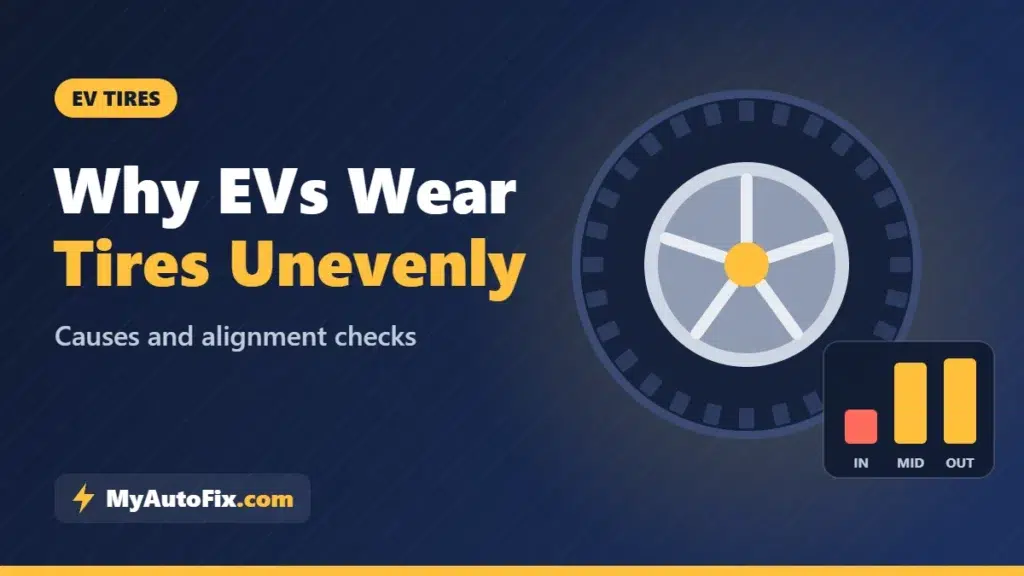
EV Tires · Maintenance Guide
Why Do Electric Cars Wear Out Tires Unevenly? Causes and Alignment Checks
By Mozammel HussainUpdated October 18, 20269 min read
As an Amazon Associate I earn from qualifying purchases. We may earn a commission if you buy through links on this page, at no extra cost to you. Learn more.
EV uneven tire wear is one of the most common complaints from new owners. EV owners often find their first set of tires wearing faster than expected, and not always evenly. Inner edges go bald while the outer tread looks fine, or the drive axle wears out long before the other. The reasons are physical: EVs are heavy, deliver instant torque and often use alignment settings that load the inner edge. The good news is that most uneven wear can be caught early with a gauge and a regular rotation. For official background, see NHTSA's tire safety guide.
Key takeaways
- Battery weight and instant torque make EVs harder on tires than similar gas cars.
- Inner-edge wear usually points to camber or toe settings; worn edges on both sides usually mean under-inflation.
- Measure tread at the inner, center and outer grooves; a difference of about 2/32 in is a signal to act.
- Tesla, for example, recommends rotating every 6,250 miles or when tread depths differ by 2/32 in or more.
Why EVs Are Hard on Tires
- Weight: battery packs add hundreds of pounds, increasing the load on every tire.
- Instant torque: full torque from a standstill scrubs the drive tires, especially with spirited launches.
- Regenerative braking: regen loads the driven wheels every time you lift off, adding wear to that axle.
- Alignment settings: many EVs use noticeable negative camber for handling and stability, which concentrates wear on the inner shoulder.
- Staggered setups: cars with wider rear tires often can't rotate front-to-back, so each axle wears at its own rate.
Reading EV Uneven Tire Wear Patterns
| Wear pattern | Likely cause | What to do |
|---|---|---|
| Inner edge worn | Negative camber or toe-out | Alignment check; ask for the before and after printout |
| Both outer edges worn | Under-inflation | Set cold pressure to the door placard and check monthly |
| Center worn | Over-inflation | Lower to the placard pressure |
| Feathered ribs (smooth one way, sharp the other) | Toe out of spec | Alignment check |
| Scalloped dips (cupping) | Worn shocks or struts, imbalance | Inspect the suspension and balance the wheels |
| One axle much more worn | Drive-axle torque and regen, missed rotations | Rotate on schedule if your setup allows |
For more on scalloped wear, see tire cupping explained.
How to Check Your EV's Tires
- Check pressure cold. Use a digital gauge before driving and set each tire to the pressure on the door placard. Many EVs specify 40 psi or more.
- Measure tread in three places. Measure the inner, center and outer grooves on each tire, and write the readings down.
- Compare. If the inner and outer readings on one tire differ by about 2/32 in, or tires on the same axle differ, book an alignment check.
- Look and feel. Run your hand across the tread (carefully) to feel feathering, and look for cupping, bulges or cords.
- Rotate on schedule. Follow your manual's interval and pattern. If your tires are staggered, rotate side to side only if they are non-directional.
- Repeat monthly. A few minutes a month catches problems before a tire is ruined.
Getting an Alignment Right on an EV
Ask the shop for a printout showing the before and after camber, caster and toe readings against the factory specs. Many EVs can only be adjusted for toe from the factory, so persistent inner wear may need aftermarket adjustable parts, which affects handling and should be done by a specialist. Some EVs also need a special service mode before lifting or alignment; for example, Teslas with air suspension have a jack mode. Our tire alignment checks guide covers what you can spot at home before paying for an alignment.
Habits and Choices That Make Tires Last
- Ease off hard launches; instant torque wears drive tires fast.
- Keep pressures at spec. Heavy cars are sensitive to under-inflation.
- Replace worn bushings and dampers, which let alignment wander under load.
- Choose replacements with the correct load index (often XL or HL on EVs).
- Read how to make tires last longer and why tire rotation matters.
Tools for Checking EV Tire Wear
These inexpensive tools make monthly checks quick and accurate.
- Measure tread depthGODESON Color-Coded Tread Depth Gauge (2-pack)Color bands show green, yellow and red tread depth at a glance, in 32nds of an inch.Check Price
- Accurate pressureAstroAI Digital Tire Pressure GaugeBacklit digital gauge reading up to 150 psi; easy to read in a dark garage.Check Price
- Top up at homeAstroAI L7 Cordless Tire InflatorCordless inflator with a digital preset and auto shut-off, handy for the higher pressures many EVs specify.Check Price
More EV Guides
EV Range Loss in Hot Weather: Why It Happens and How to Reduce It
EV range loss in hot weather explained: A/C load, battery cooling, parked drain and tire pressure, plus practical ways to protect range…
Read guide →
EV Heat Pump Not Working in Winter? 5 Signs, Causes and Repairs
EV heat pump not working in winter? Weak heat, cold air or big range loss: how heat pumps work, what's normal in…
Read guide →
EV Suspension Clunking Over Bumps: Common Causes and Parts to Check
EV suspension clunking over bumps? Learn which parts usually cause it, from sway-bar links to control-arm bushings, and how to diagnose it…
Read guide →Frequently Asked Questions
Why do EVs wear tires faster?
They are heavier, deliver instant torque and use regenerative braking on the drive wheels. Together these add load and scrubbing, especially on the drive axle.
Why are my EV's inner tire edges worn?
Usually negative camber or toe settings concentrate load on the inner shoulder. An alignment check against factory specs is the first step.
How often should I rotate EV tires?
Follow your owner's manual. Tesla, for example, recommends every 6,250 miles or when tread depths differ by 2/32 in or more, whichever comes first.
Do I need special tires to reduce wear on my EV?
Not necessarily EV-branded tires, but you do need the correct size, load index and speed rating. Some EV-focused tires use harder-wearing compounds.
What tire pressure should my EV run?
Use the cold pressure on the door-jamb placard, not the sidewall maximum. Many EVs specify 40 psi or higher.
The Bottom Line
EVs wear tires harder, but uneven wear is usually preventable. Check pressure and tread monthly, rotate on schedule and get an alignment with a printout when inner and outer readings start to differ. Gentle launches help too. When it's time for new tires, match the load index on the placard.
Mozammel writes maintenance guides and product research for My Auto Fix, focusing on tires, charging and everyday EV and car care. About our editorial process.