
EV Charging · Buying Guide
Best EV Charging Cable Organizers (2026): Holsters, J-Hooks and Ceiling Retractors
As an Amazon Associate I earn from qualifying purchases. We may earn a commission if you buy through links on this page, at no extra cost to you. Learn more.
The best EV charging cable organizers are inexpensive accessories that solve daily annoyances: a heavy charging cable tangled on the garage floor, a connector full of grit, and a trip hazard every time you walk past the car. Leaving the cable on the ground also exposes it to being driven over, chewed by pets or soaked in puddles, which shortens its life.
A simple holster and hook keeps the connector clean and dry and the cable neatly coiled. We compared the most popular options for J1772 and Tesla NACS chargers, from holster and J-hook combos to holster-only docks and ceiling retractors, and explain how to mount them securely.
How we chose: we compared connector compatibility, build materials, included hardware, outdoor suitability and owner feedback for holsters, hooks and retractors, and reviewed manufacturer installation guidance. We haven’t installed every product ourselves for this guide, so our picks are research-based. For home charging basics, see the U.S. Department of Energy’s guide to charging at home.
Key takeaways
- Choose a holster that matches your connector: J1772 or Tesla NACS.
- A holster plus J-hook combo handles both the plug and the cable.
- Mount into studs or masonry, or use rated anchors; cables are heavy.
- Coil the cable in large, loose loops to protect the conductors.
Our Top EV Cable Organizer Picks at a Glance
- Best Overall (J1772)Lectron EV Charger Nozzle Holster Dock and J-Hook for J1772Check Price
- Best for Tesla / NACSLectron Tesla NACS Charger Holster Dock and J-HookCheck Price
- Best Budget ComboJ1772 Nozzle Holster Dock and J-Hook Wall Mount SetCheck Price
- Best Eco-Friendly HolsterJ1772 EVSE Holster Dock (Recycled ABS)Check Price
- Best Budget Cable HookHeavy-Duty Steel Wall Hose HangerCheck Price
In this guide
EV Cable Organizer Comparison
| Product | Connector | Type | Material | Best for |
|---|---|---|---|---|
| Lectron J1772 combo | J1772 | Holster + J-hook | Metal | Most J1772 setups |
| Lectron NACS combo | Tesla/NACS | Holster + J-hook | Metal | Tesla owners |
| Budget holster + J-hook | J1772 | Holster + J-hook | Plastic | Budget setups |
| Recycled ABS holster | J1772 | Holster only | Recycled ABS | Budget |
| Steel hose hanger | Any | Cable hook | Steel | Long, heavy cables |
Which Cable Organizer Is Right for You?
- You have a J1772 charger and nothing to hold the cable: Lectron J1772 holster and J-hook combo.
- You have a Tesla Wall Connector, Mobile Connector or any NACS charger: Lectron NACS combo.
- Your charger has a cable wrap but no plug dock: a simple holster dock (the budget holster-and-hook set includes one).
- You have a very long cable: add a wide steel hose hanger or an overhead retractor.
- You have two EVs with different connectors: install one holster of each type.
The Best EV Charging Cable Organizers, Reviewed
1. Lectron EV Charger Nozzle Holster Dock and J-Hook for J1772
Lectron’s holster and J-hook combo gives you both parts of a tidy charging station in one product: a dock that the J1772 connector clicks into, and a wide metal hook for coiling the cable. Lectron says it fits all J1772 connectors, and the dock and hook are designed to keep the cable off the floor so it doesn’t kink or tangle.
- FitsAll J1772 connectors (per Lectron)
- IncludesHolster dock and J-hook, screws, wall plugs
- MaterialMetal frame
- UseIndoor or outdoor
The metal construction is the main reason we prefer it to all-plastic holders. A full Level 2 cable is heavy, especially 20–25 feet of thick outdoor-rated cord, and a sturdy hook won’t sag or crack over time. Retailers list it for mounting on concrete, brick, wood, metal and tile, and it comes with screws and wall plugs.
Owner reviews highlight easy installation and a neat result. As with any wall-mounted organizer, use proper anchors or screw into a stud; drywall alone isn’t strong enough for a heavy coiled cable.
Who should buy it: owners of any J1772 charger who want a complete, sturdy solution. Skip it if: your charger has a NACS (Tesla-style) connector.
What we like
- Holster and hook in one
- Sturdy metal construction
- Fits all J1772 connectors
- Easy DIY install
Watch out for
- Needs solid mounting
- Not for NACS plugs
Verdict: The simplest complete cable organizer for J1772 chargers.
Check Price on Amazon2. Lectron Tesla NACS Charger Holster Dock and J-Hook
Tesla’s NACS connector is slimmer than J1772 and has a different nozzle shape, so it needs its own holster. Lectron makes a NACS version of its holster and J-hook combo that grips the narrower nozzle firmly while the hook carries the cable.
- FitsTesla / NACS connectors
- IncludesHolster dock and J-hook, screws, wall plugs
- UseGarage or outdoor
- Pairs withTesla Mobile Connector and NACS chargers
It’s a natural match for a Tesla Mobile Connector setup or any NACS-plug charger. The Tesla Wall Connector has a built-in cable wrap, but many owners still add a holster nearer the car or a hook for extra cable. As more automakers switch to NACS ports, NACS chargers and holsters will become more common in non-Tesla garages too.
It includes screws and wall plugs for installation. Owners describe it as easy to install and handy for keeping the cable off the floor.
Who should buy it: Tesla owners and anyone with a NACS-connector charger. Skip it if: your charger uses J1772.
What we like
- Designed for the NACS nozzle
- Holster plus hook
- Easy install
- Good for portable Tesla setups
Watch out for
- Not for J1772
- Requires solid mounting
Verdict: The go-to organizer for NACS and Tesla charging cables.
Check Price on Amazon3. J1772 Nozzle Holster Dock and J-Hook Wall Mount Set
This set covers both jobs for a J1772 charger: a holster dock that holds the connector securely and keeps rain and dirt off the pins, and a J-hook that holds the coiled cable off the floor. It is a lower-cost alternative to the Lectron combo above.
- FitsJ1772 connectors
- IncludesHolster dock + J-hook
- MountingWall screws (anchors as needed)
- UseIndoor or sheltered outdoor
Mount the holster at a comfortable height near where you park, ideally so the connector points slightly down, and put the hook beside it so the cable loops loosely without kinks. Use anchors suited to your wall, since a full-length cable is heavier than it looks.
Budget docks vary in how snugly they grip the connector and how well the plastic stands up to sun and cold. If yours sits outdoors, check that the latch engages firmly, and keep an eye on the plastic for cracking over time.
Who should buy it: J1772 owners who want a tidy holster-and-hook setup for less. Skip it if: you have a Tesla connector; choose the Lectron NACS combo instead.
What we like
- Holster and hook in one set
- Low price
- Keeps pins clean
- Gets the cable off the floor
Watch out for
- Grip and plastic quality vary
- Mounting hardware may need upgrading for masonry
- J1772 only
Verdict: A tidy plug dock for chargers that already wrap their cable.
Check Price on Amazon4. J1772 EVSE Holster Dock (Recycled ABS)
Several small brands sell injection-molded J1772 holsters. One popular design is made from 100% recycled ABS plastic and is listed with a maximum weight capacity of 30 lb and a recommended load of 10 lb.
- Material100% recycled ABS (per listing)
- Capacity30 lb max, 10 lb recommended (per listing)
- TypeHolster dock
- MountWall
A plastic holster is perfectly adequate for holding the connector itself, which is light. It isn’t designed to carry the whole coiled cable, so pair it with a separate hook or the charger’s built-in wrap.
The advantages are low cost and a neat, molded look. Check the listing to confirm it fits your connector shape and that mounting hardware is included.
Who should buy it: budget buyers who just need a plug dock. Skip it if: you need a sturdy outdoor hook for the whole cable.
What we like
- Inexpensive
- Recycled material
- Neat molded design
- Protects the plug
Watch out for
- Not for holding the full cable
- Plastic less robust outdoors
Verdict: A low-cost, sustainable plug dock.
Check Price on Amazon5. Heavy-Duty Steel Wall Hose Hanger
If your charger already has a holster but the cable keeps ending up on the floor, a heavy-duty garden hose hanger is an inexpensive, surprisingly effective fix. Wide, curved steel hangers are designed to hold 100 feet of water-filled hose, so a 25-foot EV cable is easy work.
- TypeWide steel hanger
- StrengthHolds heavy coils easily
- BenefitLarge bend radius protects cable
- MountStud or masonry
The wide radius stops the cable bending too tightly, which is better for the conductors inside than a narrow hook. Powder-coated steel versions resist rust in garages and outdoors.
Choose a hanger with a smooth, rounded edge and no sharp metal that could cut the cable jacket. Mount it to a stud or masonry.
Who should buy it: anyone with a long, heavy cable who needs somewhere to coil it. Skip it if: you want a matched holster-and-hook look.
What we like
- Very inexpensive
- Holds long, heavy cables
- Gentle bend radius
- Rust-resistant options
Watch out for
- Not EV-specific
- No plug dock
Verdict: A cheap, strong way to get a long cable off the floor.
Check Price on AmazonWant a tidy charging station today? Lectron’s J1772 holster and J-hook combo docks the plug and coils the cable, with mounting hardware included.
Why EV Cable Management Matters
- Protects the cable. Charging cables are expensive. Being driven over, kinked or chewed damages insulation and conductors.
- Protects the connector. Dirt, grit and moisture in the pins cause poor connections and charging errors.
- Prevents trips. A cable across the garage floor is a fall hazard, especially in the dark.
- Makes charging faster. A docked connector and neat coil take seconds to use.
- Looks better. A tidy wall is more pleasant, and it helps when selling a house with a charger installed.
How Cable Damage Happens (and How Organizers Prevent It)
| Cause | What happens | How an organizer helps |
|---|---|---|
| Being driven over | Crushed conductors, damaged jacket | Cable stays off the floor |
| Tight coiling and kinks | Stressed conductors and insulation | Wide hook gives a gentle bend |
| Dirt in the connector | Poor contact, charging errors | Holster keeps the plug clean |
| Water and ice | Corrosion, frozen latches | Docked plug stays dry |
| Pets chewing | Exposed conductors | Cable hangs out of reach |
| Pulling on the cable | Strain at the plug or charger | Tidy coil reduces tugging |
Most of these risks come from one habit: dropping the cable on the floor after unplugging. A holster and hook make the tidy option the easy option, which is why they’re among the cheapest, most effective EV accessories you can buy.
Types of EV Cable Organizers
| Type | How it works | Pros | Cons |
|---|---|---|---|
| Holster and J-hook combo | Plug dock plus wide cable hook | Complete solution, simple | Wall space needed |
| Holster only | Dock for the plug | Compact, cheap | Cable still needs a home |
| Cable hook or hanger | Wide hook for coils | Holds long cables | No plug protection |
| Ceiling retractor | Overhead reel or spring | Cable off the floor automatically | Costlier, more complex install |
| Charger with built-in wrap | Hook or wrap on the unit | No extra parts | Limited capacity for long cables |
J1772 vs NACS: Why the Holster Matters
North America is in the middle of a connector transition. For years, almost every non-Tesla EV used the J1772 connector for Level 1 and Level 2 charging, while Teslas used Tesla’s own connector, now standardized as NACS (SAE J3400). Many automakers have since moved, or are moving, to NACS ports, and new home chargers increasingly ship with NACS plugs.
The two connectors have very different shapes. J1772 is round and bulky, with a latch on top; NACS is slim with a small button. A holster molded for one won’t securely hold the other, which is why connector compatibility is the first thing to check. If you switch cars or chargers during the transition, a holster is an inexpensive part to replace. In mixed households, mounting one of each keeps both connectors protected.
DIY Cable Management Ideas
- Wide hose reels or hangers work well for long cables, as long as the radius is generous.
- Garage slatwall or rail systems let you move hooks as your setup changes.
- Velcro straps keep a loose coil together on the hook without squeezing the cable.
- A ceiling hook and pulley can lift a cable over the car on a budget; make sure it’s anchored into a joist.
- Avoid zip ties and tight clamps on the cable, which can damage the jacket over time.
How to Choose an EV Cable Organizer
1. Connector compatibility
J1772 holsters won’t hold a NACS plug securely, and vice versa. Check your charger’s connector before ordering. If your household has both, install one of each.
2. Cable length and weight
A 25-foot Level 2 cable is heavy, especially in cold weather when the jacket stiffens. Longer cables need a wider, stronger hook, and the coil should hang without sharp bends.
3. Material and location
Metal hooks are stronger and more durable outdoors. Plastic holsters are fine for docking the plug indoors. For outdoor mounts, choose rust-resistant and UV-resistant materials, and mount under an eave if possible.
4. Placement
Mount the holster where you can reach it easily when standing by the charge port, and where the cable reaches the car without stretching. Think about how you park day to day.
How to Install a Holster and J-Hook
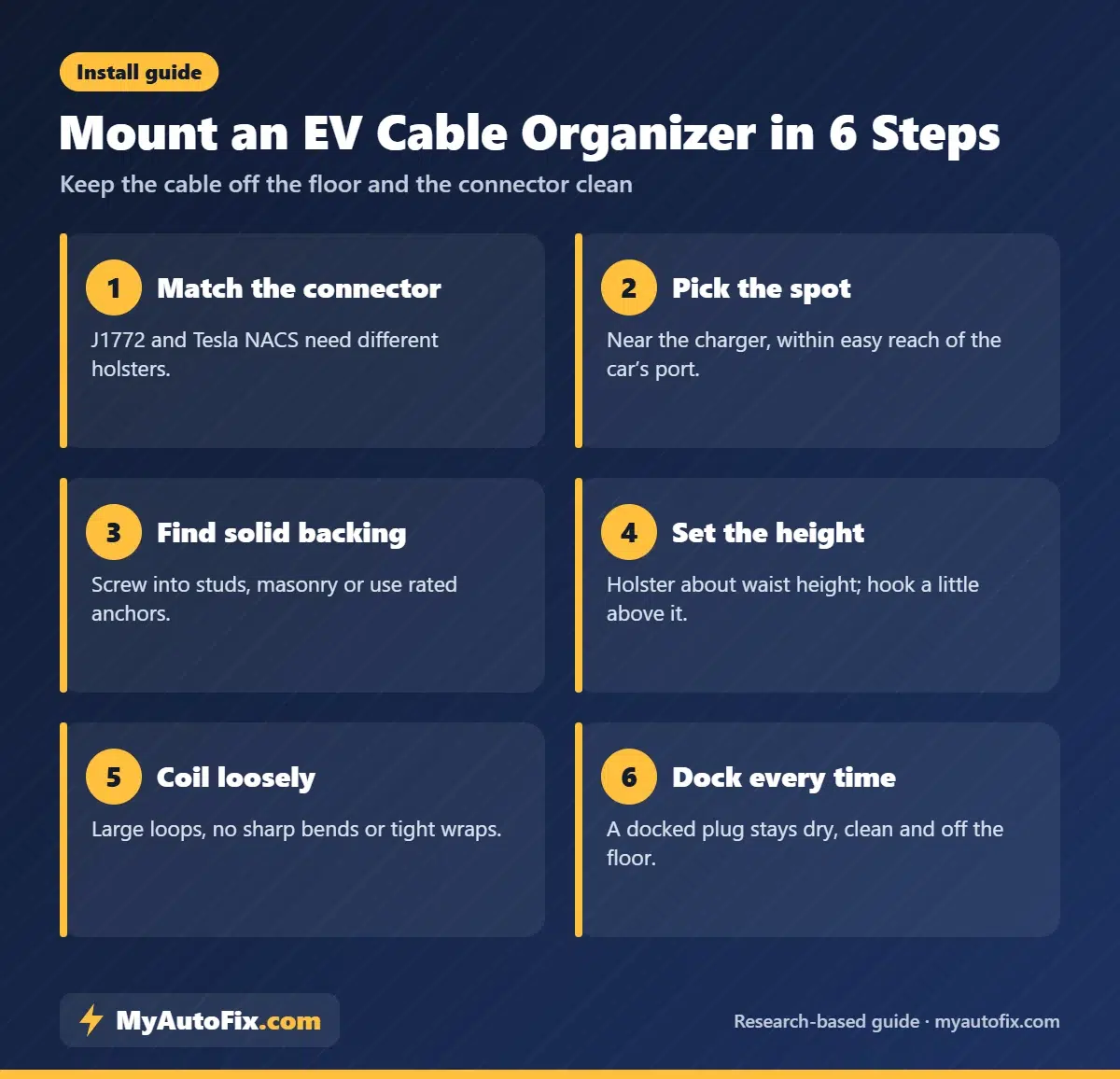
- Decide on the position. Hold the connector and cable in place, park the car as usual and check the cable reaches the port with slack.
- Locate a stud or solid backing. Use a stud finder. On masonry, use masonry anchors; on drywall without a stud, use heavy-duty anchors.
- Mark the holes. Use the bracket as a template and check it’s level.
- Drill pilot holes. Use the bit size recommended for the anchors or screws.
- Fit anchors and screw the bracket on. Tighten firmly without cracking plastic parts.
- Test with the full cable. Coil the cable onto the hook and dock the plug; check nothing flexes or loosens.
Avoid electrical hazards: don’t drill near the charger’s supply wiring or electrical panel. If you’re unsure where cables run behind the wall, ask an electrician.
Choosing the Right Wall Anchors
| Wall type | What to use | Notes |
|---|---|---|
| Wood stud | Wood screws (often included) | Strongest option; find the stud center |
| Drywall without a stud | Heavy-duty toggle or snap-toggle anchors | Avoid plastic expansion plugs for hooks |
| Concrete or brick | Masonry anchors and a masonry bit | Drill with a hammer drill |
| Metal post | Self-tapping or through bolts | Seal holes outdoors |
| Garage slatwall | Rated slatwall hooks | Check the hook’s load rating |
Remember that the load on a hook is more than the weight of the cable: people tug on it when they pull the plug out, which adds leverage. Over-specify your anchors and you won’t have a hook fall off the wall a few months later.
Ceiling Retractors and Overhead Systems
For tight garages, long cables or households with two EVs, an overhead cable management system keeps the cable above the floor entirely. Options range from simple ceiling-mounted pulleys to spring-loaded retractable reels and swinging arms. They make it easy to reach either side of the car and stop the cable lying across the floor while charging.
Overhead systems need solid mounting into ceiling joists and enough headroom so the cable doesn’t hang at head height when retracted. Some chargers offer listed cable management accessories, which also matter for code: the National Electrical Code allows cord lengths beyond 25 feet only when a listed cable management system is part of the charging equipment. If you’re considering a long cable with a retractor, check with your electrician.
Do You Need a Ceiling Retractor?
Most single-EV garages don’t. A holster and wall hook handle a standard 18–25 foot cable perfectly well. A retractor or overhead system earns its keep when the cable must reach across the car to a port on the far side, when two cars share one charger, when the garage is so narrow that a cable on the wall gets in the way of doors, or when you want the cable completely off the floor while charging. If any of those apply, plan the overhead route before mounting the charger, and choose hardware rated for the cable’s weight with a soft guide that won’t cut the jacket. Retractable systems also make cable handling easier for people who find lifting a heavy coil difficult.
Outdoor and Driveway Setups
- Mount holsters on the charger’s post or a nearby wall, under cover if possible.
- Keep the connector docked so rain and snow can’t enter the pins.
- Choose metal hooks with powder coating to resist rust.
- Use a hose-style hanger for long cables that must reach across a driveway.
- For outdoor charger recommendations, see our guide to the best outdoor Level 2 EV chargers.
Garage Layout Ideas for EV Charging
| Situation | Suggested setup |
|---|---|
| One EV, charger on the side wall | Charger near the front corner of the parking space, holster at waist height beside it, hook above |
| One EV, charge port on the opposite side | Back in, or route the cable overhead with a ceiling hook or retractor |
| Two EVs sharing one charger | Mount the charger between the spaces and use an overhead retractor to reach both ports |
| Carport or driveway | Post-mounted charger with a holster on the post and a hose-style hanger for the cable |
| Apartment or shared parking | Use the building’s cable management; carry a small bag for any adapters |
Before installing a new charger, check where each car’s charge port is. Many EVs have it on the driver-side rear, but plenty are elsewhere, and a few feet in the right direction can save you a cable that crosses the garage every night.
Protecting a Cable That Crosses a Path
If your charging cable must cross a walkway or driveway, a rubber cable protector (also called a cable ramp) lets people and vehicles pass over it without crushing it. Choose one with a channel large enough for your cable diameter and bright edges so it’s visible. For permanent setups, it’s better to move the charger or install a post-mounted unit nearer the parking spot.
Real-World Tips
- Uncoil fully before charging on hot days; a tight coil traps heat.
- Clean the connector occasionally with a dry brush. Never spray water into the pins.
- Check the latch on the connector if charging won’t start; a dirty or stiff latch is common. See EV not charging at a station for similar fixes.
- Label holsters if you have both J1772 and NACS cables in one garage.
- Keep pets away from cables; chewing damage is common.
Storing a Portable Charger Neatly
Many owners use a portable Level 1 or Level 2 charger at home and take it on trips. A wall dock for the connector and a hook for the cable give it a permanent home, so it’s always ready and never left on the floor. Keep the carry bag on the same hook so it’s easy to grab when you travel. See our guides to the best portable Level 1 EV chargers and, for Tesla owners, NACS adapter problems.
Winter Cable Care
- Cold cables stiffen; uncoil slowly and avoid sharp bends.
- Knock snow off the connector and keep it docked so ice doesn’t form in the pins.
- If the connector freezes in the car’s port, use the car’s defrost or preconditioning; don’t force it. Our guide to an EV charging cable stuck in the port explains safe release methods.
- Wipe off road salt and slush that drips from the car onto the cable.
Keeping Your Charging Area Safe
- Keep the floor around the charger clear and dry so you’re not standing in water when plugging in.
- Don’t store fuel, solvents or flammable items right next to the charger.
- Make sure the charger’s breaker is labeled in your electrical panel.
- Teach family members how to dock the connector and coil the cable correctly.
- Inspect the cable, connector and mounting hardware every few months.
Signs Your Charging Cable Needs Attention
- Cuts, cracks or flattened sections in the jacket.
- Discolored or melted plastic at the connector or near the charger.
- Bent, pitted or blackened pins.
- A latch that won’t click or release.
- Charging that stops intermittently or fails to start.
- A burning smell or excessive heat.
Stop using a damaged cable and contact the charger manufacturer. Charging cables are part of a certified assembly and generally shouldn’t be repaired with tape or spliced.
Cable Management Mistakes to Avoid
- Wrapping tightly around a small hook. Sharp bends stress the conductors.
- Mounting in drywall without anchors. Heavy cables pull screws out.
- Leaving the plug on the floor. Dirt and water in the pins cause faults.
- Buying the wrong connector holster.
- Mounting too far from the parking spot so the cable is always stretched.
Frequently Asked Questions
Do I need a holster for my EV charger?
It isn’t required, but a holster keeps the connector clean, dry and off the ground, protects the pins from damage and makes daily charging tidier.
Are J1772 and Tesla holsters interchangeable?
No. The J1772 connector is larger with a different shape than the Tesla NACS connector, so each needs a matching holster.
How high should I mount an EV charger holster?
Most people find waist height comfortable, roughly 36–48 inches, with the cable hook slightly higher. Some local codes specify connector storage heights for EV equipment, so check if you’re installing a new charger.
Can I mount a cable organizer in drywall?
Use proper wall anchors rated for the load or screw into a stud. A heavy coiled cable can pull plain screws out of drywall over time.
Is it bad to leave the EV cable on the floor?
Yes. It can be run over, chewed, kinked or soaked, and the connector collects dirt and moisture, all of which shorten its life.
How should I coil an EV charging cable?
In large, loose loops without twisting or sharp bends. Avoid tight wraps around a small hook, which strain the conductors.
What is a retractable EV cable system?
A ceiling- or wall-mounted reel or spring arm that lifts the cable off the floor and takes up slack automatically. It’s useful for long cables or tight garages.
Can I use cable organizers outdoors?
Yes. Choose metal or UV-resistant materials, mount them under cover if possible, and keep the connector docked so rain can’t collect in it.
How long do EV charging cables last?
With good care, a charging cable can last as long as the charger. The main causes of early failure are crushing, kinking, connector contamination and pet damage, which cable organizers help prevent.
The Bottom Line
For most J1772 chargers, the Lectron holster and J-hook combo is the best EV charging cable organizer: a sturdy, complete solution that docks the plug and coils the cable. Tesla and NACS owners should choose the Lectron NACS combo. If your charger already wraps its cable, a simple holster dock (the budget holster-and-hook set includes one) finishes the job, and a heavy-duty steel hose hanger is a cheap way to hang a long cable. Mount everything into solid backing, coil loosely and dock the plug every time.
J1772: Lectron Combo Tesla: Lectron NACS Combo Budget Combo: Holster + Hook
More EV Guides
Best J1772 Extension Cables (2026): Safe Picks, Code Limits and Better Alternatives
The best J1772 extension cables from Lectron and EVDANCE, plus portable charger alternatives, plus the safety facts most listings skip: certification, NEC…
EV Range Loss in Cold Weather: Why It Happens and 9 Ways to Get Miles Back
EV range loss in cold weather explained: how much range electric cars lose in winter, why it happens, and 9 practical ways…

6 Best Tesla Model Y Floor Mats (2026): All-Weather Picks for Pre-Refresh and Juniper
The best Tesla Model Y floor mats: 3D MAXpider, WeatherTech, TuxMat and value TPE sets, plus how to get the right fit…