

Garage Tools · Buying Guide
6 Best Mechanic Creepers for 2026: Low-Profile, Z-Creeper and Topside Picks
As an Amazon Associate I earn from qualifying purchases. We may earn a commission if you buy through links on this page, at no extra cost to you. Learn more.
The best mechanic creepers make working under a car faster, safer and much easier on your back. Lying on cold, oily concrete is uncomfortable, and every time you have to wriggle out to grab a tool you lose time. A good creeper lets you glide under the car, keeps your body off the floor and gives you a bit more room between your face and the underside. But the right choice depends on your car, your floor and your body. We compared the most popular creepers on Amazon, from ultra-low plastic boards for sports cars to convertible Z-creepers that double as a shop seat, and explain the specs that actually matter.
How we chose: we compared ground clearance, caster size and quantity, weight capacity, frame type, padding, convertibility and storage, and cross-checked specs and findings from several independent creeper roundups and owner feedback. We haven’t tested each creeper ourselves for this guide, so our picks are research-based. For tips on preventing strain during garage work, see OSHA’s ergonomics resources.
Key takeaways
- Clearance vs casters: low creepers give more room but need smooth floors.
- Z-creepers double as a rolling seat for brake and wheel jobs.
- Choose a capacity well above your weight for a creeper that doesn’t flex.
- A creeper never replaces jack stands or ramps for supporting the car.
Our Top Mechanic Creeper Picks at a Glance
- Best OverallPro-LifT C-9100 Foldable Z-Creeper (450 lb)Check Price
- Best Low-ProfileLisle 97102 Low-Profile Plastic CreeperCheck Price
- Best Budget 2-in-1Pro-LifT C-2036D Convertible Z-CreeperCheck Price
- Most ComfortableTraxion 1-100 ProGear Wide-Body CreeperCheck Price
- Best Lightweight PlasticPro-LifT C-6040 40″ HDPE Plastic CreeperCheck Price
- Best for Engine BaysTraxion 3-100 Foldable Topside CreeperCheck Price
In this guide
Mechanic Creeper Comparison
| Creeper | Type | Capacity | Clearance/casters | Best for |
|---|---|---|---|---|
| Pro-LifT C-9100 | Z-creeper (2-in-1) | 450 lb | ~3 in, 6 casters | Most users |
| Lisle 97102 | Plastic low-profile | 300 lb | 7/8 in | Low cars |
| Pro-LifT C-2036D | Z-creeper (2-in-1) | 300 lb | 6 casters | Budget, small garages |
| Traxion 1-100 ProGear | Padded drop deck | 400 lb | 5 in casters | Comfort, rough floors |
| Pro-LifT C-6040 | Plastic | 350 lb | ~3 in casters | Lightweight |
| Traxion 3-100 | Topside | 400 lb | Locking casters | Engine bays |
Which Mechanic Creeper Is Right for You?
- You do a bit of everything in a home garage: the Pro-LifT C-9100 Z-creeper covers under-car work and seated jobs.
- You drive a low car or work on ramps: the Lisle 97102’s 7/8-inch deck gives you the most room.
- You’re on a tight budget or short of space: the Pro-LifT C-2036D folds compact and costs little.
- You spend hours under vehicles or your floor is rough: the Traxion ProGear’s padding and 5-inch casters make long jobs bearable.
- You want something light to grab for quick jobs: the Pro-LifT C-6040 plastic creeper hangs on a hook.
- You work on truck and SUV engines: add a Traxion 3-100 topside creeper.
Creeper vs Creeper Seat: Do You Need Both?
A creeper is for lying under the car; a creeper seat (a low rolling stool) is for jobs at wheel height, such as brake pads, rotors, tire rotations, wheel cleaning and detailing lower panels. Squatting for those jobs is hard on knees and backs, and a seat with a tool tray keeps everything within reach. Convertible Z-creepers give you both in one, which is why they’re so popular in home garages. If you do lots of brake and wheel work, a dedicated seat with a padded top and big casters is more comfortable than a Z-creeper’s seat mode.
The Best Mechanic Creepers, Reviewed
1. Pro-LifT C-9100 Foldable Z-Creeper (450 lb)
The Pro-LifT C-9100 is the creeper most often ranked first in recent roundups, and it’s easy to see why. It’s a Z-style creeper that converts from a flat creeper into a rolling seat in seconds, so you get one tool for under-car work and for brake jobs, wheel cleaning or tire work at seat height.
- Capacity450 lb
- Frame40 in steel
- Casters6 polyurethane
- ClearanceAbout 3 in
Its 40-inch steel frame is rated for 450 lb, one of the highest capacities in this category, and it rides on six oil-resistant polyurethane casters. Garage Tooled lists its ground clearance at about 3 inches. That balance of strength, comfort and versatility makes it the safest all-round choice, especially for bigger users who find many creepers flex or feel cramped.
The trade-offs are weight and size: at around 25 lb it’s heavier than a plastic creeper, and the steel frame sits a little higher than the lowest boards. If you mainly work under lowered cars, a low-profile plastic creeper will give you more room.
Who should buy it: most DIYers, and anyone over about 250 lb. Skip it if: you need the absolute lowest profile for a sports car.
What we like
- Converts to a rolling seat
- Very high weight capacity
- Sturdy steel frame
- Oil-resistant casters
Watch out for
- Heavier than plastic creepers
- Not the lowest profile
Verdict: The most versatile creeper for most home garages.
Check Price on Amazon2. Lisle 97102 Low-Profile Plastic Creeper
If every inch under the car counts, the Lisle 97102 is the classic choice. Its one-piece molded body sits just 7/8 inch off the floor, among the lowest of any creeper, and is shaped to support your back and shoulders.
- Clearance7/8 in
- Capacity300 lb
- BodyOne-piece molded plastic
- WarrantyLifetime on body (per retailers)
Lisle has made creepers for decades, and this model is rated for 300 lb with a lifetime warranty on the body, according to retailers. Being plastic, it’s light, easy to clean and won’t rust, and spilled oil wipes straight off.
The low height comes from small casters, which is the main trade-off. They roll best on smooth, swept concrete and can catch on cracks, expansion joints and debris. It also has no padding, so a folded towel under your head helps on long jobs.
Who should buy it: owners of low cars, and anyone working on cars on ramps or low jack stands. Skip it if: your garage floor is cracked or rough.
What we like
- Among the lowest clearances available
- Light and easy to clean
- Ergonomic body shape
- Proven Lisle design
Watch out for
- Small casters dislike cracks
- No padding
Verdict: The go-to creeper when you need every bit of space.
Check Price on Amazon3. Pro-LifT C-2036D Convertible Z-Creeper
The C-2036D is a smaller, more affordable take on the Z-creeper idea and one of the most popular creepers sold online. Pull a pin and it folds from a flat creeper into a low rolling seat, which is ideal for brake jobs and tire work.
- Capacity300 lb
- TypeConvertible creeper and seat
- Casters6 swivel
- PaddingVinyl cushions
It is rated for 300 lb, uses six swivel casters and has vinyl-padded cushions. Several reviewers call it the benchmark convertible creeper for home mechanics with limited space, because it folds compact for storage.
Its casters suit smooth concrete better than rough driveways, and the 300 lb rating and smaller frame make it less roomy than the C-9100. The padding is modest, but for occasional DIY use it’s excellent value.
Who should buy it: DIYers who want a creeper and a seat without spending much. Skip it if: you’re a larger user or work on rough floors.
What we like
- Creeper and seat in one
- Folds compact
- Very affordable
- Popular, proven design
Watch out for
- Lower capacity
- Best on smooth floors
Verdict: Excellent value for small home garages.
Check Price on Amazon4. Traxion 1-100 ProGear Wide-Body Creeper
The Traxion ProGear looks more like a classic car than a creeper, with a wide, padded drop deck that supports your whole body. It’s designed for long sessions under a vehicle, where comfort matters more than the last half-inch of clearance.
- Capacity400 lb
- Casters5 in
- DeckWide, padded drop deck
- LengthAbout 43 in
Its big 5-inch casters sit roughly level with the top of the deck, which lets it roll over cracks, zip ties and small debris that stop low creepers dead, while the drop-deck design keeps your body relatively low. It is rated for 400 lb.
Reviewers love the comfort but have reported occasional quality-control issues with some units, so inspect yours when it arrives. It’s also bulky to store.
Who should buy it: people who spend hours under vehicles or have rough garage floors. Skip it if: you need minimum height for low cars.
What we like
- Very comfortable for long jobs
- Large casters handle cracks
- Wide deck
- High capacity
Watch out for
- Bulky
- Some QC complaints
Verdict: The comfort pick for long jobs and imperfect floors.
Check Price on Amazon5. Pro-LifT C-6040 40″ HDPE Plastic Creeper
A one-piece HDPE plastic creeper is the simplest kind of creeper: no frame to bend, nothing to rust and almost nothing to maintain. The Pro-LifT C-6040 is a 40-inch model rated for 350 lb, with six multi-terrain casters and dual tool trays molded into the sides.
- Capacity350 lb
- BodyOne-piece HDPE
- Casters6 multi-terrain (about 3 in)
- ExtrasDual tool trays
At about 14 lb, it’s light enough to hang on a wall hook. The built-in trays keep sockets and bolts from rolling away, which is a small but genuinely useful feature when you’re lying on your back.
Plastic creepers don’t have padding, and this one sits higher than the ultra-low Lisle. But for oil changes and quick inspections, it’s an easy, durable, inexpensive choice.
Who should buy it: DIYers who want a light, low-maintenance creeper. Skip it if: you want cushioning or a 2-in-1 seat.
What we like
- Light and easy to store
- Built-in tool trays
- Nothing to rust
- Affordable
Watch out for
- No padding
- Higher than ultra-low boards
Verdict: A light, practical plastic creeper for routine jobs.
Check Price on Amazon6. Traxion 3-100 Foldable Topside Creeper
Not all car work happens underneath. On trucks and SUVs, reaching the back of the engine bay can mean hours leaning over a fender, which is brutal on your back. A topside creeper lets you lie over the engine bay on a padded platform instead.
- Capacity400 lb
- TypeTopside, height-adjustable
- CastersLocking
- StorageFolds
The Traxion 3-100 is a foldable, height-adjustable topside creeper rated for 400 lb, with locking casters to keep it in place. Reviewers highlight how much easier it makes jobs at the top of the engine, such as spark plugs, intake work and accessory belts on tall vehicles.
It’s a specialized tool, bulky even when folded and not useful for under-car work, so it’s a second creeper for most people rather than a first.
Who should buy it: truck and SUV owners who work on engines. Skip it if: you mostly work under the car.
What we like
- Saves your back on engine work
- Adjustable height
- Locking casters
- Folds for storage
Watch out for
- Specialized use
- Bulky
Verdict: A back-saver for engine-bay work on tall vehicles.
Check Price on AmazonWant one creeper that does it all? The Pro-LifT C-9100 converts from creeper to rolling seat and carries up to 450 lb on six oil-resistant casters.
How to Choose a Mechanic Creeper
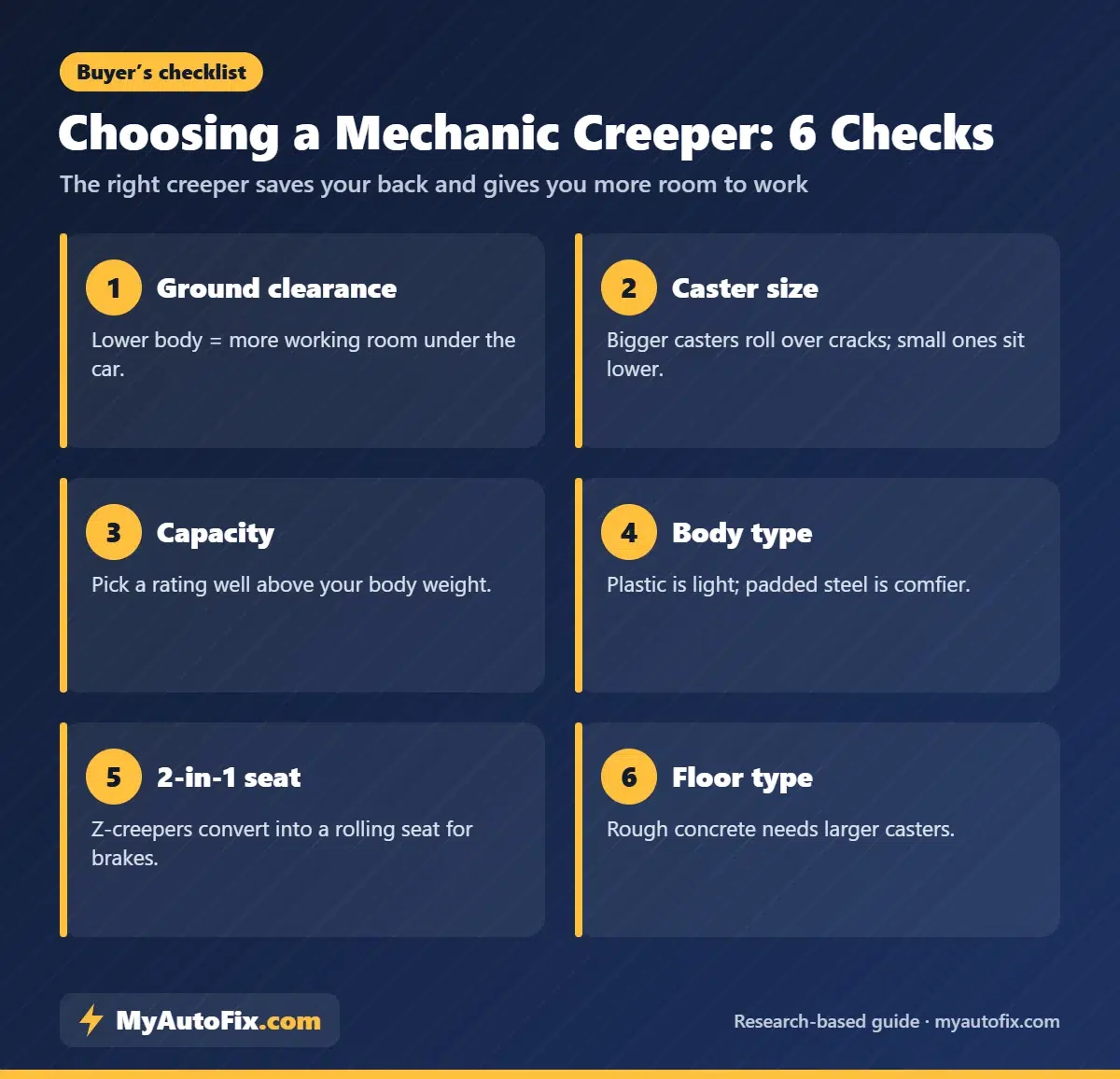
1. Ground clearance
Ground clearance is the distance between the floor and the creeper’s deck. Every inch of clearance comes out of your working space under the car. With a car on jack stands at a typical height, a 1-inch creeper might give you 4–5 inches more room above your face than a 5-inch-high creeper. For low cars or cars on ramps, choose the lowest creeper you can.
2. Caster size and quality
Small casters keep the creeper low but snag on cracks, zip ties and gravel. Large casters roll over almost anything but raise the deck. Polyurethane wheels roll quietly and resist oil; cheap hard plastic wheels skid and crack. Six casters spread the load and roll more stably than four.
3. Weight capacity and frame
Capacity ratings range from about 250 to 450 lb. A creeper rated well above your body weight flexes less and lasts longer. Steel frames are strong but heavier; one-piece plastic bodies can’t bend or rust and are easy to clean.
4. Comfort features
- Padded deck and headrest: worth it for jobs longer than half an hour.
- Body-contoured shape: supports your back on plastic creepers.
- Tool trays: keep parts and sockets within reach.
- Adjustable headrest: lets you look up into tight areas without straining your neck.
5. Convertible and specialty designs
Z-creepers fold into a low rolling seat for brakes, tires and detailing wheels, saving space and money. Topside creepers suit engine work on tall vehicles. If you have room for only one, a Z-creeper covers the most jobs.
Mechanic Creeper Types Explained
| Type | How it works | Pros | Cons |
|---|---|---|---|
| Plastic one-piece | Molded body with small casters | Very low, light, easy to clean | No padding, small casters |
| Padded steel frame | Steel frame with vinyl padding | Comfortable, durable | Heavier, sits higher |
| Z-creeper (convertible) | Folds into a rolling seat | Two tools in one, compact storage | Slightly higher deck |
| Drop-deck wide body | Deck sits between large casters | Comfort and rolls over cracks | Bulky |
| Topside creeper | Padded platform over the engine | Saves your back on engine work | Specialized, large |
| Creeper seat | Rolling stool, often with tool tray | Great for brakes and wheels | Not for under-car work |
How Much Clearance Do You Need?
Here’s a quick way to decide how low your creeper must be. Lift the car the way you normally do, on ramps or jack stands, and measure from the floor to the lowest parts you work around: the oil pan, exhaust and crossmembers. Subtract the creeper height and the thickness of your chest (about 9–12 inches for most adults). What’s left is your working space for hands and tools.
| Vehicle setup | Typical floor-to-underbody height | Recommended creeper |
|---|---|---|
| Lowered or sports car on ramps | About 14–17 in | Ultra-low plastic (under 1 in) |
| Sedan on jack stands | About 16–20 in | Low plastic or Z-creeper (2–3 in) |
| Crossover or SUV on stands | About 20–26 in | Z-creeper or padded creeper |
| Pickup or lifted 4×4 | 26 in and up | Padded drop deck or creeper seat |
These figures are rough guides; measure your own car. If space is tight, the lowest creeper often makes a bigger difference than a taller set of stands, which reduces stability.
Prepare Your Garage Floor
- Sweep before every job. Zip-tie ends, bolts and gravel jam small casters.
- Degrease oil spots. Oil makes casters slide unpredictably and sticks grit to the wheels.
- Fill large cracks. Concrete crack filler lets low creepers roll smoothly across expansion joints.
- Consider epoxy or interlocking tiles. A smooth, sealed floor makes any creeper roll better and cleans easily.
- Use a mat outdoors. On a driveway, lay a smooth board or rubber mat under the creeper path.
Set Up a More Comfortable Garage Workspace
A creeper is one piece of a comfortable, efficient home garage. A few small additions make under-car work far more pleasant and safer:
- Lighting: an LED shop light or a rechargeable magnetic work light that you can stick to the underbody puts light exactly where you need it. A headlamp frees both hands.
- Magnetic parts trays: bolts and clips stay put instead of rolling across the floor.
- A rolling tool cart: keep sockets, wrenches and fluids beside the car rather than walking back and forth.
- Knee pads or a kneeling pad: for jobs where you kneel beside the car, such as wheel and brake work.
- Gloves and eye protection: nitrile gloves keep oil off your skin; safety glasses stop rust and dirt falling into your eyes.
- Absorbent mats: catch drips under the car so your creeper stays clean.
- Heat in winter: a safe, properly ventilated garage heater makes cold-weather work much more bearable. Never run a car engine in a closed garage.
Most of these items are inexpensive, and together with a good creeper, jack stands and a floor jack, they turn a cramped garage into a comfortable place to work.
Creeper Safety Rules
- Never use a creeper on a slope where it could roll on its own.
- Don’t stand, kneel or sit on a flat creeper; it can shoot out from under you.
- Keep loose clothing, hair and cords away from casters.
- Keep children and pets away from the work area while you’re under the car.
- If you feel the car move or hear a creak, roll out immediately and re-check the supports.
How to Work Under a Car Safely With a Creeper
- Support the car properly. Use jack stands or car ramps. Never rely on a jack alone.
- Chock the wheels and set the parking brake. Prevent the car moving while you’re underneath.
- Sweep the floor. Clear zip ties, bolts and grit so the casters roll freely.
- Lay out tools first. Put what you need in the creeper’s tray or on a magnetic tray beside you.
- Wear eye protection. Rust, dirt and drips fall straight into your face under a car.
- Keep your head out of the crush zone. Position yourself so the frame or a wheel would stop the car if something shifted.
- Have a way out. Keep a clear path to roll out quickly, and tell someone you’re working under the car.
Never get under a car supported only by a jack, and never use a creeper on a slope where it could roll on its own.
Tools That Pair Well With a Creeper
- A bright work light or headlamp: under-car lighting is always poor.
- An inspection camera: see behind brackets and into tight spaces; see our inspection camera picks.
- A low-profile floor jack: see our floor jack guide.
- A cordless impact wrench: speeds up stubborn fasteners; see our impact wrench guide.
- A drain pan and absorbent pads: keep oil off the floor and off your creeper.
Do EV Owners Need a Creeper?
Electric cars need fewer under-car jobs since there are no oil changes or exhaust repairs, but a creeper is still useful for inspecting the battery underside after hitting debris, checking suspension parts and brake lines, removing aerodynamic underbody panels and cleaning off road salt. EVs often have smooth, flat underbodies with little extra room, so a low creeper helps. Always lift an EV only at the manufacturer’s jacking points with proper EV jack pads, never on the battery pack.
How to Maintain Your Creeper
- Clean off oil and grime. Wipe the deck with a degreaser after messy jobs.
- Clear the casters. Pull hair, string and grit off caster axles monthly.
- Lubricate swivels. A drop of light oil or dry lube keeps casters turning freely.
- Check fasteners. Tighten loose caster bolts and frame hardware on steel creepers.
- Inspect padding. Patch small vinyl tears before they spread and soak up oil.
- Store it off the floor. Hang it on a wall to keep casters clean and the floor clear.
When to Replace a Creeper
A well-made creeper lasts many years, but a few signs mean it’s time for a new one: a cracked plastic body, a bent or creaking steel frame, casters that no longer swivel even after cleaning, or padding so torn that it soaks up oil. Replacement casters are available for many models, and swapping cheap hard wheels for quality polyurethane ones can make an older creeper roll like new. If your current creeper is simply too high for the cars you work on, upgrading to a lower model is one of the most noticeable comfort improvements you can make in a home garage.
Real-World Tips for Using a Creeper
- Clean casters monthly. Hair and grit wrap around axles and stop them rolling.
- Add a lightweight mat on rough floors. A thin rubber mat gives casters a smoother path.
- Keep it hanging. Storing a creeper on a wall hook keeps casters clean and the floor clear.
- Use a towel as a pillow on plastic creepers for long jobs.
- Mark your tool tray. Magnetic trays stop small bolts rolling away.
Common Under-Car Jobs and the Best Creeper for Each
| Job | Typical time | Best creeper style |
|---|---|---|
| Oil and filter change | 20–40 min | Low plastic or Z-creeper |
| Exhaust leak repair | 1–2 hours | Padded or drop-deck creeper |
| Transmission fluid service | 1 hour | Low plastic or Z-creeper |
| Suspension and steering checks | 30–60 min | Z-creeper |
| Brake pads and rotors | 1–2 hours | Creeper seat or Z-creeper seat mode |
| Engine work on trucks | Varies | Topside creeper |
For specific jobs, our guides to fixing an exhaust leak and brake system maintenance walk you through the steps. An automotive multimeter is also handy under the car for checking sensors and wiring.
Creeper Mistakes to Avoid
- Buying too high a creeper for a low car. You’ll have no room to work.
- Ignoring your floor. Tiny casters on cracked concrete are frustrating.
- Exceeding the capacity. Overloaded frames flex and casters fail.
- Letting oil build up. Oily creepers get slippery and dirty your clothes.
- Using a creeper as a step. Z-creeper seats aren’t designed to stand on.
Frequently Asked Questions
What is the best mechanic creeper for home use?
For most people, a convertible Z-creeper like the Pro-LifT C-9100 is the best all-round choice because it works as both a creeper and a rolling seat. For low cars, the Lisle 97102 offers the lowest clearance.
What is a good ground clearance for a creeper?
Lower is better for working space. Ultra-low plastic creepers sit under 1 inch off the floor, while most padded and Z-creepers sit around 3 inches. Higher creepers roll better on rough floors.
Are plastic or padded creepers better?
Plastic creepers are light, low and easy to clean. Padded steel creepers are more comfortable for long jobs. Many home mechanics prefer a Z-creeper as a compromise.
Why won’t my creeper roll smoothly?
Small casters catch on cracks, debris and zip ties. Sweep the floor, clean hair and grit from the casters, and consider a creeper with larger casters if your floor is rough.
Can I use a creeper on a driveway?
Only creepers with large casters, like the Traxion ProGear, cope well with asphalt or rough concrete. Low-profile plastic creepers work best on smooth garage floors.
What is a topside creeper?
A topside creeper is a padded platform on a stand that lets you lie over the engine bay of a tall vehicle, reducing back strain.
How do I clean a mechanic creeper?
Wipe oil with a degreaser and rag, clean grit out of the casters and lubricate swivels occasionally. Plastic creepers can be hosed off.
Do I still need jack stands with a creeper?
Yes. A creeper only helps you move under the car. The car must always be supported on jack stands or ramps.
How low should a mechanic creeper be?
As low as your floor allows. Ultra-low plastic creepers sit under 1 inch off the floor and give the most working room, but they need smooth concrete. Most Z-creepers sit around 3 inches.
What weight capacity creeper do I need?
Choose a capacity comfortably above your body weight. Ratings range from about 250 to 450 lb; higher-rated creepers flex less.
Can I replace the casters on my creeper?
Often, yes. Many creepers use standard bolt-in or stem casters. Upgrading to quality polyurethane casters makes an older creeper roll more smoothly and quietly.
The Bottom Line
For most home mechanics, the Pro-LifT C-9100 is the best mechanic creeper: a sturdy, 450 lb-rated Z-creeper that also works as a rolling seat. If you work on low cars, the Lisle 97102’s 7/8-inch clearance gives you the most room. On a budget, the Pro-LifT C-2036D delivers 2-in-1 versatility for less, and for long jobs on rough floors, the Traxion ProGear is the comfort pick. Pair any creeper with proper jack stands or ramps, and work under the car safely every time.
Best Overall: Pro-LifT C-9100 Low-Profile: Lisle 97102 Budget: Pro-LifT C-2036D
More Tool Reviews

6 Best Socket Sets for Cars (2026): Mechanics Tool Sets for Every Garage
The best socket sets for cars: DeWalt, GearWrench, Crescent, Craftsman and TEKTON picks, plus drive sizes, 6- vs 12-point, metric vs SAE…

Best Cordless Impact Wrench for Lug Nuts: 8 Top Picks for 2026
The best cordless impact wrench for lug nuts: DeWalt DCF891, Milwaukee M18 FUEL 2962, high-torque and budget picks, plus how much torque…

6 Best Car Ramps for 2026: Oil Changes, Low Cars and Heavy SUVs
The best car ramps for oil changes and underbody work: RhinoRamps MAX, low-profile picks for low cars, trailer loading ramps and more,…