

Repair Guide
Car Cranks But Won’t Start in the Cold? 8 Causes and Fixes
As an Amazon Associate I earn from qualifying purchases. We may earn a commission if you buy through links on this page, at no extra cost to you. Learn more.
When your car cranks but won’t start on a cold morning, the battery and starter are doing their job; the engine just isn’t firing. An engine needs three things to run: fuel, spark and compression, plus the right signals from its sensors and security system. Cold weather makes each of those harder. This guide walks through the most likely causes in order, from a flooded engine and a weak fuel pump to frozen fuel lines and faulty sensors, with simple checks you can do in a few minutes and the fixes that get you back on the road.
Quick answer
- If your car cranks but won’t start, the problem is usually fuel, spark or a sensor, not the battery.
- Listen for the fuel pump hum when you switch the ignition on.
- Repeated cranking can flood the engine; use the clear-flood technique.
- Scan for trouble codes; they often point straight to the cause.
In this guide
For more official guidance, see FuelEconomy.gov’s cold-weather driving guide.
Why a Car Cranks But Won’t Start in Cold Weather
Cold makes fuel harder to vaporize, thickens oil so the engine turns slower, weakens batteries, and exposes any component that was already marginal. A fuel pump that’s getting tired, spark plugs past their service life or a sensor giving slightly wrong readings may cope in summer and fail on the first freezing morning.
| Clue | Likely cause |
|---|---|
| Cranks normally, no fuel pump hum | Fuel pump, relay or fuse |
| Strong fuel smell after cranking | Flooded engine |
| Starts after several tries, then runs rough | Weak spark, plugs or coil |
| Security or key light flashing | Immobilizer or key fob |
| Starts fine when warm, not when cold | Coolant temperature sensor, fuel pressure leak-down |
| Cranks slowly | Weak battery or thick oil |
| Diesel: long crank, white smoke | Glow plugs or fuel gelling |
The 8 Most Common Causes
1. Weak battery causing a weak crank
Even if it cranks, a weak battery may not spin the engine fast enough or may drop voltage too low for the computer and ignition. If cranking sounds slow, test the battery first. See our guide to a car battery that dies in cold weather.
2. Fuel pump or relay failure
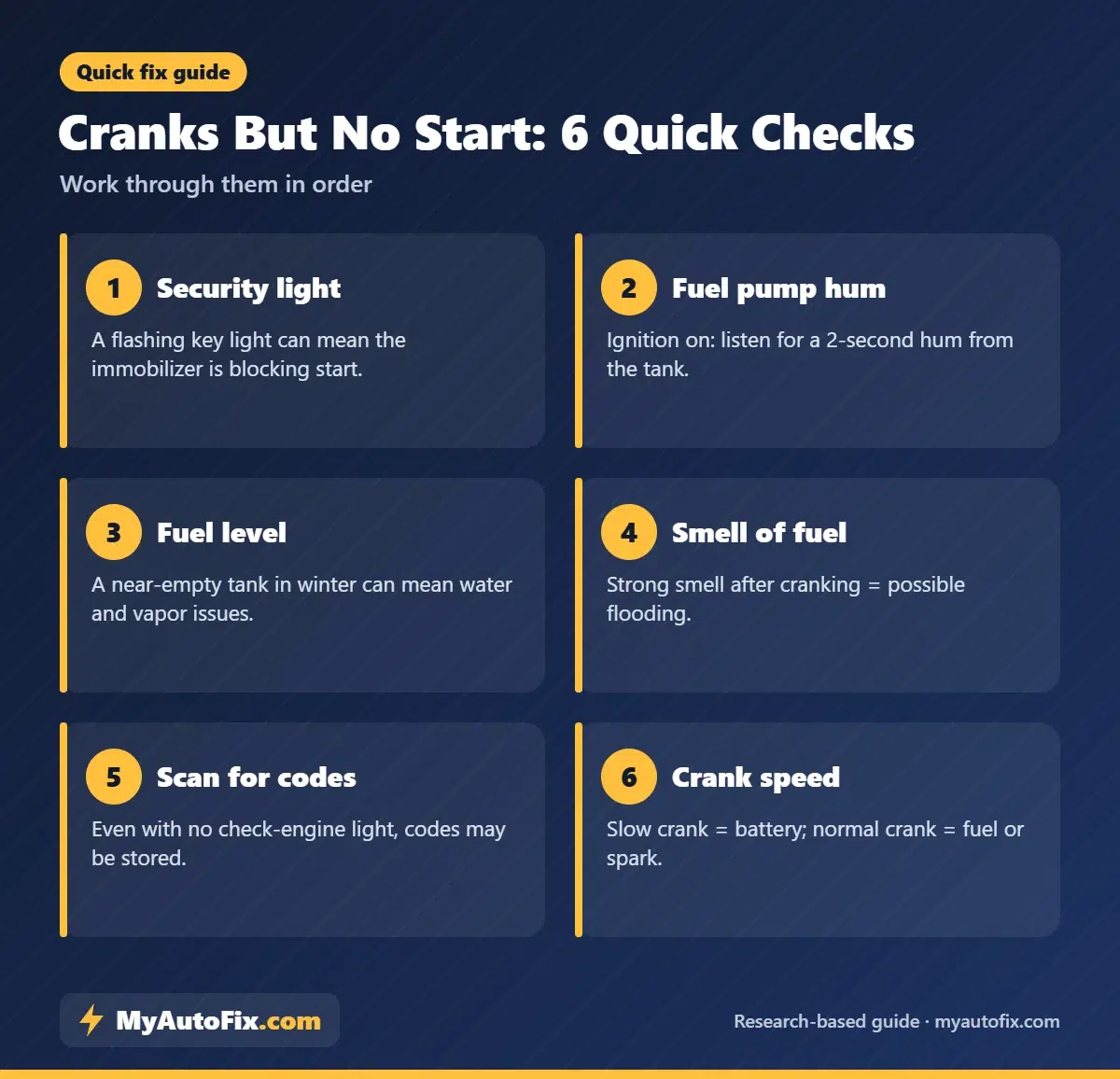
When you switch the ignition on, you should hear the fuel pump hum for a second or two. No hum suggests a failed pump, relay or fuse. Cold can be the last straw for a worn pump. Check the fuse and relay first; swapping the relay with an identical one (such as the horn relay) is a quick test on many cars.
3. Flooded engine
Repeated cranking, especially pumping the accelerator, can put too much fuel in the cylinders. You’ll often smell fuel. Many fuel-injected cars have a “clear flood” mode: hold the accelerator fully to the floor while cranking for a few seconds, which cuts fuel injection. Then release and try a normal start.
4. Weak spark or worn spark plugs
Worn plugs need more voltage to fire, and cold makes that harder. A failing ignition coil can also cause a no-start or rough start. If plugs are overdue, replacing them is a worthwhile DIY job on many engines.
5. Water or ice in the fuel
Condensation in a near-empty tank can introduce water, which can freeze in fuel lines or filters. Keeping the tank at least half full in winter reduces condensation. A fuel-line antifreeze additive can help in older vehicles; follow the product instructions.
6. Faulty coolant temperature sensor
The engine computer uses the coolant temperature sensor to decide how much extra fuel a cold engine needs. If it wrongly reports a warm engine, the mixture is too lean to start in the cold. A scan tool showing coolant temperature far above the outside temperature on a cold engine is a giveaway.
7. Immobilizer or key fob problems
If the security light flashes or the dash shows a key warning, the immobilizer may not be recognizing the key. A weak fob battery is common in cold weather. Try the spare key, or hold the fob against the start button or marked area as your manual describes.
8. Diesel glow plugs or gelled fuel
Diesels rely on glow plugs to start in the cold. Wait for the glow plug light to go out before cranking. In very cold weather, summer diesel can gel; winter-blend fuel and anti-gel additives prevent it.
The Tricky Trick: Prime the Fuel System
If your car cranks but won’t start after sitting in the cold, fuel pressure may have bled down overnight. Turn the ignition to ON (without starting) for two to three seconds, then off, and repeat two or three times. Each cycle runs the fuel pump and rebuilds pressure. Then start normally. If this helps consistently, have the fuel pump check valve or injectors checked for leak-down.
Scan for Trouble Codes
Many no-start problems leave stored codes even without a check-engine light, such as crankshaft position sensor, fuel pressure or immobilizer codes. An inexpensive OBD2 scanner reads them in seconds. The OBDLink MX+ is a popular Bluetooth option; see our best OBD2 scanners for more.
Protect your starter: crank for no more than about 10 seconds at a time, and wait 30–60 seconds between attempts.
How to Prevent Cold No-Starts
- Keep the tank at least half full in winter.
- Replace spark plugs and filters on schedule.
- Use the oil viscosity specified for cold weather.
- Test the battery before winter.
- Use an engine block heater in very cold climates.
- Park in a garage or out of the wind when possible.
The Bottom Line
If your car cranks but won’t start in the cold, start with the simple checks: listen for the fuel pump, look at the security light, try the clear-flood technique and scan for codes. Most cases come down to a weak battery, fuel delivery, worn ignition parts or a sensor. If the car still cranks but won’t start after these steps, or you smell fuel strongly or see warning lights, have it towed to a mechanic rather than cranking it until the battery dies.
Frequently Asked Questions
Why does my car crank but won’t start when cold?
Cold exposes weak fuel pumps, worn spark plugs, faulty sensors and weak batteries. Check for fuel pump hum, trouble codes and the security light.
How do I fix a flooded engine?
Wait a few minutes, then hold the accelerator to the floor while cranking for a few seconds to engage clear-flood mode on many fuel-injected cars.
Can a bad battery cause crank but no start?
Yes. A weak battery may crank slowly and drop voltage too low for ignition and the engine computer.
How do I know if my fuel pump is bad?
With the ignition on, listen for a brief hum from the fuel tank. No sound may mean a failed pump, relay or fuse.
Does gas line antifreeze help?
It can absorb small amounts of water in older vehicles. Keeping the tank half full in winter is the best prevention.
More Repair Guides
Car Battery Dies in Cold Weather? Why It Happens and How to Stop It
Car battery dies in cold weather? Why cold weakens batteries, how to test yours in five minutes, how to jump-start safely, and…

Windshield Fogging Up Inside? How to Clear It Fast and Stop It Coming Back
Windshield fogging up inside? The fastest way to defog with A/C and fresh air, why recirculation makes it worse, and how to…

Frozen Car Door Won’t Open? 8 Safe Ways to Get In (and Stop It Happening Again)
Frozen car door won't open? Safe ways to free frozen seals, handles and locks without tearing rubber or breaking handles, plus EV…