
Garage Safety · Tool Buying Guide
7 Best Jack Stands for 2026: Safe, Certified Picks for Cars, SUVs and Trucks
As an Amazon Associate I earn from qualifying purchases. We may earn a commission if you buy through links on this page, at no extra cost to you. Learn more.
The best jack stands are the most important safety tools in any home garage. A floor jack is built to lift a car, not hold it, and every year people are badly injured or killed when a car slips off a jack or a cheap stand fails. Good stands are rated by an independent standard, lock positively, sit on a wide base and are tall enough for your vehicle. We compared the most trusted jack stands on Amazon, from certified pin-type stands to budget double-lock models and 6-ton stands for trucks, and explain capacity, height, locking styles and the step-by-step routine that keeps you safe under a car.
How we chose: we compared certification (ASME PASE), locking design, capacity, height range, base footprint, saddle shape and long-term owner feedback, and cross-checked independent comparisons such as Project Farm’s jack stand stability and crush tests. We haven’t tested each of these stands ourselves for this guide, so our picks are research-based. Before buying any stand, check for recalls in NHTSA’s recall database.
Key takeaways
- A jack lifts; a stand holds. Never get under a car supported only by a jack.
- Choose stands certified to ASME PASE with a positive lock (pin, or ratchet plus pin).
- 3-ton pairs suit cars and small SUVs; 6-ton pairs give trucks the height they need.
- Always use level concrete, wheel chocks and a shake test.
Our Top Jack Stand Picks at a Glance
- Best OverallESCO 10498 3-Ton Performance Jack Stands (Pair)Check Price
- Best Pro-Grade RatchetHein-Werner HW93503 3-Ton Jack Stands (Pair)Check Price
- Check Price
- Best for Trucks & SUVsBIG RED T46002A Double-Locking 6-Ton Jack StandsCheck Price
- Check Price
- Best Value 6-TonVEVOR 6-Ton Double-Locking Jack Stands (Pair)Check Price
- Also Consider: 6-TonSALIFTFE 6-Ton Jack Stands (Pair)Check Price
In this guide
Jack Stand Comparison
| Stand | Capacity (pair) | Lock type | Height (approx.) | Best for |
|---|---|---|---|---|
| ESCO 10498 | 3 tons | Pin, solid shaft | 13.5–21+ in | Max confidence |
| Hein-Werner HW93503 | 3 tons | Ratchet | 11.5–17 in | Cars, fast setup |
| Big Red T43002A | 3 tons | Ratchet + pin | Mid-teens max | Value |
| Big Red T46002A | 6 tons | Ratchet + pin | Low-to-mid 20s max | Trucks & SUVs |
| Powerbuilt Unijack | 3 tons | Hydraulic + mechanical | Varies | Compact 2-in-1 |
| VEVOR 6-ton | 6 tons | Double locking | Check listing | Trucks, budget |
| SALIFTFE 6-ton | 6 tons | Check listing | Check listing | Heavy vehicles |
Which Jack Stand Is Right for You?
- You change your own oil and brakes on a sedan or crossover: a 3-ton double-locking pair like the Big Red T43002A covers you, or the ESCO 10498 if you want the very best.
- You work under the car often, for hours at a time: choose pin-type ESCO stands with flat rubber tops and buy two pairs.
- You drive a pickup, van or large SUV: go straight to 6-ton stands for the height and a wider base.
- You have a lowered or sports car: check the minimum height first; ratchet stands like the Hein-Werner start lower than pin stands.
- You only need to swap wheels twice a year: a 3-ton pair plus a floor jack is enough. The Powerbuilt Unijack is a compact alternative if space is tight.
The Best Jack Stands, Reviewed
1. ESCO 10498 3-Ton Performance Jack Stands (Pair)
The ESCO 10498 is the stand many experienced mechanics recommend when someone asks “what would you trust your life to?” It is a pin-type stand with a tripod base and a solid steel center shaft, rather than the stamped ratchet bar used on most budget stands. ESCO says its stands are tested to the ASME PASE standard by an independent A2LA-accredited lab.
- Capacity3 tons per pair
- LockPin through solid steel shaft
- HeightAbout 13.5 in to 21+ in
- TopFlat rubber pad
The flat top has a rubber pad, which spreads the load and protects pinch welds and frame rails from crushing and scratching. That matters on modern unibody cars, where the pinch weld is often the designated support point and is easily bent by a narrow V-shaped saddle. The height range runs from about 13.5 inches up past 21 inches, tall enough for most SUVs and light trucks as well as cars.
Pin-type stands are slower to adjust than ratchets because you lift the shaft and drop a pin into the nearest hole, but that pin is a simple, positive lock with nothing to slip. The powder-coated finish resists rust better than typical enamel paint.
Who should buy it: anyone who works under their car regularly and wants the most confidence possible. Skip it if: you have a lowered car with very little clearance; the 13.5-inch minimum height may be too tall.
What we like
- Solid steel center shaft
- ASME PASE tested by independent lab
- Rubber top protects pinch welds
- Tall enough for SUVs
Watch out for
- Premium price
- High minimum height for low cars
Verdict: The safest-feeling 3-ton stand you can buy for home use.
Check Price on Amazon2. Hein-Werner HW93503 3-Ton Jack Stands (Pair)
Hein-Werner has a long history in professional shop equipment, and the HW93503 is its 3-ton ratchet-style stand for cars and light trucks. The saddle column adjusts from about 11.5 inches to about 17 inches.
- Capacity3 tons per pair
- LockRatchet with locking handle
- HeightAbout 11.5 in to 17 in
- BuildHeavy-duty steel, wide base
Ratchet stands are faster to use than pin stands: you simply lift the column to the height you need and it clicks into place. The HW93503’s heavy-duty construction and wide base give it a reassuringly solid stance, and many reviewers describe it as a clear step up in fit and finish over big-box budget stands.
Like any ratchet stand, you should make sure the pawl is fully engaged in the teeth before lowering the car, and push down on the column handle to confirm it is locked. Hein-Werner stands use a ratchet with a locking handle rather than a secondary pin, so a little extra care at setup is worthwhile.
Who should buy it: DIYers who want shop-quality ratchet stands for sedans, hatchbacks and small crossovers. Skip it if: you need more than about 17 inches of height for a tall truck or SUV.
What we like
- Quick ratchet adjustment
- Professional build quality
- Stable wide base
- Good low starting height
Watch out for
- No secondary safety pin
- Limited max height for tall trucks
Verdict: A pro-quality ratchet stand for cars and smaller crossovers.
Check Price on Amazon3. BIG RED T43002A Double-Locking 3-Ton Jack Stands
Torin’s Big Red line is probably the most common jack stand in American home garages, and the T43002A adds a feature many budget stands lack: a double-locking design. The ratchet bar locks into the teeth as usual, and a separate pin goes through the column as a second line of defense.
- Capacity3 tons per pair
- LockRatchet plus secondary pin
- BuildStamped steel, 4-leg base
- SaddleV-shaped (use a pad on pinch welds)
That secondary pin is the main reason we recommend it over single-lock budget stands. If the ratchet pawl were somehow knocked out of engagement, the pin is still there. Reviewers routinely call it the value champion: a genuine double-lock stand for roughly the price of a no-name pair.
The stamped steel construction is lighter and less refined than an ESCO or Hein-Werner, and the saddle is a conventional V-shape, so use a slotted rubber pad on pinch welds. Check the height range on the listing against your vehicle; standard 3-ton stands top out in the mid-to-high teens in inches, which may not be enough for a lifted truck.
Who should buy it: first-time DIYers and anyone wanting safe, affordable stands for cars and small SUVs. Skip it if: you work on tall trucks; get the 6-ton version instead.
What we like
- Double-locking for extra safety
- Very affordable
- Widely available
- Simple to use
Watch out for
- Less refined build
- V-saddle needs a pad for pinch welds
Verdict: The best safe stand for the money.
Check Price on Amazon4. BIG RED T46002A Double-Locking 6-Ton Jack Stands
Full-size pickups, three-row SUVs and lifted 4x4s need more height and more capacity margin than a 3-ton stand gives. The Big Red T46002A uses the same double-locking ratchet-plus-pin design as the 3-ton version, scaled up to a 6-ton (12,000 lb) rating per pair with a taller column and a wider footprint.
- Capacity6 tons (12,000 lb) per pair
- LockRatchet plus secondary pin
- HeightTaller range for trucks (check listing)
- BaseWide 4-leg base
Height is the key advantage. Its range reaches into the low-to-mid 20s in inches, letting you support a truck frame high enough to remove wheels and work on suspension. The wider base also resists tipping, which matters more as the stand gets taller.
The trade-off is bulk and a higher minimum height, which may not slide under a car with low ground clearance. Many owners keep a 3-ton pair for cars and a 6-ton pair for the truck.
Who should buy it: truck and SUV owners. Skip it if: you only work on cars; the extra height and weight are unnecessary.
What we like
- Big capacity margin
- Tall enough for trucks
- Double-locking
- Stable wide base
Watch out for
- Too tall for low cars
- Heavy to move
Verdict: Affordable, double-locked support for trucks and SUVs.
Check Price on Amazon5. Powerbuilt 620471 3-Ton Unijack (Bottle Jack and Stand)
The Unijack combines a bottle jack and a jack stand in one tool. You lift the vehicle hydraulically, then a locking mechanism holds it mechanically so you don’t have to rely on the hydraulics alone. It’s a clever idea for people with limited storage or who want one compact tool in the trunk.
- Capacity3 tons
- TypeBottle jack with mechanical lock
- UseOne support point per unit
- StorageCompact
Its main appeal is convenience: one tool per corner instead of a jack and a stand, and it can be useful for quick jobs like a tire rotation or swapping to winter wheels. It is not a substitute for a set of dedicated stands for longer jobs under the car, and you still need to place it at a proper lift point and use wheel chocks.
Because you can only lift and support one point at a time with one Unijack, you’d need two or more for jobs where a whole axle must be in the air.
Who should buy it: drivers with little storage space who want a compact lift-and-hold tool. Skip it if: you do longer jobs under the car; dedicated stands are safer and more stable.
What we like
- Lift and support in one tool
- Compact storage
- Handy for wheel swaps
- Mechanical lock backup
Watch out for
- One point per unit
- Less stable than a dedicated stand
Verdict: A space-saving option for quick jobs, not a replacement for stands.
Check Price on Amazon6. VEVOR 6-Ton Double-Locking Jack Stands (Pair)
VEVOR’s 6-ton pair is a budget route to truck-size capacity, rated at 13,000 lb for the pair. Like the BIG RED 6-ton, it uses a double-locking design: a ratchet that holds the column, plus a secondary lock as a backup.
- Capacity6 tons (13,000 lb) per pair
- Lock typeDouble locking
- HeightCheck listing
- Sold asPair
The higher rating is useful for pickups, full-size SUVs and heavy EVs, and taller 6-ton stands usually offer more lift range to match a floor jack’s reach under lifted vehicles. Check the minimum height on the listing if you also work on low cars, since bigger stands often start higher.
As with any budget stand, inspect the welds, ratchet teeth and base before each use, make sure both locks are fully engaged, and never exceed the rating. Use a pair under solid frame or axle points, never under suspension arms or body panels.
Who should buy it: truck and SUV owners who want 6-ton capacity for less. Skip it if: you only work on small cars; a 3-ton pair is lighter and easier to position.
What we like
- High capacity for the price
- Double-locking backup
- Suits trucks and large SUVs
Watch out for
- Heavier and bulkier than 3-ton stands
- Minimum height may be too tall for low cars
- Inspect build quality before use
Verdict: undefined
Check Price on Amazon7. SALIFTFE 6-Ton Jack Stands (Pair)
SALIFTFE’s 6-ton stands are rated at 13,200 lb for the pair, a similar class to the VEVOR and BIG RED 6-ton options. They are aimed at owners of pickups, vans and large SUVs who need more capacity than a 3-ton pair offers.
- Capacity6 tons (13,200 lb) per pair
- Lock typeCheck listing
- HeightCheck listing
- Sold asPair
Before buying, compare the minimum and maximum heights on the listing with your vehicle’s ground clearance and the reach of your floor jack, and check how the lock works. A stand that is too tall at its lowest setting will not fit under a lowered car.
Treat any jack stand as safety equipment: set it on hard, level ground, place it under a manufacturer-approved support point, confirm the lock is fully engaged, and give the vehicle a firm shake test before you go underneath.
Who should buy it: owners of heavy vehicles who want a second 6-ton option. Skip it if: you need a proven, long-established brand; the BIG RED or ESCO stands have longer track records.
What we like
- High rated capacity
- Suits trucks, vans and large SUVs
- Budget price
Watch out for
- Less-established brand
- Check height range and lock design
- Heavy to move around
Verdict: undefined
Check Price on AmazonWant safe stands on a budget? The Big Red T43002A adds a secondary locking pin to a classic ratchet stand at a very fair price.
How to Choose the Best Jack Stands
1. Certification: look for ASME PASE
In the U.S., the relevant safety standard for jack stands is ASME PASE (Portable Automotive Service Equipment). It sets requirements for load testing and design. A certified stand has been proof-loaded beyond its rating. Look for the standard on the packaging or a label on the stand, and prefer brands that publish independent test details.
2. Capacity per pair, not per stand
Most manufacturers rate stands per pair. A “3-ton” pair means each stand is rated for 1.5 tons. Because a pair supports only one end of the vehicle, and the weight is rarely split perfectly, it’s wise to choose a rating well above half your vehicle’s weight. For most cars and crossovers, 3 tons per pair is plenty; trucks, large SUVs and heavy EVs benefit from 6-ton stands.
3. Height range
Measure from the floor to your lift points with the vehicle on a jack at a comfortable working height. You need stands whose range covers that height with the column only partly extended, since a stand is most stable when its column isn’t at full height. Low cars need a low minimum height; trucks need a high maximum.
4. Locking mechanism
- Pin-type: a steel pin goes through holes in the column. Very simple and positive, but slower to adjust.
- Ratchet: a toothed bar and pawl. Quick to adjust; make sure the pawl is fully engaged.
- Double-locking: a ratchet plus a secondary pin. The best of both for home use.
5. Base and saddle
A wider base resists tipping. Four-leg pyramid bases are common; tripods are naturally stable on uneven concrete. The saddle (the top) should suit your lift points: flat rubber tops or slotted pads protect pinch welds, while V-shaped saddles cradle round axles and frame rails.
How to Use Jack Stands Safely: Step by Step
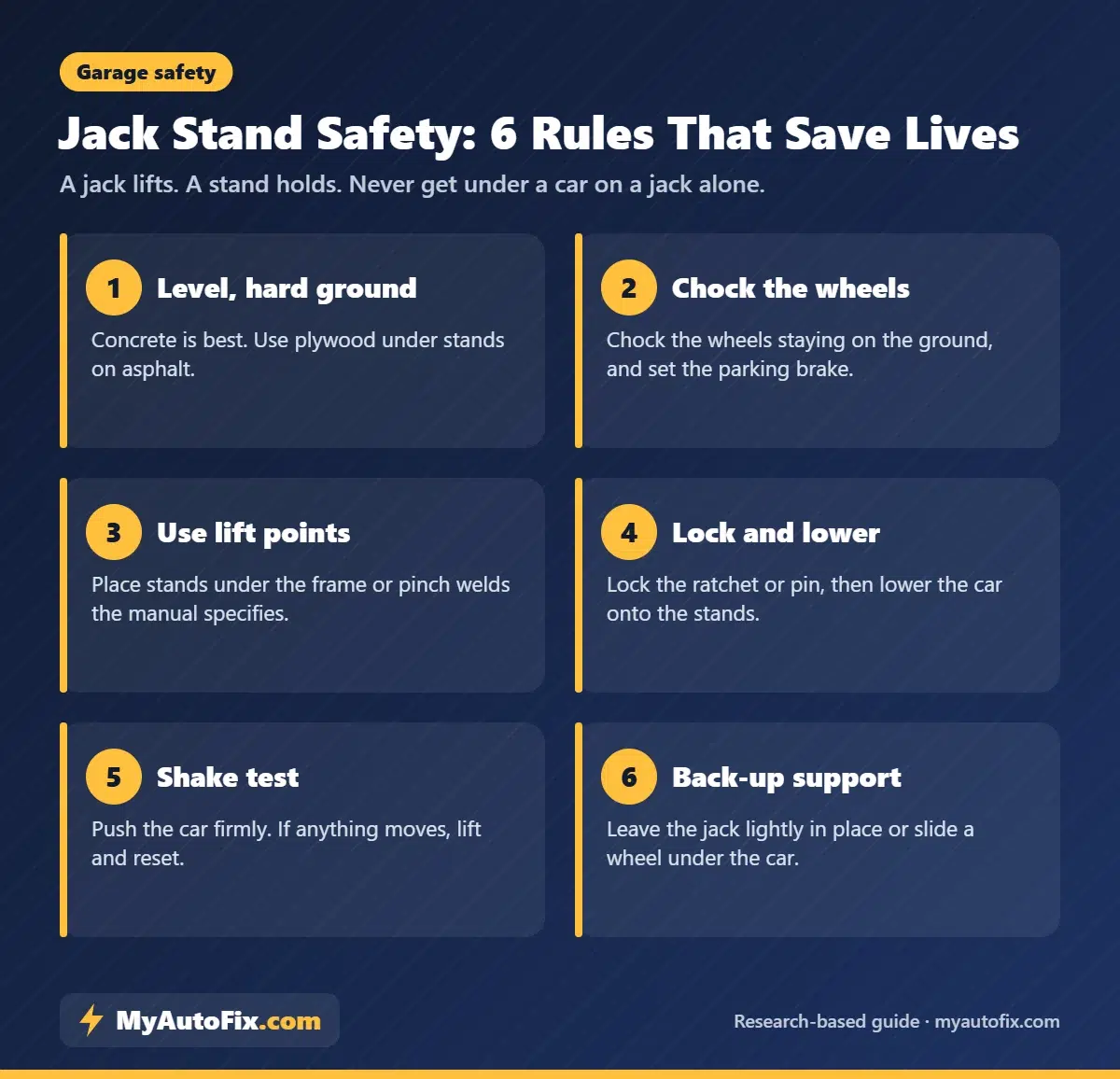
- Choose your surface. Work on level, solid concrete. On asphalt, put a square of thick plywood under each stand.
- Set the parking brake and chock the wheels. Chock the wheels that stay on the ground, front and back of the tire.
- Find the correct lift point. Check your owner’s manual for jacking and support points. Electric cars have specific points to avoid the battery pack; use EV jack pads.
- Lift with a floor jack. Raise the car just high enough to place the stand. A low-profile floor jack helps with low cars.
- Position the stand. Set the stand under the support point, adjust to the right height and lock it with the pin or ratchet.
- Lower slowly onto the stand. Let the car settle onto the saddle gently, watching that it centers properly.
- Repeat on the other side. Keep the stands at the same height so the car sits level.
- Shake test. Push firmly on the car. If anything moves or creaks, lift again and reset.
- Add a backup. Leave the jack lightly raised under a solid point, or slide a removed wheel under the frame as extra protection.
Never use bricks, cinder blocks, wood stacks or the car’s scissor jack to hold a car while you work under it. Cinder blocks can crumble without warning.
Jack Stand Placement for Different Vehicles
| Vehicle type | Typical support points | Tip |
|---|---|---|
| Unibody cars & crossovers | Reinforced pinch welds near each wheel | Use slotted rubber pads |
| Body-on-frame trucks & SUVs | Frame rails or axle tubes | V-saddle fits round axles |
| Electric vehicles | Specific reinforced points shown in the manual | Never lift on the battery pack |
| Lowered or sports cars | Pinch welds or subframe points | Low minimum-height stands needed |
If you’re rotating tires or replacing brakes, lift one end at a time and keep the other wheels chocked. For tire work, see our guides on tire rotation and brake system maintenance, and torque the lug nuts correctly with a torque wrench when you’re done.
Jack Stand Capacity Cheat Sheet
Use this as a starting point, then check your vehicle’s curb weight (on the door-jamb sticker or in the manual). Remember that one end of the car is often heavier than the other: front-engine cars carry more weight up front, and many EVs are heavy overall because of the battery.
| Vehicle | Typical curb weight | Suggested stands (per pair) |
|---|---|---|
| Compact car or hatchback | 2,600–3,300 lb | 2–3 tons |
| Midsize sedan or small crossover | 3,200–4,000 lb | 3 tons |
| Electric crossover (e.g. Model Y class) | 4,000–4,600 lb | 3 tons, or 6 tons for extra margin and height |
| Full-size SUV or half-ton pickup | 4,800–6,000 lb | 6 tons |
| Heavy-duty pickup | 6,500 lb and up | 6 tons or more, pin-type preferred |
Jack Stands for Electric Vehicles
EVs bring two extra considerations. First, the battery pack covers much of the underside and must never be used as a lift or support point. Manufacturers specify reinforced points, often marked on the pack’s edge or the body sill, and recommend a pad that fits those points. Second, EVs are heavy for their size, so the extra margin and broader base of a quality stand are worth it.
- Put the car in jack or service mode if it has one. Some EVs lower or lock the suspension and disable features that could move the car.
- Use the manual’s jack points with proper pads. Our guide to EV jack pads shows options for Tesla and other EVs.
- Place stands at the designated support points. On many EVs these are close to the jack points; follow the manual exactly.
- Never put stands or a jack under the battery pack. Damage to the pack can be extremely expensive and dangerous.
How to Lift a Whole Car Level on Four Stands
- Lift and support the front first. Jack up the front at the central jacking point (or one side at a time), and set two stands at the front support points.
- Then lift the rear. Jack the rear and set two stands at the rear support points at a similar height.
- Level it. Adjust the stands so the car sits level side to side and roughly level front to back.
- Shake test all four corners. Push firmly on each corner of the car.
- Keep a backup under the car. Leave the jack lightly raised under a strong point or slide wheels under the sills.
Useful Jack Stand Accessories
- Slotted rubber pads: cushion pinch welds and stop the car sliding. Search Amazon for slotted jack stand pads.
- Wheel chocks: solid rubber chocks hold far better than a brick or block of wood. Try heavy-duty rubber wheel chocks.
- A good floor jack: see our low-profile floor jack picks.
- A creeper or mat: keeps you off cold, wet concrete and makes it easier to slide out quickly.
- A bright work light: magnetic or head-mounted lights let you see without moving the stands.
Do Jack Stands Expire?
Jack stands don’t have a printed expiry date, but they wear out. Rust weakens thin steel, ratchet teeth round off, pins bend and bases warp if a stand is overloaded or dropped. Inspect your stands before each use and retire any that show damage. If you bought very cheap, uncertified stands years ago, replacing them with a certified pair is one of the most worthwhile safety upgrades you can make in a home garage.
Real-World Tips From the Garage Floor
- Buy two pairs. Four stands let you lift the whole car level for exhaust or underbody work.
- Keep a rubber pad set. Slotted pads protect pinch welds and stop cars sliding on the saddle.
- Mark your lift points. A dab of paint on the pinch-weld locations saves time crawling around with a flashlight.
- Lay down a creeper or mat. You’ll work more carefully if you’re comfortable.
- Keep your head out of the crush zone. Position yourself so that if something shifted, the frame wouldn’t land on you.
- Inspect before every use. Look for bent legs, cracked welds, damaged teeth and worn pins.
Jack Stand Mistakes to Avoid
- Working under a car on a jack only. Hydraulic seals can fail without warning.
- Using stands on soft ground or a slope. Legs sink or the car rolls.
- Extending the column to its limit. Stability drops as the column rises.
- Mixing up capacity ratings. Remember ratings are usually per pair.
- Placing stands under suspension arms or the oil pan. They can move or crush.
- Forgetting wheel chocks. A car can roll off stands, especially front-wheel-drive cars with the front lifted.
- Keeping a damaged or recalled stand. If in doubt, throw it out.
Jack Stands vs Car Ramps vs a Lift
| Option | Best for | Pros | Cons |
|---|---|---|---|
| Jack stands | Wheel, brake and suspension work | Wheels free, flexible placement | Takes setup time |
| Car ramps | Oil changes, quick inspections | Fast, very stable | Wheels stay on, low cars may not clear |
| Two-post lift | Frequent, heavy work | Best access | Expensive, needs space and ceiling height |
Many home mechanics use both stands and ramps: ramps for oil changes and quick looks underneath, stands whenever the wheels need to come off.
Common DIY Jobs That Need Jack Stands
If you’re wondering whether jack stands are worth buying, here are the jobs most home mechanics use them for, and what else you’ll need:
| Job | Lift | Other tools |
|---|---|---|
| Tire rotation or seasonal wheel swap | One end, then the other (or all four) | Torque wrench, lug wrench |
| Brake pads and rotors | One axle | Socket set, C-clamp, brake cleaner |
| Brake fluid flush | All four wheels free or one at a time | Bleeder kit, fluid, hose |
| Suspension work (struts, links) | One axle | Sockets, pry bar, spring compressor if needed |
| Exhaust leak repair | Whole car level | Exhaust sealant or clamps |
| Diagnosing clunks and noises | One axle | Pry bar, flashlight, stethoscope |
For specific jobs, see our guides to fixing an exhaust leak, EV brake rotor rust and suspension clunking. For diagnosing warning lights before you lift the car, an OBD2 scanner is the best first step.
How to Inspect and Store Jack Stands
- Wipe off oil and grease so stands don’t slip and you can spot cracks.
- Check pins, ratchet teeth and pawls for wear or deformation.
- Look for bent legs or a base that no longer sits flat.
- Store stands indoors, dry and upright, at their lowest height.
- Replace any stand that has been overloaded, dropped from height or involved in a slip.
Frequently Asked Questions
What are the best jack stands for home use?
For most people, a pair of ASME-certified 3-ton stands with a positive lock is ideal. The ESCO 10498 is our top pick for build quality, and the BIG RED T43002A double-locking stands are the best value. Truck owners should consider 6-ton stands for the extra height.
How much weight should jack stands be rated for?
Jack stand ratings are usually per pair. Since each pair supports only one end of the vehicle, a 3-ton pair has plenty of margin for most cars and small SUVs. Trucks and large SUVs should use 6-ton stands, mainly for height and stability.
Are pin-type or ratchet jack stands safer?
Both are safe when certified and used correctly. Pin types have a very simple positive lock. Ratchet stands adjust faster; double-locking ratchet stands add a pin as a backup.
Can I use jack stands on asphalt?
Asphalt can soften in heat and stand legs can sink. Place each stand on a square of thick plywood or a steel plate to spread the load, and avoid soft or sloped surfaces entirely.
Where do I put jack stands on a unibody car?
Use the support points listed in your owner’s manual, usually the reinforced pinch welds near each wheel. Use a slotted rubber pad so the weld isn’t bent.
How long do jack stands last?
Good stands last many years. Retire any stand that is bent, cracked, rusted through, has damaged teeth or pins, or has been dropped from height or overloaded.
Do I need four jack stands?
Two are enough for working on one end of the car. For jobs that need the whole car in the air, such as some exhaust or transmission work, use four stands on a level surface.
Were any jack stands recalled?
Yes. Some jack stands have been recalled in recent years because the ratchet could disengage under load. Check the NHTSA recall database for your stand’s brand and model.
Can jack stands be used on an electric car?
Yes, at the support points listed in the owner’s manual, with suitable pads. Never place a stand or jack under the battery pack.
How high should jack stands be set?
High enough to work comfortably, but avoid extending the column to its maximum, where stability is lowest. Set both stands at the same height.
Should I buy jack stands made in the USA?
Country of origin matters less than certification and build quality. Look for ASME PASE compliance, a positive lock and good owner feedback, and check NHTSA for recalls.
Can I leave a car on jack stands for weeks?
Yes, on level concrete with the stands at the correct points and the car shake-tested. Check them periodically and keep people, especially children, away from the car.
The Bottom Line
The ESCO 10498 is the best jack stand for anyone who wants pro-level confidence: a solid shaft, a positive pin lock and independent ASME testing. For fast, quality ratchet stands for cars, choose the Hein-Werner HW93503. On a budget, the BIG RED T43002A gives you double locking for very little money, and truck owners should step up to the T46002A 6-ton. Whatever you buy, use level concrete, wheel chocks and a shake test every time.
Best Overall: ESCO 10498 Best Value: Big Red 3-Ton Trucks: Big Red 6-Ton
More Tool Reviews

6 Best Trim Removal Tool Kits of 2026 (No-Scratch Pry Tools)
The best trim removal tool kits for door panels, dashboards and stereo installs: 5- to 120-piece kits compared, and how to remove…

6 Best Automotive Inspection Cameras (Borescopes) of 2026
The best automotive inspection cameras and borescopes for mechanics and DIYers: articulating, dual-lens and phone models, plus how to inspect an engine…
6 Best Automotive Multimeters of 2026 for DIY Car Electrical Work
The best automotive multimeters for DIY car electrical work: battery and alternator checks, parasitic drain tests and sensors, from Fluke, Klein and…