
Tesla Model Y · Winter Tire Buying Guide
7 Best Winter Tires for Tesla Model Y (2026): Snow, Ice and Range Compared
As an Amazon Associate I earn from qualifying purchases. We may earn a commission if you buy through links on this page, at no extra cost to you. Learn more.
The best winter tires for Tesla Model Y do more than survive snow. They have to carry a heavy electric crossover, handle instant torque without spinning, stay reasonably quiet, and avoid gobbling up range. All-season tires stiffen and lose grip once temperatures drop below about 45°F (7°C), which is why a dedicated winter set is the single biggest safety upgrade for a Model Y in cold climates. We compared the leading studless, EV-specific and all-weather options in the Model Y’s common 255/45R19 and 255/40R20 sizes, and explain load ratings, TPMS sensors, wheel packages and how winter tires affect range.
How we chose: we compared tire type (studless, studded, performance winter, all-weather), availability in the Model Y’s common sizes and XL load ratings, published test results and rankings from independent tire testers and retailers (including TireGrades, The Car Guide and PMCtire), EV-specific design, noise and tread life. We have not run these tires on our own Model Y for this guide, so our picks are research-based. For general tire safety, see NHTSA’s tire safety guide.
Key takeaways
- All-season tires lose grip below about 45°F (7°C); winter tires are built for it.
- Buy the exact size and an XL load rating; most Model Ys use 255/45R19 or 255/40R20.
- Michelin X-Ice Snow is the best all-rounder; Blizzak 6 is best on ice.
- A second wheel set with TPMS sensors makes seasonal swaps cheap and quick.
Our Top Tesla Model Y Winter Tire Picks at a Glance
- Best OverallMichelin X-Ice SnowCheck Price
- Best for Ice & Deep SnowBridgestone Blizzak 6Check Price
- Best EV-SpecificNokian Hakkapeliitta R5 EVCheck Price
- Best for Slush & Wet RoadsContinental VikingContact 7Check Price
- Best Performance WinterPirelli Winter Sottozero 3Check Price
- Best All-Weather AlternativeMichelin CrossClimate2Check Price
- Best StuddedNokian Hakkapeliitta 10 EV (Studded)Check Price
In this guide
Model Y Winter Tire Comparison
| Tire | Type | Biggest strength | Best for |
|---|---|---|---|
| Michelin X-Ice Snow | Studless | All-round balance, tread life | Most owners |
| Bridgestone Blizzak 6 | Studless | Glare ice, deep snow | Harsh winters |
| Nokian Hakkapeliitta R5 EV | Studless, EV | Low rolling resistance | Range + extreme cold |
| Continental VikingContact 7 | Nordic studless | Slush and wet | Highway commuters |
| Pirelli Winter Sottozero 3 | Performance winter | Cold dry/wet handling | Mild winters |
| Michelin CrossClimate2 | All-weather 3PMSF | No seasonal swap | Light snow |
| Nokian Hakkapeliitta 10 EV | Studded, EV | Maximum ice grip | Icy rural roads |
The Best Winter Tires for Tesla Model Y, Reviewed
1. Michelin X-Ice Snow
The Michelin X-Ice Snow is the winter tire most often recommended for the Model Y by North American tire retailers and Tesla specialists, and it is easy to see why. It balances ice braking, deep-snow traction, comfort and tread life better than almost anything else in its class, and it is widely available in 255/45R19.
- TypeStudless winter, 3PMSF
- Common Model Y size255/45R19 (check XL load)
- StrengthIce braking, snow traction, tread life
- NoiseQuiet for a winter tire
Its directional tread uses V-shaped grooves to evacuate slush and water quickly, while dense sipes create thousands of biting edges for ice. Michelin’s compound is designed to stay flexible in the cold and to keep its winter grip as the tread wears, which matters on an EV, where torque and weight tend to wear tires faster than on a gas car.
Owners frequently mention how quiet and composed it feels for a winter tire, which is important in a car with no engine noise to mask tire roar. It isn’t the cheapest option, but its long life narrows the cost gap over several seasons.
Who should buy it: drivers who see regular snow and ice and want the best all-round winter tire. Skip it if: you live where winter is mostly cold and wet with little snow; a performance winter or all-weather tire may suit you better.
What we like
- Excellent ice and snow grip
- Long tread life for a winter tire
- Quiet and comfortable
- Widely available in Model Y sizes
Watch out for
- Premium price
- Softer handling than performance winters
Verdict: The best all-round winter tire for most Model Y owners.
Check Price on Amazon2. Bridgestone Blizzak 6
Bridgestone’s Blizzak line has been the benchmark for ice traction for decades, and the Blizzak 6 is the latest premium studless model, succeeding the WS90 and DM-V2. Its multicell compound wicks away the thin layer of water that sits on top of ice, which is what makes ice so slippery, and the result is remarkable stopping power on glare ice.
- TypePremium studless winter, 3PMSF
- ReplacesBlizzak WS90 and DM-V2
- StrengthIce braking and deep snow
- NoteIce compound concentrated in upper tread
Tire testing site TireGrades ranks the earlier Blizzak WS90 as its top winter tire for the Model Y, and the Blizzak 6 builds on that design with improved handling and durability. Some sizes may still be available as WS90 while stock lasts; either is an excellent ice tire.
The trade-off with Blizzaks has always been that the special ice compound is concentrated in the first part of the tread. Once that layer wears, you’re left with a more ordinary winter tire, so expect peak ice performance for the first several seasons rather than the full life of the tread.
Size note: our Amazon link opens the Blizzak 6 listing in 235/40R19. Before you buy, switch the size to 255/45R19 for the stock 19-inch Model Y wheels, or to the size printed on your own tires, and confirm the load index is XL.
Who should buy it: drivers in places with frequent ice, freezing rain or very cold temperatures. Skip it if: you prioritize the longest possible tread life or drive many highway miles in mild weather.
What we like
- Outstanding grip on glare ice
- Strong deep-snow traction
- Proven Blizzak technology
- Improved handling over WS90
Watch out for
- Ice compound wears before the full tread
- Can feel soft on dry roads
Verdict: The pick if ice is your biggest winter worry.
Check Price on Amazon3. Nokian Hakkapeliitta R5 EV
Nokian invented the winter tire in Finland, and the Hakkapeliitta R5 EV is a version of its premium studless tire designed specifically for electric vehicles. It aims for the R5’s Nordic-level snow and ice grip while lowering rolling resistance and noise to suit EVs.
- TypeStudless winter, EV-optimized
- FocusLow rolling resistance and low noise
- StrengthNordic snow and ice grip
- SizesIncludes 255/45R19 (check availability)
Lower rolling resistance means less energy lost to the tires, which helps limit the range hit that every winter tire causes. Combined with Nokian’s focus on noise reduction, it’s a natural match for a Model Y owner who drives long distances in very cold climates such as the northern U.S. and Canada.
Availability in the U.S. can be patchier than Michelin or Bridgestone, and Nokian’s prices are at the premium end. Nokian also makes the Hakkapeliitta 10 EV studded tire for drivers who need studs, covered below.
Who should buy it: EV owners in severe winter climates who want to protect range. Skip it if: you can’t find your size locally and need tires quickly.
What we like
- Designed for EV weight and torque
- Lower rolling resistance helps range
- Quiet
- Excellent snow and ice grip
Watch out for
- Premium price
- Patchier U.S. availability
Verdict: The best choice for Model Y owners who want winter grip with the smallest range penalty.
Check Price on Amazon4. Continental VikingContact 7
Continental’s VikingContact 7 is a Nordic-style studless tire with a reputation for strong performance across the full mix of winter surfaces: snow, ice, slush and cold wet pavement. PMCtire, a large Canadian retailer, ranks it as its number-two winter tire for the Model Y.
- TypeNordic studless winter, 3PMSF
- StrengthSlush, wet and snow balance
- HandlingResponsive for a winter tire
- Common Model Y size255/45R19
Its tread uses a high number of edges and a compound that stays soft in the cold, while open grooves help clear slush, which can be more dangerous than snow because it causes hydroplaning at highway speeds. For drivers who commute on salted highways that are wet and slushy more often than snowy, that balance is valuable.
The VikingContact 7 is generally regarded as a little sportier and more responsive than very soft ice tires, while still delivering serious winter grip.
Size note: our Amazon link opens the VikingContact 7 listing in 185/60R15. Before you buy, switch the size to 255/45R19 for the stock 19-inch Model Y wheels, or to the size printed on your own tires. Do not order the size shown by default; it will not fit a Model Y.
Who should buy it: highway commuters dealing with slush, wet cold roads and occasional snow. Skip it if: your priority is the absolute best grip on glare ice.
What we like
- Strong in slush and wet cold
- Good snow traction
- Responsive handling
- Respected Nordic design
Watch out for
- Not the top ice tire
- Availability varies by size
Verdict: A great all-surface winter tire for highway-heavy commutes.
Check Price on Amazon5. Pirelli Winter Sottozero 3
Performance winter tires sit between all-seasons and full studless winter tires. They use a cold-weather compound and plenty of sipes, but keep a more rigid tread for sharp handling on cold, dry and wet pavement. The Sottozero 3 is one of the best-known, and retailers list versions of it as a Tesla-marked option for the Model Y.
- TypePerformance winter, 3PMSF
- StrengthCold dry and wet handling
- Model Y noteTesla-marked versions exist in some sizes
- Best climateCold, wet, occasional snow
For drivers in places like the Mid-Atlantic, Pacific Northwest lowlands or the UK, where winters are cold and wet but deep snow and ice are occasional, a performance winter tire keeps the Model Y feeling planted and responsive while still giving far better cold-weather grip than all-seasons.
It is not the tire for mountain passes, unplowed side streets or frequent ice. In those conditions, a studless tire like the X-Ice Snow or Blizzak 6 is much safer.
Who should buy it: drivers with mild-to-moderate winters who value handling, and Model Y Performance owners. Skip it if: you see deep snow or ice regularly.
What we like
- Sharp handling in the cold
- Strong wet braking
- Higher speed ratings than most winters
- Tesla-marked options
Watch out for
- Weaker on ice and deep snow
- Premium price
Verdict: The best fit for mild, wet winters and drivers who want sporty handling.
Check Price on Amazon6. Michelin CrossClimate2
If you live where snow is occasional and you don’t want to store and swap a second set of tires, an all-weather tire with the three-peak mountain snowflake (3PMSF) symbol is the compromise. The Michelin CrossClimate2 is the most popular and is TireGrades’ top all-weather pick for the Model Y.
- TypeAll-weather, 3PMSF
- UseYear-round
- StrengthLight snow plus wet and dry grip
- Swap neededNo
Unlike ordinary all-seasons, the CrossClimate2 is certified for severe snow traction and uses a V-shaped tread that clears snow and water well. It stays usable all year, so you avoid swapping costs and storage.
The honest limitation: an all-weather tire is still not as good on ice as a true winter tire, and it is less precise in summer heat than a dedicated summer or touring tire. For regular snow and ice, buy winter tires.
Who should buy it: drivers in areas with a few snowy days a year who want one set of tires. Skip it if: you face frequent ice or deep snow.
What we like
- One set all year
- Certified snow traction
- Strong wet grip
- Long tread life
Watch out for
- Weaker on ice than winter tires
- Compromise in summer heat
Verdict: The best one-tire solution for light-snow climates.
Check Price on Amazon7. Nokian Hakkapeliitta 10 EV (Studded)
For rural roads that stay icy for months, nothing beats metal studs. The Hakkapeliitta 10 EV is Nokian’s studded winter tire designed specifically for electric vehicles, and The Car Guide ranked it number one in its 2025–2026 winter tires for EVs roundup.
- TypeStudded winter, EV-specific
- StrengthMaximum ice grip
- Legal noteSeasonal or full bans in some places
- Size255/45R19 available
Nokian designs the stud system and tread to handle EV weight and torque, aiming for strong ice grip with less road noise than older studded designs. It is offered in 255/45R19 for the Model Y.
Studded tires come with real restrictions. Many U.S. states and Canadian provinces limit them to certain months, and some ban them entirely. They are also noisier than studless tires and wear dry roads. Check your local rules before buying.
Who should buy it: drivers in very icy rural areas where studs are allowed. Skip it if: you drive mostly on plowed, salted city roads.
What we like
- The best possible ice traction
- Built for EV weight
- Strong snow grip too
- Highly rated by Canadian testers
Watch out for
- Restricted or banned in some areas
- Noisier than studless tires
Verdict: The ultimate choice for icy rural roads where studs are legal.
Check Price on AmazonWant the safe, all-round choice? The Michelin X-Ice Snow balances ice, snow, comfort and tread life. Make sure you select your exact size and an XL load rating.
How to Choose Winter Tires for a Tesla Model Y
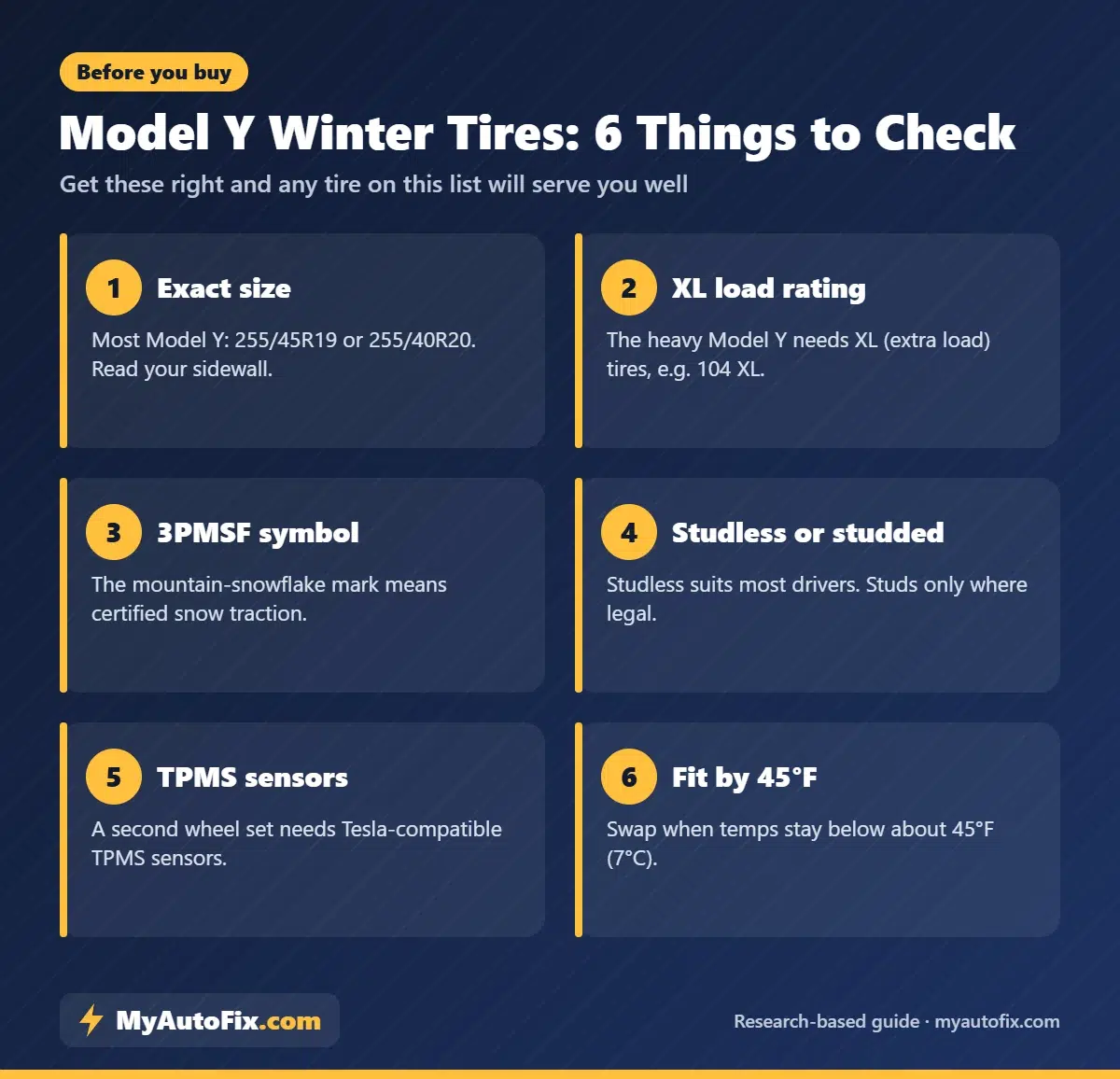
1. Get the size and load rating exactly right
Start with the sidewall of your current tires. The 19-inch Gemini wheels use 255/45R19, the 20-inch Induction wheels use 255/40R20, and Performance models use 21-inch tires. The refreshed Model Y may use different wheel designs, so always confirm. Just as important is the load index: the Model Y is a heavy vehicle and needs XL (extra load) tires that match or exceed the original rating. Don’t accept a standard-load tire to save money.
2. Choose the right type of winter tire
- Studless winter tires (X-Ice Snow, Blizzak 6, Hakkapeliitta R5 EV, VikingContact 7) are the best choice for most snowy climates.
- Performance winter tires (Sottozero 3) suit cold, wet winters with occasional snow and drivers who value handling.
- Studded tires (Hakkapeliitta 10 EV) are for icy rural roads where studs are legal.
- All-weather tires (CrossClimate2) are a one-set compromise for light snow.
3. Look for the 3PMSF symbol
The three-peak mountain snowflake symbol means the tire passed a standardized snow traction test. Plain “M+S” (mud and snow) markings are not a guarantee of winter performance; many all-season tires carry M+S. For real winter grip, look for 3PMSF.
4. Consider an EV-specific design
EV-specific tires are designed to handle extra weight and instant torque, reduce rolling resistance and cut noise. They aren’t essential, but they help limit the range loss and road roar that winter tires can bring. Some tires also use foam liners to dampen cabin noise, which Tesla uses on many of its original tires.
5. Plan for wheels and TPMS
If you buy a second set of wheels for winter, you’ll need TPMS sensors that work with your Model Y. Many Model Ys built from around 2021 use Bluetooth-based sensors, which are different from older radio sensors, so buy sensors specified for your exact model year. Our guides to TPMS systems and installing and calibrating TPMS explain how sensors work.
Why Winter Tires Matter Even With AWD
It’s easy to assume a dual-motor Model Y with traction control doesn’t need winter tires. But all-wheel drive only helps you put power down. Stopping and steering depend entirely on how much grip the four contact patches have, and that is where tire compound and tread design take over.
- Compound: all-season rubber gets harder as temperatures fall, losing grip even on dry, cold pavement. Winter compounds use more natural rubber and silica so they stay flexible well below freezing.
- Sipes: winter tires have thousands of tiny slits that open up and act as biting edges on ice and packed snow.
- Snow-on-snow grip: deep grooves pack with snow, and snow grips snow better than rubber does.
- Slush evacuation: wide channels push slush out from under the tire to reduce hydroplaning.
Electronic aids make the most of the grip available, but they can’t create grip that the tires don’t have. That’s why insurers, safety agencies and tire makers all recommend winter tires for cold climates regardless of drivetrain.
Winter Tire Speed Ratings Explained
Many winter tires carry a lower speed rating than the original all-season tires, such as T (118 mph) or H (130 mph) rather than V or W. That’s normal and generally acceptable for winter use because you shouldn’t be driving at those speeds on winter roads. Some insurers and regions expect a minimum rating, so check your policy. Performance winter tires like the Pirelli Sottozero 3 usually carry higher ratings, which is one reason Model Y Performance owners choose them.
Studded Tire Rules at a Glance
Studded tire rules vary widely. Several U.S. states and Canadian provinces allow studs only between set dates, typically from late fall to spring. A few ban them or limit them to certain vehicles. Fines can apply if you leave studs on past the deadline. If you’re considering the Nokian Hakkapeliitta 10 EV or any studded tire, check your state DOT or provincial transport ministry for current dates before you buy.
Wheel Package or Swap Tires Each Season?
| Option | Upfront cost | Seasonal cost | Pros | Cons |
|---|---|---|---|---|
| Dedicated winter wheels + tires | Higher | Low (DIY swap possible) | Fast swaps, protects main wheels, can downsize to 19″ | Need storage space and TPMS sensors |
| Swap tires on one wheel set | Lower | Mount and balance twice a year | No extra wheels to store | Costlier each season, wear on beads and sensors |
| All-weather tires year-round | Lowest | None | No swapping or storage | Less ice grip than winter tires |
Tesla also sells winter wheel and tire packages for Model Y through its online shop. A factory package is convenient and comes with compatible sensors, though third-party packages can cost less. Whichever route you choose, a complete second wheel set is usually the most cost-effective option over the life of the car.
How to Swap to Winter Wheels Yourself
With a second set of wheels, you can swap at home in under an hour. You’ll need a jack, EV jack pads to protect the battery pack, and a torque wrench.
- Park on level ground and put the car in Jack Mode if it has one. Jack Mode stops the air suspension (where fitted) and some systems from reacting while lifted. Check your manual.
- Loosen lug nuts slightly while the wheel is on the ground. Break them free about a quarter turn so the wheel doesn’t spin.
- Lift at the approved jack points with a jack pad. Never lift on the battery pack itself.
- Swap the wheel. Remove the lug nuts, change the wheel, and thread the nuts back by hand.
- Lower and torque in a star pattern. Tesla specifies 129 lb-ft (175 Nm) for Model Y lug nuts. Retorque after about 50 miles.
- Update the wheel setting and check TPMS. Select the correct wheel type in the car’s settings and confirm all four sensors report.
Winter Tires and Model Y Range
Expect some range loss when you switch to winter tires, though most of the winter range drop comes from cold itself and cabin heating. AAA testing found a 41% range reduction at 20°F with the heater running, far more than any tire choice. To reduce the tire part of the penalty:
- Choose an EV-optimized tire with low rolling resistance.
- Keep pressure at the door-placard value; it falls about 1 psi for every 10°F drop. Use a good gauge and a portable inflator.
- Downsize to 19-inch wheels if you have 20s or 21s; taller sidewalls also ride better on rough winter roads.
- Precondition while plugged in so the battery and cabin warm up on grid power.
Real-World Tips for Model Y Winter Driving
- Use Chill mode on snow for gentler acceleration.
- Reduce regenerative braking if your car offers the setting, to avoid rear-wheel slip when lifting off on ice.
- Leave more space. Even with winter tires, stopping distances on ice are far longer than on dry pavement.
- Carry traction aids for passes. See our guide to the best snow chains for Tesla Model Y.
- Keep a snow brush in the car. Our best ice scrapers with snow brush guide has picks for every size of vehicle.
- Watch for uneven wear. Heavy EVs can wear tires unevenly; see EV uneven tire wear.
Winter Tire Mistakes to Avoid
- Fitting only two winter tires. Mixing winter and all-season tires front to rear makes the car unstable. Always fit four.
- Ignoring the load index. Standard-load tires are not suitable for the Model Y.
- Leaving winter tires on all summer. Soft compounds wear rapidly and grip worse in heat.
- Running worn winter tires. Below about 6/32 inch, snow traction drops sharply. Check with a tread depth gauge.
- Forgetting TPMS sensors. A permanent warning light is annoying and means you lose low-pressure alerts.
- Not storing tires properly. Keep off-season tires clean, dry and out of sunlight.
How to Store Your Off-Season Tires
- Clean the tires and wheels and let them dry completely.
- Store them in a cool, dry, dark place away from electric motors and heaters, which produce ozone.
- Stack mounted wheels on their sides, or hang them; store unmounted tires upright and rotate them occasionally.
- Mark each tire’s position (LF, RF, LR, RR) so you can rotate correctly next season. Our guide to tire rotation explains patterns.
Frequently Asked Questions
What size winter tires does a Tesla Model Y need?
Most Model Ys use 255/45R19 tires on 19-inch wheels or 255/40R20 on 20-inch wheels. Performance models use 21-inch tires. Always check the sidewall of your current tires and your owner’s manual.
Do Model Y winter tires need an XL load rating?
Yes. The Model Y is heavy, and tires should match or exceed the original load index. In 255/45R19, that usually means an XL (extra load) tire such as 104 XL.
Are winter tires worth it on an AWD Model Y?
Yes. All-wheel drive helps you accelerate, but it does nothing for braking or cornering. Winter tires improve stopping and steering on cold, snowy and icy roads.
Do winter tires reduce Tesla range?
Usually a little, because of softer compounds and deeper tread. EV-specific tires such as the Nokian Hakkapeliitta R5 EV are designed to reduce that penalty. Cold weather itself reduces range much more than the tires do.
Should I buy a separate wheel set for winter tires?
It’s often worth it. Swapping complete wheels is faster and cheaper each season, protects your main wheels from salt, and lets you use smaller, more affordable 19-inch winter wheels. You’ll need compatible TPMS sensors.
When should I put winter tires on my Model Y?
When daytime temperatures stay below about 45°F (7°C), and before the first snow. Swap back in spring once temperatures stay above that level.
Can I use studded tires on a Tesla?
Yes, where studs are legal. Many states restrict studded tires to certain months and some ban them. Check local rules first.
Do I need to rotate winter tires on a Model Y?
Yes. Rotate them like your summer or all-season tires to even out wear. Tesla’s service guidance for Model Y suggests rotation every 6,250 miles or when tread depths differ by 2/32 inch.
Is a lower speed rating OK on winter tires?
Usually, yes. Many winter tires carry T or H ratings, below the original all-season tires. That is normal for winter use, but check your insurer’s requirements.
Weekly Winter Tire Care Checklist
- Check pressure weekly. Cold mornings can drop pressure several psi overnight. Inflate to the door-placard value when the tires are cold.
- Look for embedded stones and nails. Deep winter tread picks up debris; remove stones that could work into the rubber. A plugged nail hole is fine to repair if it is in the tread, not the sidewall.
- Rinse off salt. Salt and brine corrode wheels and lug nuts. A quick rinse of wheels and wheel wells after salty weeks protects them.
- Watch for vibration. Ice and packed snow inside the wheel barrel can unbalance the wheel and cause vibration at highway speeds. Knock it out when you park.
- Measure tread monthly. Winter tires lose much of their snow performance below about 6/32 inch even though they are still legal.
The Bottom Line
For most drivers, the Michelin X-Ice Snow is the best winter tire for Tesla Model Y, with excellent ice and snow grip, low noise and long tread life. If ice is your main concern, choose the Bridgestone Blizzak 6. For the smallest range penalty in extreme cold, the Nokian Hakkapeliitta R5 EV is built for electric cars. In mild, wet winters, the Pirelli Sottozero 3 or an all-weather Michelin CrossClimate2 may be all you need. Whatever you choose, buy four, match the exact size and XL load rating, and fit them before the first snow.
Best Overall: X-Ice Snow Best on Ice: Blizzak 6 EV Pick: Nokian R5 EV
More EV Guides

5 Best Snow Chains for Tesla Model Y (2026): Approved Fits, Snow Socks & Rules
The best snow chains for Tesla Model Y: Tesla-approved König XG-12 Pro, snow socks and budget cable chains, plus wheel-size rules, rear-only…
7 Best Outdoor Level 2 EV Chargers of 2026 (Weatherproof Picks)
The best outdoor Level 2 EV chargers for driveways and carports: Grizzl-E, ChargePoint, Autel and EVIQO compared by amps, weather rating and…
VW ID.4 Battery Recall: Fire Risk, 80% Charge Limit and What to Do
The VW ID.4 battery recall explained: which 2023–2026 ID.4s are covered, the fire risk, the 80% charge limit advice and what the…