

Winter Traction · Tesla Buying Guide
5 Best Snow Chains for Tesla Model Y (2026): Approved Fits, Snow Socks & Rules
As an Amazon Associate I earn from qualifying purchases. We may earn a commission if you buy through links on this page, at no extra cost to you. Learn more.
Finding the best snow chains for a Tesla Model Y is harder than for most SUVs. The Model Y has wide, low-profile tires and very little space between the tire and the suspension, so ordinary chains can rub on brake lines, the wheel well liner or the upper control arm. Tesla only approves chains for certain wheel sizes, and only on the rear axle. This guide explains exactly what fits, compares the Tesla-approved König XG-12 Pro with snow socks and budget cable chains, and shows how to fit them quickly when a chain-control sign appears on a mountain pass.
How we chose: we started from Tesla’s own Model Y snow chain guidance, then compared low-profile designs, sizing data from Tesla accessory specialists such as EVANNEX and retailers like etrailer, tensioning systems and owner feedback. We have not fitted each of these devices to our own Model Y for this guide, so our picks are research-based. Before you travel, check the official chain rules, for example Caltrans winter driving tips and chain controls.
Key takeaways
- Tesla says Model Y chains go on the rear wheels only, and only on 19-inch and 20-inch wheels.
- The König XG-12 Pro 252 is the low-profile chain Tesla has long pointed owners to.
- Snow socks are the easiest option, but they wear fast and aren’t legal as chains everywhere.
- Keep speeds under 30 mph with chains and remove them on bare pavement.
Our Top Tesla Model Y Snow Chain Picks at a Glance
- Best Overall (Tesla-Approved)König XG-12 Pro Snow Chains (Set of 2)Check Price
- Best Snow SocksISSE Super Textile Snow Socks (Size 70)Check Price
- Most Widely Sold SockAutoSock HP698 Snow Socks (Pack of 2)Check Price
- Best Emergency BackupQoosea Strap-On Snow Chains (12-Piece Set)Check Price
- Best Face-Mounted OptionKönig K-Summit XXL K66 Snow ChainsCheck Price
In this guide
Model Y Snow Chain Comparison
| Device | Type | Fitting | Max speed | Best for |
|---|---|---|---|---|
| König XG-12 Pro | Low-profile steel chain | Self-tensioning | Per Tesla: 30 mph | Most owners |
| ISSE size 70 | Textile sock | Pull-over | About 25 mph | Occasional trips |
| AutoSock HP698 | Textile sock | Pull-over | Low speed | Emergency use |
| Qoosea strap-on | Strap-on sections | Through spokes | Very low speed | Emergency backup |
| König K-Summit XXL | Face-mounted chain | Hub adapter | Per package | Frequent use |
Which Model Y Wheels Can Use Snow Chains?
Before you buy anything, check two things: the wheel diameter and the exact tire size printed on the sidewall. Snow chains are sized by tire, not by car.
| Model Y wheel | Typical tire size | Chains? |
|---|---|---|
| 19″ Gemini | 255/45R19 | Yes, rear only; remove aero covers |
| 20″ Induction | 255/40R20 | Yes, rear only |
| 21″ Überturbine | 255/35R21 front, 275/35R21 rear | Not approved by Tesla |
| Aftermarket wheels | Varies | Only if the device lists your exact size and clearance is adequate |
Newer Model Y versions may use different wheel designs and tire sizes. Always read your own sidewall and the current owner’s manual. If your car has 21-inch wheels and you regularly drive through chain-control areas, the most practical solution is a dedicated 19-inch or 20-inch winter wheel and tire set.
The Best Snow Chains for Tesla Model Y, Reviewed
1. König XG-12 Pro Snow Chains (Set of 2)
The König XG-12 Pro 252 is the chain Tesla has long pointed Model 3 and Model Y owners to in its owner’s manuals, and it is the safest place to start. The XG-12 Pro is a low-profile chain designed for vehicles with tight wheel-well clearance: the inner section sits close to the tire’s sidewall, so it does not swing into suspension parts or brake hoses.
- SizeChoose by tire size (link opens size 235)
- TypeLow-profile, 12 mm steel chain
- TensioningSelf-tensioning
- FittingRear tires only on Model Y
Size 252 is the one owners and retailers list for Model Y on 255/45R19 (Gemini) and 255/40R20 (Induction) tires. Always confirm against your own sidewall, because some Model Y versions and aftermarket wheels use different sizes. König’s self-tensioning system means you don’t have to stop and re-tighten after the first few hundred feet, which is one of the most annoying parts of fitting traditional chains in the snow.
The XG-12 Pro uses 12 mm square-link steel, which bites well on hard-packed snow and ice. It is more expensive than budget cable chains, but it is built for repeated use, and the fit is the reason you buy it. Many owners in the Sierra Nevada, Rockies and Pacific Northwest carry a set in the frunk all winter.
Size note: our Amazon link opens the XG-12 Pro in size 235. König sizes are matched to specific tire sizes, so check König’s fitment chart against the size on your tire sidewall before ordering. Size 252 is the one long cited for the Model Y’s stock 255/45R19 tires; the 235 suits smaller tires.
Who should buy it: any Model Y owner on stock 19-inch or 20-inch wheels who wants the option Tesla has historically recommended. Skip it if: you have 21-inch Überturbine wheels; Tesla does not approve chains for that size.
What we like
- The chain Tesla has pointed owners to
- Low-profile design for tight clearance
- Self-tensioning, no re-tightening stops
- Strong grip on ice and packed snow
Watch out for
- Premium price
- Not for 21-inch wheels
Verdict: The first choice for most Model Y owners on 19- or 20-inch wheels.
Check Price on Amazon2. ISSE Super Textile Snow Socks (Size 70)
Textile snow socks are fabric covers that slip over the tire. They grip snow through the fabric’s texture and by absorbing a thin film of water on ice. They weigh almost nothing, pack into a small bag, and they cannot damage suspension parts the way a loose steel chain can.
- Size70 for 255/45R19 and 255/40R20 (per EVANNEX)
- TypeTextile snow sock
- SpeedAbout 25 mph max
- WeightVery light, packs small
ISSE is one of the best-known brands, and Tesla accessory specialist EVANNEX lists size 70 for Model Y on both 255/45R19 and 255/40R20 tires. EVANNEX also notes a maximum speed of about 25 mph, which is typical for textile devices.
Socks are much easier to fit than chains: you pull them over the top of the tire, roll the car forward a little and pull them over the rest. The trade-off is durability. Fabric wears quickly on bare pavement, so take them off as soon as the road clears. They are also not accepted as chains everywhere; some chain-control areas require true chains, so check local rules before relying on socks.
Who should buy it: drivers who head to the mountains a few times a year and want the easiest possible fitting. Skip it if: you drive in deep snow every week or need a device that is legally accepted as chains everywhere.
What we like
- Easiest to fit
- Very low risk to suspension and wheels
- Light and compact
- Quiet and smooth ride
Watch out for
- Wears fast on bare road
- Not legal as chains in every area
Verdict: The easiest traction aid to live with if you only need it a few days a year.
Check Price on Amazon3. AutoSock HP698 Snow Socks (Pack of 2)
AutoSock invented the textile snow sock and remains one of the most widely sold options. Like ISSE, it covers the tread with a grippy fabric that pulls water off ice and packs snow into its weave for traction.
- TypeTextile snow sock
- FittingPull-over, no tensioning
- SizingBy tire size (use the AutoSock chart)
- StorageCompact bag
AutoSock publishes a size chart by tire size; Model Y owners need to match 255/45R19 or 255/40R20 exactly. Because the sock is a single piece with an elastic inner edge, fitting is quick even with cold hands, which is the main reason people keep a set in the frunk as an emergency device.
In some U.S. states and Canadian provinces, AutoSock is listed as an approved alternative traction device; in others it is not. Check your state DOT’s chain rules before a trip. As with any sock, treat it as a get-out-of-trouble tool for low speeds, not something to drive on for miles of bare pavement.
Size note: the HP698 linked here is listed by retailers for tire sizes such as 255/55R19, 255/50R20, 255/60R18 and 235/55R20, which covers many SUVs and some Model Y wheel and tire upgrades. It is not listed for the stock 255/45R19 size, so check AutoSock’s size chart for your exact tires and pick a different AutoSock size if needed.
Who should buy it: drivers who want an easy-fit emergency device that lives in the car. Skip it if: your route regularly has mandatory chain controls that require steel chains.
What we like
- Very quick to fit
- Safe for tight wheel wells
- Compact storage
- Accepted in some chain-control areas
Watch out for
- Short life on dry road
- Check local legal acceptance
Verdict: A dependable emergency sock to keep in the frunk.
Check Price on Amazon4. Qoosea Strap-On Snow Chains (12-Piece Set)
The Qoosea set is a different kind of traction aid from full chains. Instead of a chain that wraps the whole tire, you get 12 short chain-and-strap sections that thread through the wheel spokes and buckle around the tread. Three per tire is the usual setup.
- TypeStrap-on chain sections
- Pieces12 (about 3 per tire)
- FittingThrough wheel spokes, no jacking
- UseShort, low-speed emergency use
Their big advantage is that you can fit them without moving the car or lying in the slush, which makes them a handy emergency kit for getting off an icy driveway or out of a snowbank. They pack into a small bag in the trunk.
They are not a substitute for proper low-profile chains on a long mountain drive. Grip is only where the straps sit, speeds must stay very low, and on a Model Y you need to remove the aero wheel covers and check that the straps clear the suspension and brake parts, as Tesla’s guidance on traction devices requires. Check local chain-control rules too; strap-on devices are not accepted everywhere.
Who should buy it: owners who rarely see snow and want a compact get-unstuck kit. Skip it if: you drive mountain passes with chain controls; buy the König XG-12 Pro instead.
What we like
- Fits without moving the car
- Compact to store
- Low cost
- Good for getting unstuck
Watch out for
- Grip only where straps sit
- Very low speeds only
- Not accepted under all chain controls
- Check clearance on your wheels
Verdict: A budget way to meet chain controls with stock 19-inch tires.
Check Price on Amazon5. König K-Summit XXL K66 Snow Chains
The K-Summit is a different design: instead of wrapping around the whole tire, it mounts to a hub adapter on the outside of the wheel and its arms hold the chain across the tread. Because nothing needs to be threaded behind the tire, fitting is fast and you never have to lie in the slush.
- TypeFace-mounted chain with hub adapter
- FittingFrom the outside of the wheel
- SizeXXL K66 (confirm for your wheel)
- UseRear wheels only on Model Y
European Tesla specialist Shop4EV lists the K-Summit XXL K66 as its premium Model Y option and notes it is the one it offers for 21-inch wheels. That said, Tesla does not approve chains for 21-inch Model Y wheels, so treat that as the retailer’s view, not Tesla’s, and check your owner’s manual and warranty before using any device on 21-inch wheels.
The K-Summit is expensive and requires a one-time adapter fitting, but for drivers who chain up often, the speed and convenience can be worth it.
Who should buy it: frequent mountain drivers who want the fastest, cleanest fitting. Skip it if: you only chain up once or twice a year; the XG-12 Pro or socks are better value.
What we like
- Fastest fitting once set up
- No reaching behind the tire
- Clearance-friendly design
- Very strong build
Watch out for
- Most expensive option
- Adapter setup required; check Tesla guidance
Verdict: A premium, quick-fit system for people who chain up often.
Check Price on AmazonHeading to the mountains? The König XG-12 Pro 252 is the low-profile, self-tensioning chain Tesla has pointed Model Y owners to. Check the size against your tire sidewall first.
How to Choose Snow Chains for a Tesla Model Y
Clearance class matters more than brand
In North America, chains are often grouped by clearance. Vehicles with tight wheel wells need “Class S” or low-profile chains whose links stay close to the tire. The Model Y falls firmly into this group. A chain that is fine on a pickup can hit the Model Y’s suspension or wheel well liner, so prioritize devices that specifically list Model Y or your exact tire size.
Chains vs cables vs socks
- Square-link steel chains give the strongest grip on ice and hard-packed snow and last longest, but they are heavier and need careful fitting.
- Cable chains are thinner and cheaper, with good grip on snow but less bite on ice and shorter life.
- Textile socks are the easiest to fit and the gentlest on the car, but they wear quickly on bare road and are not accepted as chains everywhere.
- Face-mounted systems are the fastest to fit and avoid reaching behind the tire, but they cost the most.
Tensioning
Self-tensioning chains like the XG-12 Pro tighten themselves as you drive. Manual chains need you to stop after a short distance and retighten them. On a dark, snowy roadside with traffic, self-tensioning is worth paying for.
Legal acceptance on your route
If you drive through California’s Sierra Nevada, Washington’s passes, Oregon, Colorado or British Columbia, check what each authority accepts. Some list approved alternative traction devices; others simply say “chains.” Snow socks that are legal in one state may not satisfy a chain-control checkpoint in another.
How to Install Snow Chains on a Model Y
Practice once in your driveway on a dry day. Fitting chains for the first time in a blizzard with numb fingers is miserable, and you’ll find out then if anything is missing.
- Pull over somewhere safe. Choose a chain-up area or a flat, wide shoulder well away from traffic. Turn on hazard lights and put the car in Park.
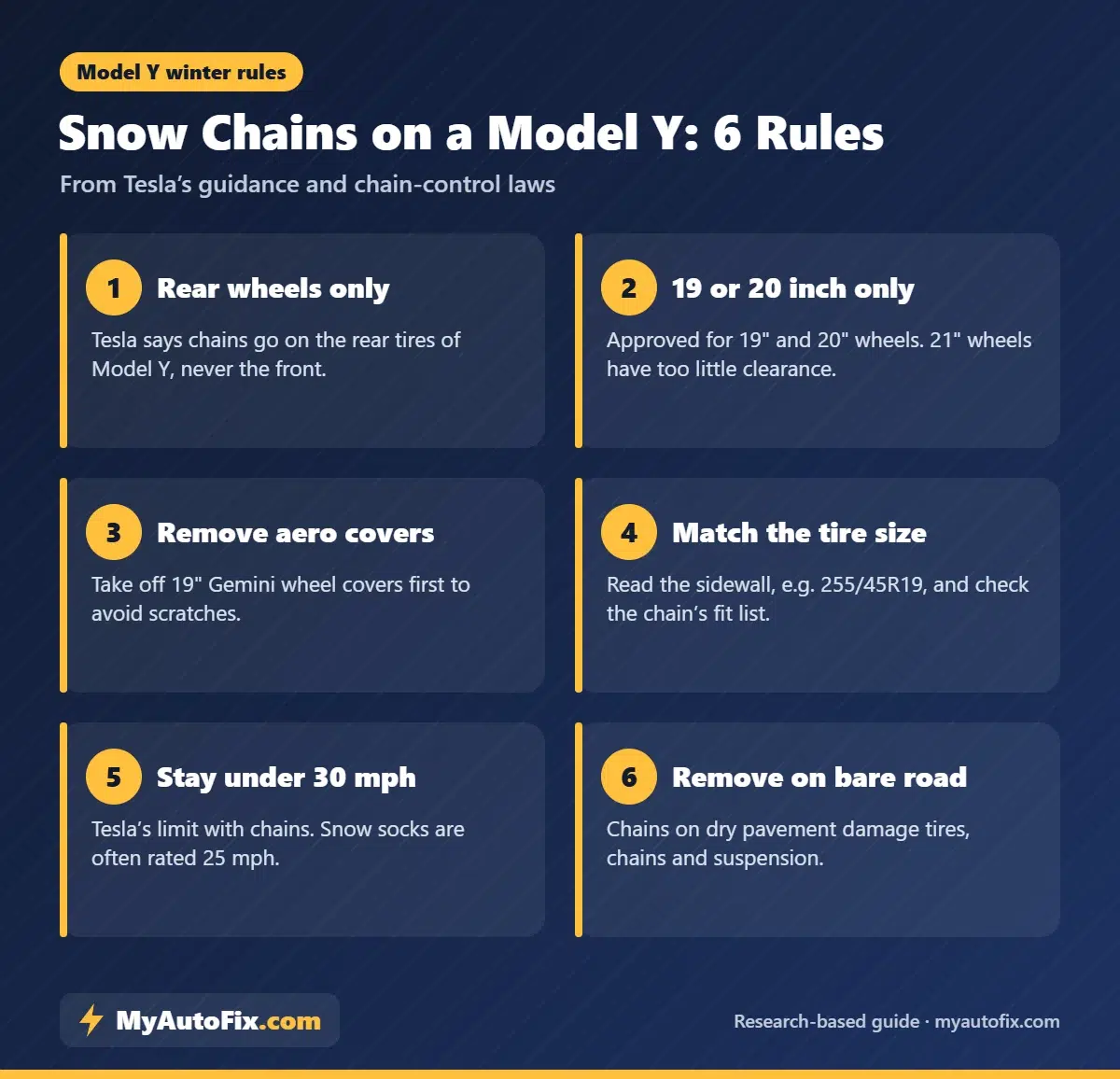
- Remove aero covers. On 19-inch Gemini wheels, pop off the aero covers to prevent scratches.
- Lay out the chain. Untangle it on the ground with the hooks and fasteners facing out, so you can see which side goes against the tire.
- Drape it over the rear tire. Lift the chain over the top of the tire and tuck the inner cable behind it, keeping it centered on the tread.
- Connect the inner and outer fasteners. Join the inner cable first, then the outer side, following the instructions printed on the bag.
- Tension the chain. Engage the self-tensioner, or pull the manual tensioner tight and secure the excess.
- Repeat on the other rear tire. Do not fit chains to the front tires of a Model Y.
- Drive a short distance and check. Roll forward slowly for about 100 feet, stop, and check that both chains are centered and tight. Retighten manual chains.
Safety: Tesla says not to exceed 30 mph (50 km/h) with chains fitted. Avoid hard acceleration, which can spin the chains against the wheel well, and remove chains as soon as you reach clear pavement.
Driving a Model Y With Chains: Settings That Help
- Use Chill mode. Smoother acceleration reduces wheel spin and chain slap.
- Set regenerative braking to low, if your car offers the option. Strong regen can slow the rear wheels abruptly on snow, especially with chains on the rear axle only.
- Turn on Slip Start only when stuck. It allows some wheel spin to help you get moving in deep snow, then turn it off.
- Precondition the battery. A warm battery delivers power more smoothly and recovers regen sooner. See our guide on EV reduced-power warnings for why cold batteries limit power.
- Keep tire pressure correct. Pressure drops in the cold. Check with a reliable tire pressure gauge before you leave.
Chain-Control Rules: When You Must Use Them
Chain controls vary by place and change with the weather. California is the best-known example, with three levels:
- R1: chains, traction devices or snow tires are required on the drive axle of all vehicles except four-wheel or all-wheel drive vehicles.
- R2: chains or traction devices are required on all vehicles except AWD/4WD vehicles with snow-tread tires on all four wheels. Those vehicles must still carry chains.
- R3: chains or traction devices are required on all vehicles, with no exceptions. Roads are often closed at this point.
In practice, a dual-motor Model Y with M+S or three-peak mountain snowflake tires can usually pass R1 and R2, but you are expected to carry approved chains. A rear-wheel-drive Model Y is treated like any two-wheel-drive car. Washington, Colorado and British Columbia have their own traction-tire and chain laws, so check each before you go.
Snow Chains vs Winter Tires on a Model Y
Chains are an emergency and legal-compliance tool. Winter tires are what actually make a Model Y safe and confident through a snowy season. A set of dedicated winter tires on 19-inch wheels transforms braking and cornering on cold roads, even when there is no snow. If you live where it snows every week, start with winter tires, and carry chains or socks for mountain passes and chain controls. Our guide to reliable tires for snowy conditions explains the differences, and our EV replacement tire guide covers load ratings and noise.
Tesla’s Own Model Y Snow Chains vs Aftermarket
Tesla sells its own “Model Y 19″/20″ Snow Chains” through the Tesla Shop, approved for Tesla-manufactured 19-inch and 20-inch wheels and Tesla-approved tires. The kit includes a pair of chains and a storage case. The big advantage is certainty: if you bought your car with factory wheels and tires, the Tesla kit is designed for exactly that setup, and Tesla’s fitting notes (rear only, remove the Gemini covers, stay under 30 mph) come with it.
Aftermarket chains like the König XG-12 Pro are widely available, often easier to find in a hurry at auto parts stores and online, and supported by detailed size charts if you’ve changed wheels or tires. Snow socks are cheaper and easier still. There’s no single right answer: if you want the official option and live near a Tesla service center, the Tesla kit is a sensible buy; if you need chains quickly or have non-factory tires, a correctly sized König set is the usual alternative.
Do Snow Chains Reduce Model Y Range?
Yes, a little, though the bigger range loss in winter comes from cold itself. Chains add rolling resistance and weight, and you’ll be driving slowly on snow, often with heat running hard. Snowy mountain roads also mean climbing, which uses more energy, although some of it comes back through regenerative braking on the descent. Plan for noticeably less range than the car’s estimate on a winter mountain trip, and arrive at the chain-up area with a healthy margin. Preconditioning the battery before you leave, and charging to a higher level than usual for that day, both help.
How to Remove Snow Chains
- Stop on a clear, safe surface. Use a chain removal area or wide shoulder once the road is clear of snow.
- Release the tension. Undo the self-tensioner or manual tensioner first so the chain goes slack.
- Unhook the outer, then inner fasteners. Work from the outside in, keeping your hands away from the moving parts of the vehicle.
- Drive forward off the chain. Roll the car slowly forward a few feet so the chain lies flat behind the tire, then pull it away.
- Refit the aero covers. Put the Gemini wheel covers back on once the chains are off.
- Rinse and dry before storing. Salt and moisture cause rust; dry chains completely before bagging them.
Model Y Winter Road-Trip Kit
- Snow chains or socks sized for your tires, plus a pair of waterproof gloves and a kneeling mat.
- A headlamp, since chain-ups often happen in the dark.
- A good snow brush and ice scraper.
- A portable tire inflator and a tire repair kit, because most Model Ys have no spare.
- Blanket, water, snacks and a phone charger in case you’re held at a closure.
Common Mistakes With Tesla Snow Chains
- Buying by wheel size alone. Two 19-inch tires can need different chain sizes. Match the full tire size.
- Fitting chains to the front. Tesla specifies rear only on Model Y.
- Leaving aero covers on. Chains can scratch them; remove them first.
- Driving too fast. Above the rated speed, chains can break and whip into the bodywork.
- Driving on bare pavement. It destroys chains and socks and can damage tires.
- Never practicing. The first install should happen at home, not on a mountain pass.
- Storing chains wet. Rinse and dry them after use so they don’t rust in the frunk.
After the Trip: Care and Storage
- Rinse chains in warm water to remove salt and grit, then dry them fully.
- Inspect for broken links, worn cables or torn fabric before putting them away.
- Store in the supplied bag, in the frunk or trunk, so they’re ready next time.
- Check tire tread and look for scuffs on the sidewalls. Uneven wear can be a sign of other issues; see EV uneven tire wear.
Frequently Asked Questions
What snow chains does Tesla recommend for Model Y?
Tesla has historically pointed Model 3 and Model Y owners to König XG-12 Pro chains (size 252 for Model Y 19-inch and 20-inch tires) and also sells its own Model Y 19″/20″ snow chains. Chains should go on the rear wheels only.
Can you put snow chains on a Model Y with 21-inch wheels?
Tesla does not approve chains for the 21-inch Überturbine wheels because there isn’t enough clearance. If you drive in chain-control areas, a set of 19-inch or 20-inch winter wheels is the safer choice.
Do Model Y snow chains go on the front or rear?
Rear only. Tesla specifies that chains be installed only on the rear wheels of Model Y, even on dual-motor AWD versions.
How fast can I drive with chains on a Tesla?
Tesla says not to exceed 30 mph (50 km/h) with chains. Many snow socks are rated for about 25 mph.
Are snow socks legal instead of chains?
It depends on the state or province. Some list textile socks such as AutoSock as approved traction devices; others require true chains. Check your DOT’s rules before the trip.
Do I need chains if my Model Y is AWD?
Often not, but you may need to carry them. In California, for example, AWD vehicles with snow-tread tires on all four wheels can usually pass R2 chain controls but must carry chains, and R3 controls require chains on all vehicles.
Should I remove the Gemini wheel covers before fitting chains?
Yes. Tesla recommends removing the aero covers on 19-inch Gemini wheels before installing chains to avoid scratches and scuffs.
Will snow chains damage my Tesla?
Correctly sized, approved chains fitted to the rear wheels and driven slowly on snow should not. Damage happens with wrong sizes, loose chains, front-wheel fitting or driving on bare pavement.
Does Tesla sell its own Model Y snow chains?
Yes. Tesla sells Model Y 19″/20″ Snow Chains approved for Tesla-manufactured 19-inch and 20-inch wheels with Tesla-approved tires, including a pair of chains and a storage case.
Do snow chains reduce EV range?
Slightly, through extra rolling resistance, but cold temperatures and heating usually affect range far more. Precondition and charge higher before a snowy trip.
The Bottom Line
For most owners, the König XG-12 Pro (in the size listed for your tires, commonly 252 for stock 19-inch tires) is the best snow chain for Tesla Model Y on 19-inch and 20-inch wheels: low-profile, self-tensioning and the chain Tesla has pointed owners to. If you only need traction a few days a year, ISSE size 70 snow socks are far easier to fit and store. For a compact get-unstuck kit, the Qoosea strap-on chains fit without moving the car, but they are an emergency aid, not a replacement for proper chains. Whatever you buy, fit it to the rear wheels only, match your exact tire size and keep it under 30 mph.
Best Overall: König XG-12 Pro Easiest: ISSE Socks Emergency: Qoosea Straps
More EV Guides
7 Best Outdoor Level 2 EV Chargers of 2026 (Weatherproof Picks)
The best outdoor Level 2 EV chargers for driveways and carports: Grizzl-E, ChargePoint, Autel and EVIQO compared by amps, weather rating and…
VW ID.4 Battery Recall: Fire Risk, 80% Charge Limit and What to Do
The VW ID.4 battery recall explained: which 2023–2026 ID.4s are covered, the fire risk, the 80% charge limit advice and what the…
Nissan LEAF Rapidgate: Why Fast Charging Slows Down and How to Cope
Nissan LEAF rapidgate explained: why repeated DC fast charging slows on air-cooled LEAF batteries, which models are affected and road-trip tips that…