
Repair Guide
Car Battery Dies in Cold Weather? Why It Happens and How to Stop It
As an Amazon Associate I earn from qualifying purchases. We may earn a commission if you buy through links on this page, at no extra cost to you. Learn more.
If your car battery dies in cold weather, you’re far from alone; dead batteries are one of the most common reasons for winter roadside calls. Cold slows the chemical reaction inside a lead-acid battery, so it delivers less power just when a cold, thick-oiled engine needs more to crank. A battery that was borderline in autumn often fails on the first truly cold morning. This guide explains what’s really happening, how to tell whether the battery, the alternator or a hidden drain is to blame, how to jump-start safely, and how to make sure it doesn’t happen again.
Quick answer
- Cold reduces battery power and makes engines harder to crank, so weak batteries fail first.
- Test the battery before winter; most last about 3–5 years.
- A battery that dies repeatedly may have a charging fault or a parasitic drain.
- Carry a jump starter, and use a maintainer for cars that sit.
In this guide
For more official guidance, see FuelEconomy.gov’s cold-weather driving guide.
Why Cold Weather Kills Car Batteries
A lead-acid battery makes electricity through a chemical reaction. In the cold, that reaction slows down, so the battery can deliver less current. At the same time, engine oil thickens in the cold, so the starter needs more power to turn the engine. That double hit is why a battery that started the car fine in October may fail in January. Battery makers commonly say a battery can lose a large share of its starting power at freezing temperatures and even more near 0°F.
Short trips make it worse. Starting uses a lot of energy, and short winter drives with heaters, defrosters, heated seats and lights running don’t give the alternator time to recharge the battery fully. Over days, the battery’s charge drifts down until one cold morning it can’t start the car.
Battery, Alternator or Drain? How to Tell
| Symptom | Likely cause |
|---|---|
| Slow crank on cold mornings, fine later | Aging or weak battery |
| Clicking but no crank | Very low battery or poor connection |
| Dies after sitting a few days | Parasitic drain or weak battery |
| Battery light on while driving | Charging system (alternator) fault |
| Dim headlights at idle, brighter when revving | Weak alternator or loose belt |
| New battery dies again | Drain or charging problem, not the battery |
How to Test Your Battery in Five Minutes
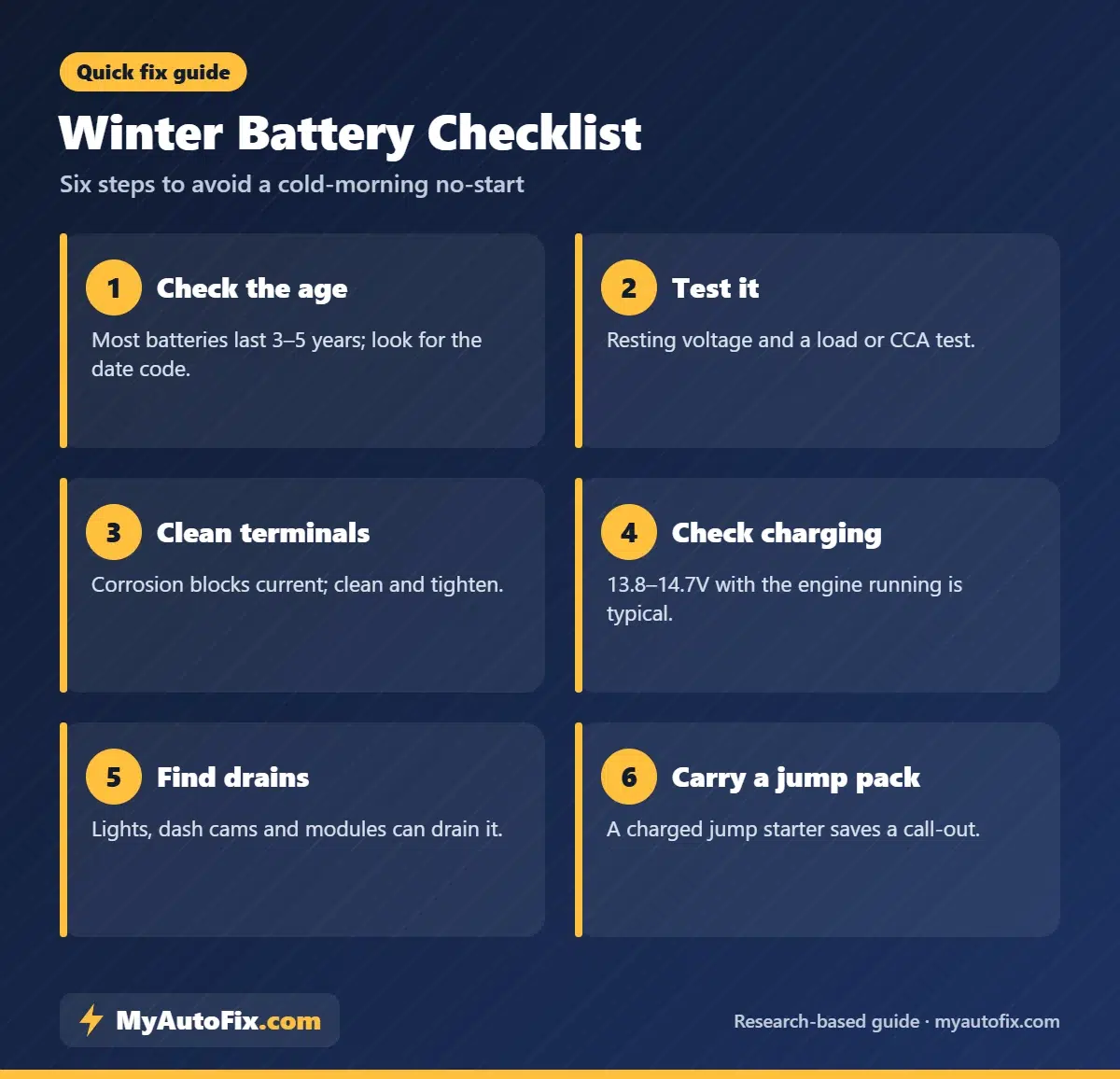
- Let the car sit for an hour. Surface charge from driving can make a weak battery look healthy.
- Check resting voltage. With a multimeter on the terminals: about 12.6V is fully charged, 12.4V is about 75%, 12.0V or lower is significantly discharged.
- Load or CCA test. A battery tester such as the ANCEL BA101 estimates cold-cranking capability and health. Many parts stores test batteries free.
- Check charging voltage. Start the engine; voltage should rise to roughly 13.8–14.7V. Lower suggests an alternator or belt problem.
- Inspect terminals. White or green crust, loose clamps or damaged cables can block current even with a good battery.
For tool options, see our guides to the best 12V battery testers and best automotive multimeters.
How to Jump-Start Safely
- Use a portable jump starter if possible. It avoids another car and is safer. The NOCO Boost GB40 is a popular compact option.
- Turn off everything. Lights, heater, radio and accessories.
- Connect red to positive. Attach the red clamp to the dead battery’s positive terminal.
- Connect black to ground. Attach the black clamp to an unpainted metal point on the engine or the negative terminal, as your manual specifies.
- Power on and start. Turn on the jump starter, wait a few seconds, then crank. Limit cranking to about 5 seconds at a time.
- Remove clamps in reverse. Black first, then red. Drive for at least 20–30 minutes to recharge.
Never jump a frozen battery. If the case is bulging or you see ice inside, it can crack or explode. Let it thaw and replace it.
The Tricky Cause: A Hidden Parasitic Drain
If a battery tests good but keeps dying after the car sits, something may be drawing power with the car off: a glovebox or trunk light that stays on, an aftermarket dash cam, a faulty module that doesn’t sleep, or a sticking relay. To find it, a mechanic (or a confident DIYer) measures current draw with a multimeter in series with the negative cable after the car has gone to sleep, then pulls fuses one at a time to see which circuit drops the draw. Most modern cars draw only a small amount once asleep; much higher draw indicates a problem.
How to Prevent Winter Battery Failures
- Test before winter and replace a battery that’s weak or over five years old.
- Use a maintainer on cars that sit for days, such as the NOCO GENIUS5. See our battery maintainer guide.
- Take longer drives occasionally, or combine short trips.
- Clean and tighten terminals.
- Park in a garage if you can; even an unheated garage is warmer.
- Carry a charged jump starter; see the best portable jump starters.
Choosing a Replacement Battery
Match the group size, terminal layout and battery type (flooded, EFB or AGM) your car specifies. In cold climates, choose a battery that meets or exceeds the original cold-cranking amp (CCA) rating. Cars with start-stop systems usually need AGM or EFB batteries, and some require the new battery to be registered with the car’s computer.
Electric car? EVs have a small 12V battery that can also fail in winter. See our guide to an EV 12V battery that keeps dying.
The Bottom Line
If your car battery dies in cold weather, test it, clean the terminals, check charging voltage and look for drains. A battery that’s more than four or five years old is usually due for replacement before winter. Keep a jump starter in the car, and a car battery that dies in cold weather becomes an inconvenience rather than a crisis.
Frequently Asked Questions
Why does my car battery die when it’s cold?
Cold slows the battery’s chemical reaction and thickens engine oil, so a weak battery can’t deliver enough power to start the engine.
How long does a car battery last?
Typically about 3–5 years, less in very hot climates and with lots of short trips.
Can a dead battery be recharged?
Often yes, with a smart charger. But a battery that has been deeply discharged several times may have lost capacity and should be tested.
How long should I drive after a jump-start?
At least 20–30 minutes of steady driving helps recharge, but a charger is more effective for a deeply drained battery.
Do battery blankets help?
Yes, in very cold climates, battery warmers and engine block heaters make starting easier.
More Repair Guides

Windshield Fogging Up Inside? How to Clear It Fast and Stop It Coming Back
Windshield fogging up inside? The fastest way to defog with A/C and fresh air, why recirculation makes it worse, and how to…

Frozen Car Door Won’t Open? 8 Safe Ways to Get In (and Stop It Happening Again)
Frozen car door won't open? Safe ways to free frozen seals, handles and locks without tearing rubber or breaking handles, plus EV…
Car Heater Blowing Cold Air? 7 Causes and the Fixes That Actually Work
Car heater blowing cold air? Diagnose low coolant, air pockets, a stuck thermostat, a clogged heater core or a bad blend door…