

Repair Guide
Car Heater Blowing Cold Air? 7 Causes and the Fixes That Actually Work
As an Amazon Associate I earn from qualifying purchases. We may earn a commission if you buy through links on this page, at no extra cost to you. Learn more.
Few things are worse on a freezing morning than a car heater blowing cold air. Your car’s heater uses hot engine coolant flowing through a small radiator behind the dashboard, called the heater core, so almost every “no heat” problem comes down to three things: not enough hot coolant, coolant that can’t flow through the core, or a door in the dashboard that sends air the wrong way. This guide shows you the quick checks that pinpoint the cause in minutes, including a simple two-hose touch test that most people have never heard of, and how to fix each problem.
Quick answer
- Check the coolant level first (engine cold). Low coolant is the most common cause.
- Air trapped in the cooling system after a repair often stops heat; it needs burping.
- A stuck-open thermostat keeps the engine too cool; watch for a low temperature gauge.
- If the engine is hot but air is cold, suspect a clogged heater core or a faulty blend door.
In this guide
Before you start, remember that coolant is hot and pressurized when the engine is warm. Only open the radiator or reservoir cap with the engine cold. For general cold-weather car tips, see FuelEconomy.gov’s cold-weather driving guide.
How Your Car Heater Works
Your engine’s water pump circulates coolant through the engine, where it absorbs heat. Some of that hot coolant flows through two rubber hoses to the heater core, a small radiator inside the dashboard. When you turn the temperature knob to hot, a blend door directs air from the blower fan through the heater core, warming it before it reaches the vents. If the coolant isn’t hot, isn’t flowing through the core, or the air bypasses the core, you get cold air.
Symptoms and What They Point To
| Symptom | Most likely cause |
|---|---|
| Cold air and temperature gauge stays low | Stuck-open thermostat |
| Cold air, gauge normal, coolant low | Low coolant or leak |
| Heat comes and goes, gurgling behind the dash | Air pocket in the system |
| Heat only when revving the engine | Low coolant, air pocket or weak water pump |
| Engine hot, both heater hoses hot, air cold | Blend door or actuator |
| Engine hot, one heater hose cold | Clogged heater core or air lock |
| Heat on one side only | Dual-zone blend door actuator |
| Sweet smell, foggy windows, damp carpet | Leaking heater core |
The 7 Most Common Causes
1. Low coolant
If the coolant is low, the heater core is often the first place to lose circulation because it sits high in the system. Check the reservoir with the engine cold and top up with the coolant type in your manual. If it keeps dropping, find the leak: look under the car, around hoses, the radiator and the water pump.
2. Air trapped in the cooling system
After a coolant change, hose replacement or topping up a very low system, air can get trapped in the heater core. You’ll often hear gurgling behind the dash. The fix is to “burp” the system so the air rises out, explained below.
3. Thermostat stuck open
The thermostat keeps coolant in the engine until it warms up. If it sticks open, coolant constantly flows through the radiator and the engine never gets hot enough, especially in winter. Signs include a temperature gauge that stays low and lukewarm heat on the highway. Replacing a thermostat is a common DIY job on many cars.
4. Clogged heater core
Over years, old coolant, rust and sealant products can clog the heater core’s tiny passages. The engine runs at normal temperature, but the air is lukewarm. A flush can sometimes clear it; badly blocked cores need replacing, which is often a big dashboard-removal job.
5. Blend door or actuator failure
On most modern cars, a small electric motor called an actuator moves the blend door. When its plastic gears strip, you may hear clicking behind the dash and the air stays cold (or hot). Some cars let you recalibrate the actuators by disconnecting the battery or running a calibration routine; others need a new actuator.
6. Weak water pump
A worn impeller or failing pump circulates less coolant. Heat may improve when you rev the engine. Watch for overheating, coolant leaks from the pump weep hole or noise.
7. Blower or climate control fault
If no air comes out at all, the problem is the blower motor, its resistor or a fuse, not heat. If the controls behave oddly, a control-panel fault is possible. An OBD2 scanner that reads body and HVAC codes can help on newer cars.
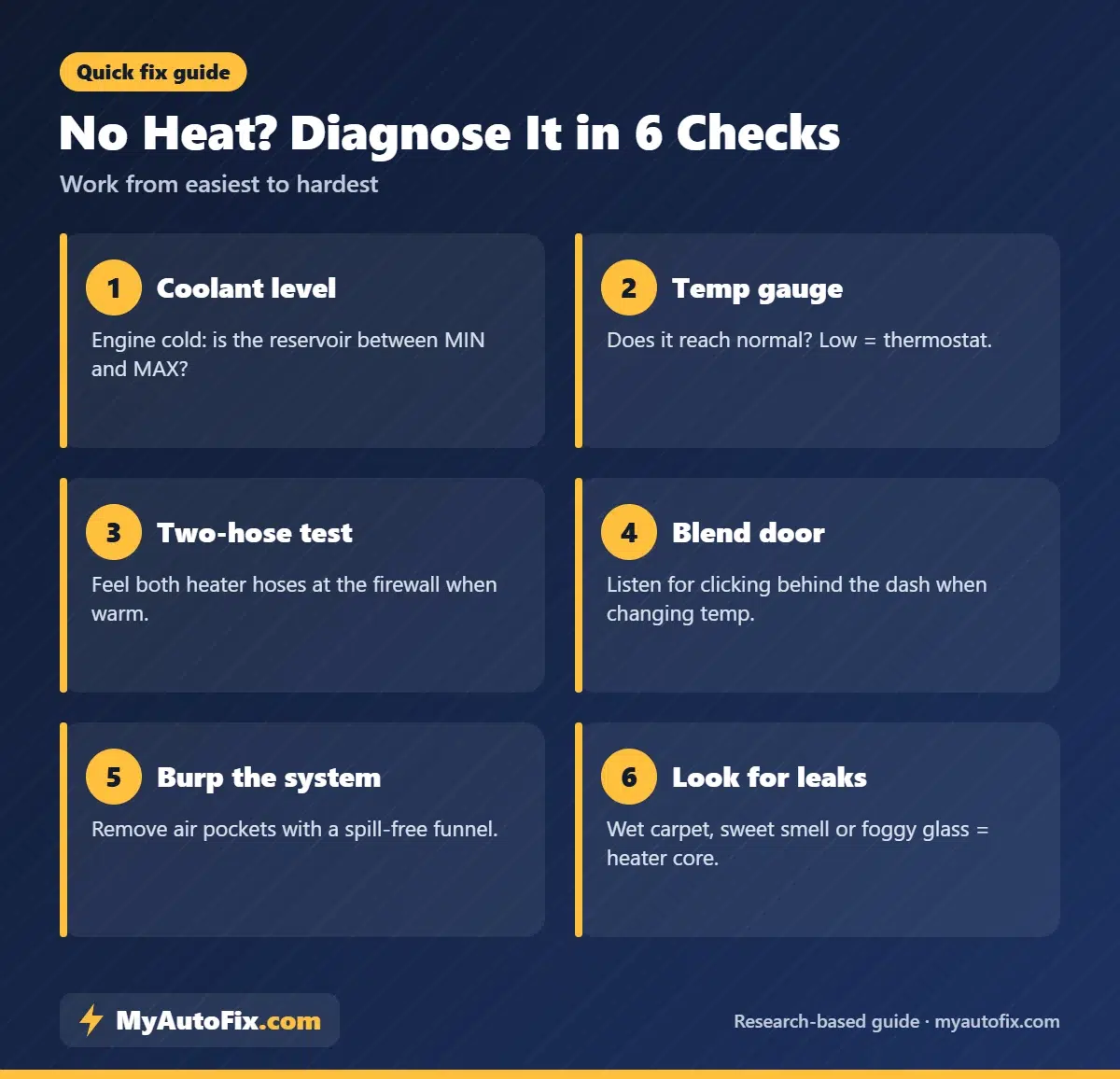
The Tricky Trick: The Two-Hose Touch Test
This test tells you, in about a minute, whether the problem is coolant flow or airflow. Warm the engine to normal temperature with the heater on hot. Locate the two heater hoses where they pass through the firewall at the back of the engine bay. Carefully touch both hoses (they can be hot, so tap them quickly or use an infrared thermometer).
| Result | What it means |
|---|---|
| Both hoses hot | Coolant is flowing through the heater core; the problem is airflow: blend door, actuator or controls |
| One hot, one much cooler | Coolant isn’t flowing through the core: clog or air pocket |
| Both lukewarm | Engine not hot: low coolant or stuck-open thermostat |
Careful: stay clear of the cooling fan and drive belts, which can start without warning, and don’t touch exhaust parts.
How to Burp Air Out of the Cooling System
- Park nose-up if possible. Raising the front helps air move toward the fill point.
- Fit a spill-free funnel. A funnel that seals to the radiator or reservoir neck lets air escape without spills. Many DIYers use the Lisle 17952 spill-free funnel.
- Fill the funnel partway with coolant. Use the correct coolant type.
- Start the engine and set the heater to hot. Turn the blower to low so the heater valve (if fitted) opens.
- Watch for bubbles. As the thermostat opens, bubbles rise into the funnel. Squeeze the upper radiator hose gently to help.
- Rev gently to about 2,000 rpm a few times. This pushes trapped air out of the heater core.
- When bubbles stop, close it up. Plug the funnel, remove it, top up and refit the cap. Recheck the level when cold.
When to See a Mechanic
- The engine overheats, or the temperature gauge climbs while the heater blows cold.
- You smell coolant inside the car or have damp front carpets.
- Coolant keeps disappearing with no visible leak (possible head gasket).
- The fix requires removing the dashboard, as heater core replacement often does.
How to Prevent Heater Problems
- Change coolant on the schedule in your manual.
- Use the correct coolant type and never mix incompatible types.
- Avoid “stop leak” products unless as a last resort; they can clog the heater core.
- Fix small leaks early before air gets into the system.
- Run the heater occasionally in summer to keep the valve and core flowing.
Electric car with no heat? EVs use heat pumps or electric heaters, not engine coolant. See our guide to an EV heat pump that isn’t working.
Frequently Asked Questions
Why is my car heater blowing cold air but the engine is hot?
Coolant may not be flowing through the heater core (clog or air pocket), or the blend door isn’t directing air through it. Use the two-hose test to tell which.
Can low coolant cause no heat?
Yes. The heater core often loses coolant flow first when the level is low. Top up with the engine cold and find the leak.
Is it safe to drive with no heat?
It can be if the engine temperature is normal, but you may be unable to defrost the windshield, which is unsafe in cold weather. Fix it promptly.
How much does a heater core replacement cost?
It varies widely because many cars require removing the dashboard. Get quotes; a flush or burping may solve it first.
Why does my heater only work when I accelerate?
Low coolant, an air pocket or a weak water pump reduces flow at idle. Check the coolant level and burp the system.
More Repair Guides
Tire Alignment Hacks: 6 DIY Checks Before Paying a Mechanic
Pulling, an off-center steering wheel or uneven tire wear? Use these 6 DIY alignment checks to spot problems early and know when…

Streaking Wiper Blades? Causes, Quick Fixes & How to Replace Them
Wipers streaking, chattering or smearing? Find out why, try these quick fixes, and learn how to replace wiper blades in under 5…
Tire Cupping Explained: Causes, Fixes and Prevention Tips
Tire cupping causes humming noise and vibration. Learn what causes cupped tires, how to spot it, whether cupped tires can be fixed…