

Garage Tools · Buying Guide
6 Best Car Ramps for 2026: Oil Changes, Low Cars and Heavy SUVs
As an Amazon Associate I earn from qualifying purchases. We may earn a commission if you buy through links on this page, at no extra cost to you. Learn more.
The best car ramps make oil changes, underbody inspections and exhaust jobs faster and, in many ways, safer than lifting a car with a jack. You simply drive up, set the brake, chock the wheels and slide underneath. But ramps vary enormously: some lift a heavy SUV with ease, while others are designed for low sports cars that would scrape their bumper on a steep ramp. We compared the most popular car ramps on Amazon, including heavy-duty plastic ramps, foam composite ramps for low cars and aluminum service stands, and explain weight ratings, approach angles, tire width and the routine that keeps you safe.
How we chose: we compared GVW and per-ramp ratings, approach angle, lift height, tire width, material, slip resistance, storage and owner feedback, and cross-checked published tests from Car and Driver, The Drive and SlashGear, plus manufacturer specifications. We haven’t tested each ramp ourselves for this guide, so our picks are research-based. For general maintenance schedules, see FuelEconomy.gov’s vehicle maintenance tips.
Key takeaways
- Check the GVW rating against your vehicle; ramps carry only one end of the car.
- Low cars need a long, low-angle ramp (around 11° or less).
- Plastic ramps can slide on smooth floors; use rubber mats.
- Always set the brake, chock the wheels and drive on slowly.
Our Top Car Ramp Picks at a Glance
- Best OverallRhinoRamps MAX 11912ABMI (16,000 lb GVW)Check Price
- Best ValueRhinoRamps 11909ABMI (12,000 lb GVW)Check Price
- Best for Trailering Low CarsRace Ramps Foam Trailer Loading Ramps for Low-Profile CarsCheck Price
- Best Budget Low-ProfileRage Powersports ML-1066 66″ Low-Profile Sports Car RampsCheck Price
- Best Budget Service RampsCar Service Ramps (7,500 lb GAWR, 6.5-Inch Lift)Check Price
- Best for Long JobsRage Powersports CR-7214 Aluminum Service Stands With Removable RampsCheck Price
In this guide
Car Ramp Comparison
| Ramp | Rating | Lift | Material | Best for |
|---|---|---|---|---|
| RhinoRamps MAX | 16,000 lb GVW | Standard | Plastic | Most vehicles |
| RhinoRamps 11909 | 12,000 lb GVW | Standard | Plastic | Cars, crossovers |
| Race Ramps trailer ramps | Check listing | Loading ramp | Foam composite | Trailering low cars |
| Rage ML-1066 66″ | Check listing | About 7 in | Composite | Low cars, budget |
| Service ramps 7,500 lb | 7,500 lb GAWR | About 6.5 in | Plastic | Routine oil changes |
| Rage CR-7214 | Check listing | Low | Aluminum | Long jobs, low cars |
Which Car Ramp Is Right for You?
- You change oil on a normal sedan or crossover: the 12,000 lb RhinoRamps are all you need.
- You have an SUV, pickup or EV: go for the RhinoRamps MAX for its 16,000 lb GVW rating.
- Your car scrapes on driveways: choose a low-angle service ramp like the Rage 66-inch ramps.
- You work under the car for hours or days: service stands such as the Rage CR-7214 give clear access once the ramps are removed.
- You want a budget pair for routine oil changes: the 7,500 lb service ramps cover most cars and small crossovers.
- You load a low car onto a trailer: Race Ramps foam trailer loading ramps.
Whichever you choose, pair your ramps with a quality tire pressure gauge and a few basic tools, and you can handle most routine maintenance at home. Keeping on top of fluid changes and inspections is one of the easiest ways to prevent expensive repairs later.
The Best Car Ramps, Reviewed
1. RhinoRamps MAX 11912ABMI (16,000 lb GVW)
RhinoRamps have been the default plastic car ramp in American garages for years, and the MAX version is the one to get for most people. It’s rated for 16,000 lb gross vehicle weight (GVW), comfortably covering everything from compact cars to most half-ton pickups and large SUVs. Car and Driver’s gear team named the RhinoRamp MAX its best overall car ramp, and SlashGear did the same.
- Rating16,000 lb GVW per pair
- MaterialReinforced hollow-core plastic
- WeightAbout 18 lb per pair
- StorageNesting design
The ramps are made from a tough, hollow-core plastic with a honeycomb structure, which keeps them light enough to carry with one hand. The pair weighs roughly 18 lb, and the ramps nest inside each other for storage. That combination of strength and light weight is why so many DIYers keep a set for oil changes.
There are two common complaints. On smooth, sealed or epoxy-coated garage floors, plastic ramps can slide forward as you drive on. A rubber mat under each ramp, or a small amount of floor grip, solves it. And the approach angle is too steep for many lowered and sports cars, which will scrape the front bumper before the tires reach the ramp.
Who should buy it: anyone with a normal-height car, crossover, SUV or light truck who wants a light, strong, storable ramp. Skip it if: your car has less than about 5–6 inches of front clearance; look at the Rage Powersports 66-inch low-profile ramps instead.
What we like
- Very high GVW rating
- Light and easy to move
- Nests for storage
- Widely recommended by testers
Watch out for
- Can slide on smooth floors
- Too steep for low cars
Verdict: The best all-round ramp for normal-height cars, SUVs and trucks.
Check Price on Amazon2. RhinoRamps 11909ABMI (12,000 lb GVW)
If your vehicle is a car or a small-to-midsize crossover, you don’t need the 16,000 lb MAX. The standard RhinoRamps 11909ABMI are rated for 12,000 lb GVW and cost less. The Drive named them its best value car ramp.
- Rating12,000 lb GVW per pair
- MaterialHoneycomb plastic
- StorageNesting
- Best forCars and crossovers
They share the MAX’s honeycomb plastic construction, light weight and nesting storage, so they’re easy to move around a small garage or keep in a shed. For the typical oil change on a sedan or crossover, they are all you need.
The same caveats apply: put rubber mats underneath on slick floors, and check your front clearance before buying if your car sits low. As with any ramp, make sure your tire width fits within the ramp’s track and that the tire sits in the cradle at the top before you shut the car off.
Who should buy it: owners of sedans, hatchbacks and compact crossovers. Skip it if: you drive a heavy truck or full-size SUV, where the MAX’s higher rating is a better margin.
What we like
- Lower cost than MAX
- Light and nestable
- Proven design
- Plenty for most cars
Watch out for
- Lower rating than MAX
- Can slide on epoxy floors
Verdict: The smart, affordable ramp for cars and crossovers.
Check Price on Amazon3. Race Ramps Foam Trailer Loading Ramps for Low-Profile Cars
These Race Ramps are a different tool from the service ramps elsewhere in this guide. They are loading ramps: they bridge the gap between the ground and a trailer deck at a gentle angle, so a low sports car can be driven or winched aboard without the front splitter or exhaust touching.
- TypeTrailer loading ramps
- MaterialFoam composite
- UseLoading low cars onto trailers
- Rating and lengthCheck listing
Race Ramps’ solid foam-composite construction is light enough for one person to carry, will not rust, and is easy on garage floors and trailer decks. That makes them popular with track-day drivers and car-show owners who move low cars regularly.
They are not designed to hold a car up while you work underneath it. For oil changes and inspections, use service ramps or jack stands rated for your vehicle. Check the listing for the ramp length and load rating, and match the length to your trailer’s deck height so the approach angle stays low enough for your car.
Who should buy it: owners who load low cars onto trailers. Skip it if: you want ramps to work under your car; choose the RhinoRamps or the Rage low-profile service ramps instead.
What we like
- Gentle angle for low cars
- Light and rust-proof
- Floor- and deck-friendly
Watch out for
- Not for working under the car
- Length must match trailer deck height
- Premium price
Verdict: The premium choice for low cars that can’t climb ordinary ramps.
Check Price on Amazon4. Rage Powersports ML-1066 66″ Low-Profile Sports Car Ramps
The Rage Powersports ML-1066 uses a long 66-inch design to create a gentle incline for low cars at a fraction of the price of Race Ramps. The Drive named it its best low-profile ramp, noting that it lifts vehicles about seven inches and includes an integrated wheel stop.
- Length66 in
- LiftAbout 7 in
- FeatureIntegrated wheel stop
- UseLow-profile cars
The long, shallow ramp spreads the climb over more distance, which helps both with front-bumper clearance and with control as you drive up. The wheel stop at the top gives you a clear signal that you’ve gone far enough.
The trade-off for the length is storage: these are long and don’t nest as neatly as plastic RhinoRamps. Check the listing’s weight rating and maximum tire width against your vehicle, especially if you have wide performance tires.
Who should buy it: low-car owners who want a gentle ramp without paying Race Ramps prices. Skip it if: you have limited storage space.
What we like
- Gentle incline for low cars
- Wheel stop built in
- Far cheaper than foam ramps
- Good lift for oil changes
Watch out for
- Long and bulky to store
- Check tire width and rating
Verdict: An affordable low-angle ramp for sports and lowered cars.
Check Price on Amazon5. Car Service Ramps (7,500 lb GAWR, 6.5-Inch Lift)
These are straightforward plastic service ramps rated at 7,500 lb GAWR (gross axle weight rating), which is the number that matters for ramps because each pair carries one axle, not the whole car. That rating covers most sedans, hatchbacks and compact crossovers with plenty of margin.
- Rating7,500 lb GAWR (per pair)
- LiftAbout 6.5 in
- MaterialPlastic
- Best forRoutine oil changes
They lift the tires about 6.5 inches, which is enough room to slide a drain pan and a low creeper underneath for an oil change or a quick inspection. Like most plastic ramps they are light, rust-proof and easy to hang on a garage wall.
At 6.5 inches the lift is modest, and the approach angle may be too steep for cars with low front bumpers. Always check the rating against your vehicle’s front axle weight, use them on flat, hard ground, and chock the wheels that stay on the ground.
Who should buy it: sedan and compact-crossover owners who want a simple, affordable pair for routine oil changes. Skip it if: you drive a heavy SUV, pickup or EV, or a very low car; choose the RhinoRamps MAX or a low-angle ramp instead.
What we like
- Affordable
- Light and rust-proof
- Axle rating suits most cars
- Easy to store
Watch out for
- Modest lift height
- May be too steep for low bumpers
- Not for heavy trucks or large EVs
Verdict: A tough, long-lasting plastic ramp for frequent users.
Check Price on Amazon6. Rage Powersports CR-7214 Aluminum Service Stands With Removable Ramps
These aluminum stands solve a common problem with ramps: the slope gets in the way. You drive up the removable ramp sections onto flat service stands, then pull the ramps away, leaving the car on short, stable platforms with clear access around the wheels. The Drive named them its best aluminum ramp option.
- MaterialAluminum
- DesignService stands with removable ramps
- UseLow-profile cars
- BenefitClear access once ramps are removed
Aluminum is light and won’t crack like plastic, and the low-profile design suits sports cars. Removing the ramp sections gives you room to work on suspension parts and the front of the car without a ramp in your way.
They cost more than plastic ramps and take more space. As with any low-profile system, check the rated capacity against your car’s weight before buying.
Who should buy it: enthusiasts with low cars who do longer jobs under the car. Skip it if: you just want quick oil changes on a normal-height car.
What we like
- Ramps remove for better access
- Won’t crack
- Suits low cars
- Stable platforms
Watch out for
- Pricier than plastic
- Takes more storage space
Verdict: A clever stand-and-ramp system for low cars and longer jobs.
Check Price on AmazonNeed one set that fits almost anything? The RhinoRamps MAX is rated for 16,000 lb GVW, weighs about 18 lb a pair and nests for storage.
How to Choose the Best Car Ramps
1. Weight rating: GVW vs per-ramp
Ramp ratings are confusing because brands use different methods. Some list gross vehicle weight (GVW), which is the total weight of the vehicle the pair is designed for. Others list a single-axle or per-ramp capacity. A 12,000 lb GVW pair, for example, is designed to hold about 6,000 lb on the two ramps, because only one end of the vehicle is lifted. Some low-profile ramps are rated at about 1,500 lb per ramp, which works out to roughly a 6,000 lb GVW rating for the pair. Always compare the rating with your vehicle’s curb weight from the door-jamb sticker, and leave a healthy margin.
2. Approach angle
The approach angle determines whether your front bumper or splitter will hit the ramp before the tire climbs it. Most standard plastic ramps are steep, at around 17 degrees. Low-profile ramps use a longer length to get below about 11 degrees. To check your car, lay a straight edge from the front tire’s contact patch up to the lowest point of the bumper and measure the angle or clearance, the “yardstick method” Race Ramps recommends.
3. Lift height
More lift gives you more room to work, but it requires a longer or steeper ramp. For oil changes, 6–8 inches of lift is enough for most people with a low creeper. If you need more room, use ramps for the front and add jack stands for the rear, or use service stands.
4. Tire width
Measure your tire tread width or read it from the sidewall (the first number, in millimeters). A 255 tire is about 10 inches wide. The tire must sit fully within the ramp’s track; overhanging tires can damage the sidewall and make the car unstable.
5. Material and storage
- Hollow plastic (RhinoRamps): light, strong and nestable, but can slide on smooth floors.
- Solid foam composite (Race Ramps): light, grippy and won’t crack, but expensive and lower-rated.
- Steel: strong but heavy, and can slide or rust.
- Aluminum stands: light and rigid, good for low cars and long jobs, but pricier.
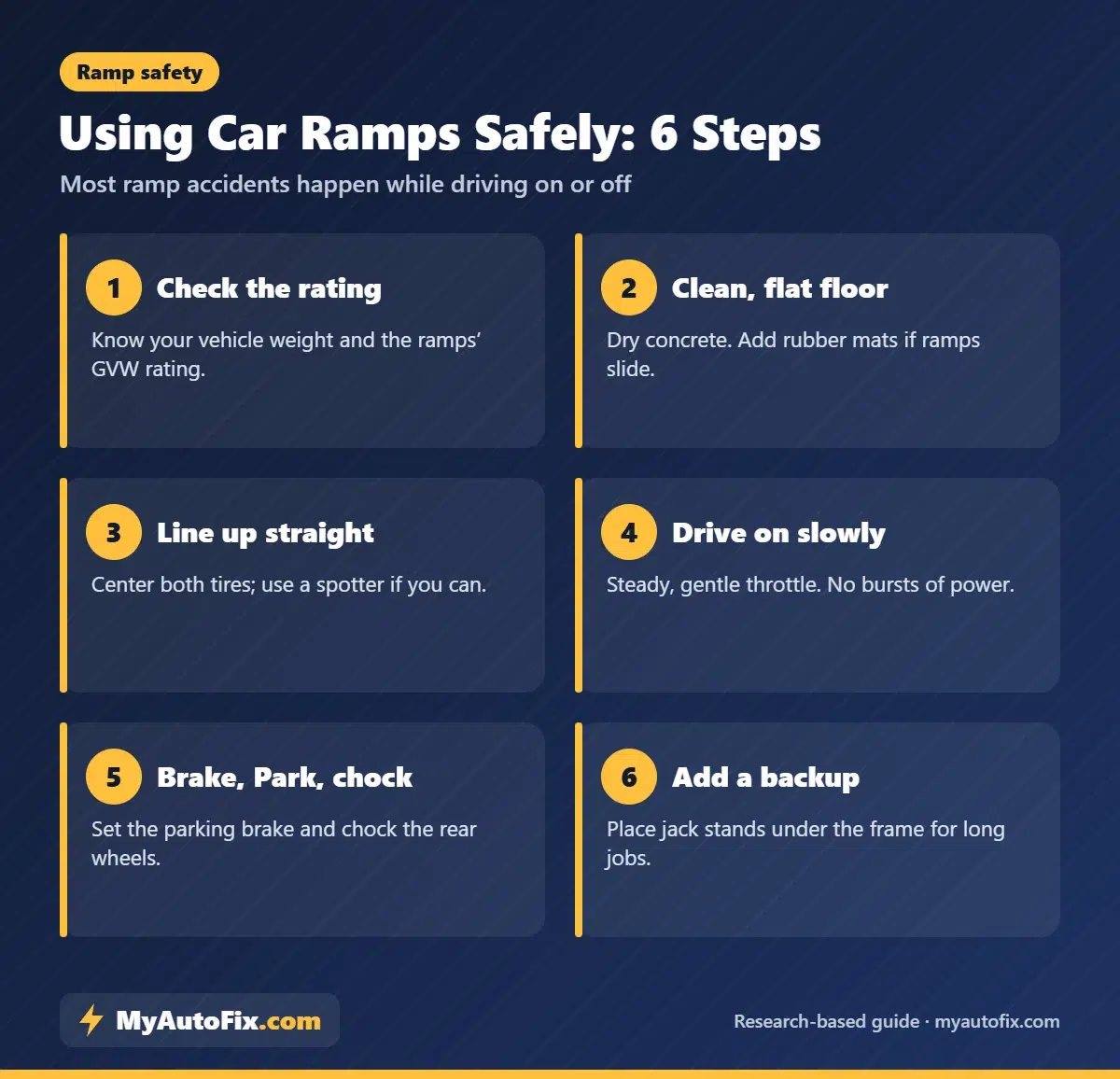
How to Use Car Ramps Safely: Step by Step
- Check the floor. Use a clean, dry, level concrete surface. Sweep away grit, oil and water.
- Position the ramps. Line them up squarely with the front tires, touching the tire tread. Put rubber mats under plastic ramps on smooth floors.
- Get a spotter. A helper can watch both tires and tell you when to stop.
- Drive on slowly and straight. Use gentle, steady throttle. If a ramp shifts or a tire isn’t centered, back off and reset.
- Stop in the cradle. Feel the tire settle into the dip at the top or touch the wheel stop. Don’t overshoot.
- Secure the car. Put the car in Park (or in gear for a manual), set the parking brake and turn off the engine.
- Chock the rear wheels. Chock both sides of the wheels still on the ground.
- Add backup support for longer jobs. Place jack stands under the frame or support points as a second layer of safety.
- Back off carefully. When finished, remove tools and stands, then reverse slowly and straight down the ramps.
Electric cars and powerful cars: instant torque can shove plastic ramps forward. Use Chill or Eco mode, a feather-light throttle, and anti-slip mats.
How to Do an Oil Change on Ramps
Ramps are made for oil changes. Here is the basic routine; always follow your vehicle’s manual for oil type and capacity.
- Warm the engine briefly. Warm oil drains faster, but don’t work on a hot exhaust.
- Drive onto the ramps and secure the car. Follow the safety steps above.
- Position a drain pan. Place it under the drain plug, offset slightly because oil flows out at an angle.
- Remove the drain plug. Use the correct socket, loosen it, then unscrew by hand while pushing inward until the last thread.
- Replace the filter. Let the old filter drain, lubricate the new filter’s gasket with fresh oil and tighten by hand per the instructions.
- Reinstall the plug. Use a new crush washer if specified and tighten to the correct torque.
- Refill and check. Add oil through the filler cap, run the engine briefly, check for leaks, then check the level on the dipstick once the car is level again.
Recycle your old oil at an auto parts store or local collection site. If you see a check-engine light after a service, our guide to fixing a check engine light and our OBD2 scanner picks will help.
Ramps, Jack Stands or Both?
Ramps are faster for jobs where the wheels stay on: oil changes, inspections, exhaust work and fluid checks. As soon as you need to remove wheels, for brakes, suspension or tire work, you need a floor jack and jack stands. Many home mechanics own both. If you lift with a jack, a low-profile floor jack fits under more cars.
Which Ramp Rating Does Your Vehicle Need?
Check the curb weight on your door-jamb sticker or in the owner’s manual, then use this as a guide. When in doubt, choose the higher rating.
| Vehicle | Typical curb weight | Suggested ramp |
|---|---|---|
| Light sports car or compact | 2,500–3,000 lb | Low-profile service ramps |
| Midsize sedan or small crossover | 3,000–4,000 lb | RhinoRamps 12,000 lb GVW |
| Electric crossover or midsize SUV | 4,000–5,000 lb | RhinoRamps MAX 16,000 lb GVW |
| Full-size SUV or half-ton pickup | 5,000–6,000 lb | RhinoRamps MAX or heavier-duty ramps |
Car Ramps and Electric Vehicles
Electric cars don’t need oil changes, but ramps are still useful for inspecting the underbody, checking for damage to the battery’s underside after hitting debris, looking at suspension bushings and brake lines, and cleaning off winter salt. Keep three things in mind:
- Weight: EVs are heavy for their size. A Model Y-class crossover can weigh 4,000–4,600 lb, so choose a high-rated ramp like the RhinoRamps MAX.
- Torque: EVs deliver power instantly. Use the gentlest drive mode and creep onto the ramps.
- Clearance: some EVs have low front aero panels. Check the approach angle before you drive on.
For tire and brake work on an EV, use a jack with EV jack pads at the specified points and support the car on jack stands instead. Our guide to EV brake rotor rust shows what to look for while you’re under there.
Other Jobs You Can Do on Ramps
- Transmission and differential fluid checks on many vehicles (follow the manual; some must be checked level).
- Exhaust inspections and repairs, such as clamping a leaking joint. See how to fix an exhaust leak.
- Checking for leaks from the engine, transmission, coolant hoses and power steering.
- Inspecting CV boots, tie rods and sway bar links for tears and play.
- Underbody cleaning to remove road salt in winter.
- Fitting skid plates or splash shields that have come loose.
Why Not Build Your Own Ramps?
You’ll find plenty of plans for wooden ramps made from stacked lumber. They can work if built carefully from solid timber and screwed and glued, but they have real drawbacks: wood can split along the grain, layers can shift, and there’s no tested rating. Commercial ramps are inexpensive, light and rated, so for most people they’re the safer choice. Never use cinder blocks, bricks or loose boards to support a vehicle.
Real-World Tips for Using Car Ramps
- Keep ramps clean. Oil or mud on the ramp surface reduces grip.
- Use a small block for low cars. A short board in front of the ramp can reduce the initial angle so the bumper clears.
- Mark your stopping point. A piece of tape on the garage wall that lines up with your mirror helps you stop in the right place.
- Store ramps flat or nested. Prevent warping by avoiding heavy items stacked on them.
- Inspect regularly. Look for cracks, especially in plastic ramps that have been dropped or left in hot sun.
Car Ramp Mistakes to Avoid
- Exceeding the rating. Heavy SUVs, pickups and EVs need high-rated ramps.
- Using ramps on grass, gravel or a slope. Ramps can sink or tip.
- Accelerating hard. Bursts of power can launch the car over the end or push the ramps away.
- Skipping wheel chocks. A car on ramps can roll back if not secured.
- Getting under the car while it’s running. Turn it off and remove the key.
- Ignoring cracks. A cracked plastic ramp can fail suddenly. Replace it.
How to Care for Car Ramps
- Wipe off oil and dirt after each use.
- Store ramps out of direct sunlight to slow UV damage on plastic.
- Check foam ramps for gouges and plastic ramps for cracks or deformation.
- Replace ramps that have been overloaded or dropped from height.
Frequently Asked Questions
What are the best car ramps for home use?
For most cars, SUVs and light trucks, the RhinoRamps MAX (16,000 lb GVW) is the best all-round choice. For low cars, the Rage Powersports 66-inch low-profile ramps are better.
What does GVW mean on car ramps?
GVW means gross vehicle weight: the total weight of the vehicle the pair of ramps is designed for. Because ramps lift only one end, a 12,000 lb GVW pair is designed to hold about half that weight on the ramps.
Are car ramps safer than jack stands?
Ramps are very stable once the car is on them and there’s no lifting mechanism to fail. The risky moments are driving on and off. Jack stands are needed when the wheels must come off.
Why do my plastic car ramps slide?
Smooth, sealed or epoxy garage floors let plastic ramps slip as the tire pushes on them. Put a rubber mat under each ramp, or have a helper hold them as the tire first touches.
Can I use car ramps on an electric car?
Yes, if the ramps are rated for its weight and its tires fit the ramp width. EVs are heavy, so check the GVW rating and drive on gently, as instant torque can push ramps forward.
How do I know if my car is too low for ramps?
Use the yardstick method: lay a long straight edge from the front tire’s contact patch to the bumper and measure the angle or clearance. Race Ramps recommends this to choose the right approach angle.
Should I put jack stands under a car on ramps?
For quick jobs like an oil change, ramps alone are generally accepted as safe when used correctly. For longer jobs, adding jack stands under the frame as a backup is good practice.
How high do car ramps lift a car?
Typical plastic ramps lift about 6–9 inches. Low-profile ramps lift less, while some are designed specifically for higher lift.
Can I use car ramps on an epoxy garage floor?
Yes, but plastic ramps may slide. Put a rubber mat or a non-slip pad under each ramp, or choose foam composite ramps with an anti-skid base.
Do I need two people to use car ramps?
It isn’t required, but a spotter makes it much easier to keep both tires centered and to stop in the right place.
The Bottom Line
For most drivers, the RhinoRamps MAX is the best car ramp: a 16,000 lb GVW rating, light weight and nesting storage. If you only work on cars and small crossovers, the 12,000 lb RhinoRamps save money. Low-car owners should choose a low-angle service ramp such as the Rage Powersports 66-inch ramps, and if you trailer a low car, add Race Ramps foam loading ramps. Whatever you buy, check the rating, use rubber mats on smooth floors, drive on slowly and always chock the wheels.
Best Overall: RhinoRamps MAX Trailer Loading: Race Ramps Best Value: RhinoRamps 12K
More Tool Reviews

Best Cordless Impact Wrench for Lug Nuts: 8 Top Picks for 2026
The best cordless impact wrench for lug nuts: DeWalt DCF891, Milwaukee M18 FUEL 2962, high-torque and budget picks, plus how much torque…

7 Best Jack Stands for 2026: Safe, Certified Picks for Cars, SUVs and Trucks
The best jack stands for cars, SUVs and trucks: ESCO, Hein-Werner and Big Red picks, pin vs ratchet locks, capacity and height…

6 Best Trim Removal Tool Kits of 2026 (No-Scratch Pry Tools)
The best trim removal tool kits for door panels, dashboards and stereo installs: 5- to 120-piece kits compared, and how to remove…