
EV Charging · Nissan
Nissan LEAF Rapidgate: Why Fast Charging Slows Down and How to Cope
By Mozammel HussainUpdated November 6, 20269 min read
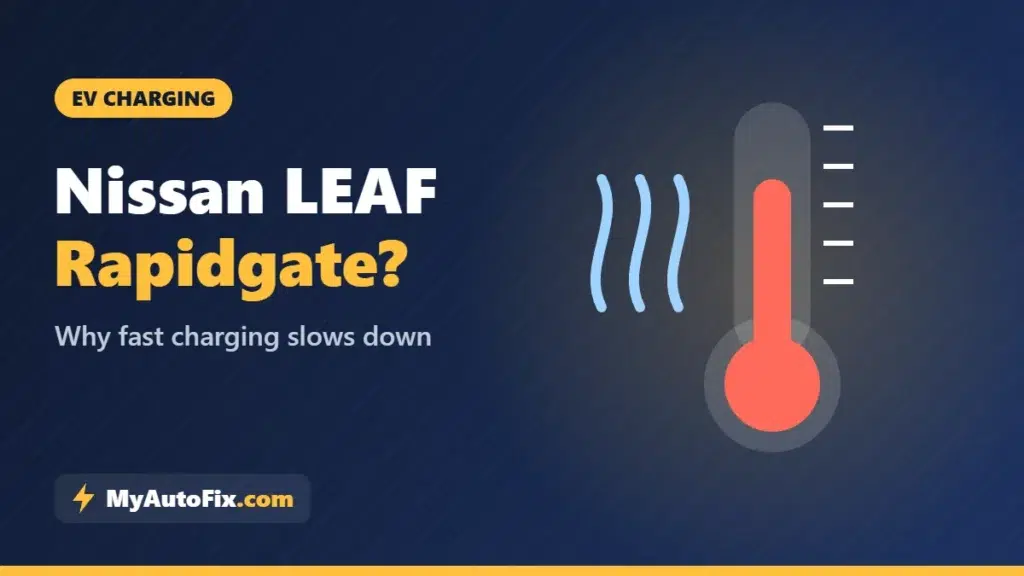
Nissan LEAF rapidgate is the nickname owners gave to a frustrating pattern: the first DC fast charge of a road trip is fine, but the second or third is painfully slow. It isn't a recall or a fault. It's how the second-generation LEAF protects a battery pack that has no liquid cooling. Here's why it happens, which LEAFs are affected, what Nissan's software update changed and how to plan trips around it.
Key takeaways
- Rapidgate affects mainly the second-generation LEAF (U.S. 2018 onward), whose battery is passively air-cooled.
- Fast charging and highway driving heat the pack; when it's hot, the car cuts charging power to protect the battery.
- A 2019 software update improved charging rates, but back-to-back fast charges can still slow sharply on hot days.
- It isn't a safety recall. Still, check your VIN for any open campaigns and keep the software current.
- The third-generation 2026 LEAF uses a liquid-cooled pack with battery warming and an NACS port, addressing the root cause.
Why Nissan LEAF Rapidgate Happens
Most modern EVs pump coolant through the battery pack to keep it in a comfortable temperature range, especially during DC fast charging. The second-generation LEAF doesn't. Its pack relies on passive air cooling, so heat from driving and fast charging builds up and leaves slowly. When the battery temperature climbs, the car reduces charging power to protect the cells. On a single fast charge this barely matters. On a road trip with several fast charges and highway driving in between, the pack can stay hot and each session gets slower.
Which LEAF Models Are Affected
| Model | Battery | Thermal management | Rapidgate risk |
|---|---|---|---|
| First-generation LEAF (2011–2017) | 24–30 kWh | Passive | Yes, but these cars rarely did multi-stop trips |
| Second-generation LEAF (U.S. 2018 onward) | 40 kWh | Passive air cooling | Yes, the main focus of rapidgate complaints |
| Second-generation LEAF Plus / e+ | 62 kWh | Passive, with more capacity | Yes, though the bigger pack reaches high temperatures less quickly |
| Third-generation LEAF (2026 onward) | Liquid-cooled pack | Active thermal management with battery warming | Designed to avoid it |
Second-generation LEAFs use a CHAdeMO fast-charging port. CHAdeMO stations are becoming less common in North America, which can make planning harder than charging speed alone.
What Nissan's Software Update Changed
After complaints in 2018, Nissan released a software update in 2019 that allowed faster charging at higher battery temperatures. It was first offered in Europe, and owners later reported it in the U.S. Independent tests found the update helped the first and sometimes second charge, but once the pack was hot, charging still slowed dramatically. Ask a Nissan dealer whether your car has the latest battery control software. Updates can still help, even though they can't change the cooling hardware.
Reading the LEAF Battery Temperature Gauge
Second-generation LEAFs have a battery temperature gauge on the instrument cluster. When it climbs into the upper segments, expect slower DC charging. Watching it on the highway lets you predict a slow stop before you arrive. Some owners use the LeafSpy app with a compatible Bluetooth OBD adapter for more detailed temperature and state-of-health data; see our OBD2 scanner guide for adapter options and check app compatibility before buying.
Road-Trip Tips for a LEAF With Rapidgate
- Start with a cool battery. Charge at home overnight and leave early, especially in summer.
- Slow down a little. Driving at 60–65 mph instead of 75 mph generates less heat and uses less energy.
- Charge to about 70–80%, not 100%. Charging slows at high states of charge anyway, and shorter sessions limit heat.
- Mix in Level 2. Use Level 2 chargers at meal stops and destinations; they add far less heat.
- Plan longer breaks. Give the battery time to cool between fast charges on hot days.
- Use charging apps. Check that CHAdeMO stations are working before you rely on them.
Our guides to why an EV is charging slowly and EV range loss in hot weather cover other heat-related effects.
Does Rapidgate Damage the Battery?
The charging limits exist to protect the battery, so the car isn't being damaged by them. Frequent high battery temperatures over many years can contribute to capacity loss in any lithium-ion battery, which is one reason passively cooled packs have historically degraded faster in hot climates. If you're buying a used LEAF, check battery health; see how to check EV battery health. Look up the VIN with the NHTSA recall lookup for any open campaigns.
Does the 2026 LEAF Fix Rapidgate?
The third-generation LEAF moves to a liquid-cooled battery pack and can warm the battery for charging, using waste heat from the motor and charger, plus a heat pump and battery heater in cold weather. It also switches to an NACS fast-charging port with a separate J1772 port for Level 2. That's the hardware change rapidgate needed. As with any new model, check real-world charging tests before buying. If you need adapters for different chargers, see NACS adapter problems.
More EV Guides
7 Best Outdoor Level 2 EV Chargers of 2026 (Weatherproof Picks)
The best outdoor Level 2 EV chargers for driveways and carports: Grizzl-E, ChargePoint, Autel and EVIQO compared by amps, weather rating and…
Read guide →
VW ID.4 Battery Recall: Fire Risk, 80% Charge Limit and What to Do
The VW ID.4 battery recall explained: which 2023–2026 ID.4s are covered, the fire risk, the 80% charge limit advice and what the…
Read guide →
Mach-E Stop Safely Now Warning: Contactor Recalls and What to Do
Seeing Mach-E Stop Safely Now? What the warning means, how the contactor recalls 22V-412 and 23V-687 fix it, which cars are covered…
Read guide →Frequently Asked Questions
What is Nissan LEAF rapidgate?
It's the slowdown in DC fast-charging speed on air-cooled LEAF batteries after the pack gets hot, especially on the second or third fast charge of a road trip.
Is rapidgate a recall?
No. It's a design characteristic of the passively cooled battery, not a safety defect. Check your VIN anyway for any unrelated open recalls.
Did Nissan fix rapidgate?
A 2019 software update improved charging at higher temperatures, but repeated fast charges can still slow sharply. The 2026 LEAF's liquid-cooled battery addresses the root cause.
Which LEAF years have rapidgate?
Mainly second-generation LEAFs sold in the U.S. from 2018, including the 62 kWh LEAF Plus. First-generation cars also have passive cooling.
How can I fast charge a LEAF faster on road trips?
Start with a cool battery, drive a little slower, charge to 70–80% instead of 100%, use Level 2 where possible and give the battery time to cool between fast charges.
Does the new LEAF use CHAdeMO?
No. The third-generation LEAF uses an NACS port for fast charging plus a J1772 port for Level 2.
The Bottom Line
Nissan LEAF rapidgate is a heat limit, not a fault. Keep the software current, watch the battery temperature gauge, drive a little slower and mix Level 2 into road trips, and a LEAF can still cover long distances, just more slowly than liquid-cooled EVs. If road trips are a priority, the liquid-cooled 2026 LEAF is the model built to avoid the problem.
Related guides
Mozammel writes maintenance guides and product research for My Auto Fix, focusing on tires, charging and everyday EV and car care. About our editorial process.