

Tires & Wheels · Maintenance Guide
Tire Rotation: Why It Matters, How Often to Do It and Which Pattern to Use
By Mozammel HussainUpdated October 13, 20268 min read
As an Amazon Associate I earn from qualifying purchases. We may earn a commission if you buy through links on this page, at no extra cost to you. Learn more.
Your front and rear tires wear at different rates. On a front-wheel-drive car the fronts handle steering, most of the braking and all of the power, so they wear much faster. Rotating the tires moves each one to a new position so they wear evenly, last longer and keep the car's handling balanced.
Key takeaways
- Most cars need a rotation about every 5,000–7,500 miles; follow your owner's manual.
- The right pattern depends on your drivetrain and whether tires are directional or staggered.
- Rotation is a good time to check tire pressure, tread depth and brakes.
- Always tighten lug nuts with a torque wrench to the specified value.
Why Tire Rotation Matters
- Longer tire life: even wear means you replace all four tires later, and at the same time.
- Better handling and braking: tires with similar tread depth give more predictable grip, especially in rain.
- Warranty: many tire tread-life warranties require proof of regular rotations.
- AWD protection: on many all-wheel-drive vehicles, big differences in tread depth between tires can strain the drivetrain.
How Often to Rotate Your Tires
The most common recommendation is every 5,000 to 7,500 miles, which for many drivers lines up with every oil change. Your owner's manual has the exact interval for your vehicle. Rotate sooner if you notice uneven wear, and always rotate a new set within the first few thousand miles.
Tire Rotation Patterns Explained
| Vehicle / tire type | Pattern | How it works |
|---|---|---|
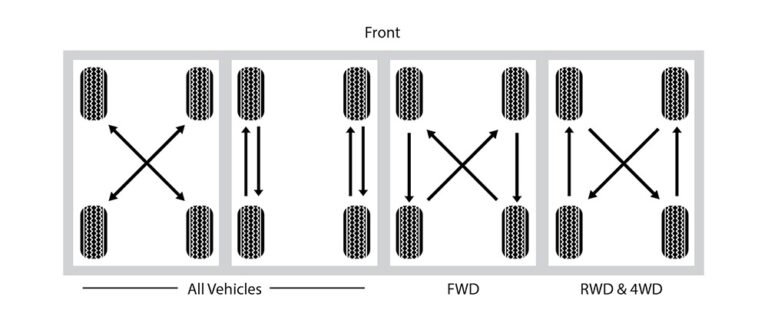
| Front-wheel drive | Forward cross | Fronts move straight back; rears cross to the opposite front. |
| Rear-wheel drive, 4WD, AWD | Rearward cross | Rears move straight forward; fronts cross to the opposite rear. |
| Any drivetrain (alternative) | X-pattern | All four tires cross diagonally. |
| Directional tires | Front-to-back | Swap front and rear on the same side only. |
| Staggered sizes (different front/rear) | Side-to-side | Swap left and right on the same axle, if tires are non-directional. |
If your vehicle has a full-size matching spare, it can be included in a five-tire rotation. Your owner's manual shows the pattern the manufacturer recommends.
How to Rotate Tires at Home
- Gather the right equipment. You need a jack, at least two (ideally four) jack stands, a lug wrench and a torque wrench. Work on flat, solid ground.
- Loosen the lug nuts first. With the car on the ground, break each lug nut loose by about half a turn.
- Lift and support the car. Jack the car at the manufacturer's lift points and set it on jack stands. Never rely on the jack alone.
- Move the tires. Remove the wheels and move them following the correct pattern for your car. Check tread depth and look for damage while they're off.
- Torque the lug nuts. Hand-tighten the nuts in a star pattern, lower the car, then torque them to the specification in your manual. Recheck after about 50 miles.
- Reset the TPMS if needed. Some vehicles need a TPMS relearn after a rotation so the system knows which sensor is where.
Tools for DIY Tire Rotation
These are the essentials for doing a rotation safely at home.
- EssentialAmazon Basics 3-Ton Jack Stands (pair)Ratcheting steel stands; never work under a car supported only by a jack.Check Price
- EssentialEPAuto 1/2-inch Drive Click Torque Wrench (10–150 ft-lb)Click-type wrench that covers common lug-nut torque specs for cars and light trucks.Check Price
- While the wheels are offGODESON Color-Coded Tread Depth Gauge (2-pack)Measure and record tread depth at each rotation to spot alignment issues early.Check Price
Frequently Asked Questions
How often should tires be rotated?
Most manufacturers recommend every 5,000 to 7,500 miles. Check your owner's manual for the exact interval for your vehicle.
What happens if you never rotate your tires?
The tires wear unevenly, so the most-worn ones need replacing sooner. Uneven tread can also reduce grip and stability, and may void a tread-life warranty.
Do I need an alignment after a tire rotation?
Not usually. Rotation doesn't change alignment angles. But if you notice uneven wear while the tires are off, it's a good time to have the alignment checked.
Can I rotate directional tires side to side?
No. Directional tires must keep rolling in the same direction, so they're only swapped front to back on the same side, unless they're dismounted and remounted on the wheels.
The Bottom Line
Rotate every 5,000–7,500 miles using the pattern for your drivetrain, and torque the lug nuts properly. It's one of the cheapest ways to get the full life out of your tires. Pair it with the habits in our guide to making tires last longer.
Mozammel writes maintenance guides and product research for My Auto Fix, focusing on tires and DIY car and powersports care. About our editorial process.