

Tire Alignment Hacks: DIY Checks Before Paying a Mechanic
Proper wheel alignment keeps your tires making even contact with the pavement, which means longer tire life, better gas mileage, smoother handling, and safer driving. In the U.S., where highways, potholes, speed bumps, and occasional curb kisses are part of everyday driving, alignment can go out of spec surprisingly quickly.
The average four-wheel alignment at a shop costs $75–$150 depending on your vehicle and location. Before you book that appointment, try these simple tire alignment hacks at home. These quick, no-cost or low-cost checks help you confirm whether you actually need professional service—or if something else (like tire pressure or worn suspension parts) is the real culprit.
What Exactly Is Wheel Alignment?
Wheel alignment refers to three key angles:
- Toe — Whether the front (or rear) of the tires point slightly inward (toe-in) or outward (toe-out) when viewed from above.
- Camber — The inward or outward tilt of the tires when viewed from the front.
- Caster — The forward or backward angle of the steering axis (affects steering stability and return-to-center feel).
When these angles are off, you get accelerated or uneven tire wear, the car pulls to one side, the steering wheel sits crooked when driving straight, or the vehicle feels vague or wanders.
Common Signs Your Alignment Is Off (Quick Self-Diagnosis)
Before any driveway tests, watch for these telltale symptoms:
- Tires wearing faster on the inside or outside edges (camber issue)
- Feathered or saw-tooth tread pattern (usually toe-related)
- Vehicle drifts or pulls left/right even on flat, straight roads
- Steering wheel off-center when driving straight ahead
- Steering wheel vibration, especially above 50–60 mph
- Tires squeal during gentle turns or the car feels “loose”
Quick visual: Park on level ground and look at all four tires from the front and rear. Obvious inward/outward lean is a red flag.
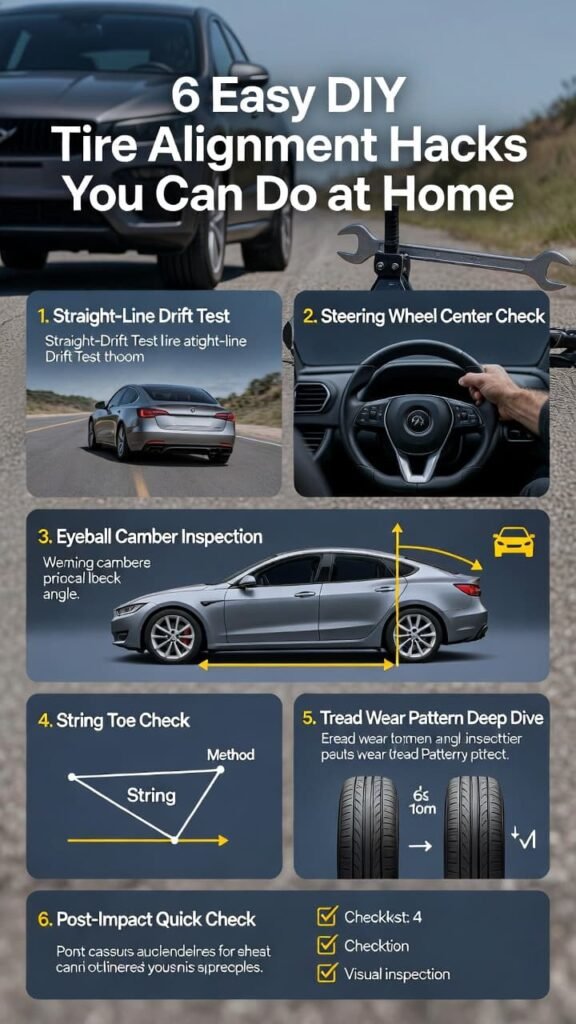
6 Easy DIY Tire Alignment Hacks You Can Do at Home
1. Hands-Free Straight-Line Drift Test
On a quiet, flat stretch of road (parking lot or empty street), drive 40–50 mph with your hands barely touching the wheel. If the car consistently pulls to one side (without wind or road crown influencing it), front toe or camber is likely off. Note which direction it pulls—this helps the mechanic later.
2. Steering Wheel Centering Check
3. Eyeball Camber Inspection
Park on flat concrete. Stand directly in front of and behind each wheel. Look for obvious tilt: top of tire leaning in (negative camber) or out (positive). For a rough gauge, hold a carpenter’s level or straight yardstick vertically against the tire sidewall—if it doesn’t match the wheel’s vertical plane, camber is out.
4. String Toe Check (Classic Home Hack)
Park straight on level ground. Run taut string or fishing line along both sides of the vehicle at hub height (use jack stands, helpers, or weights to hold strings). Measure the distance from string to front rim edge and rear rim edge on each side.
- Front measurement slightly smaller than rear = proper toe-in (typical spec: 1/32″ to 1/8″ total toe-in).
- Equal or front wider = toe-out or zero toe → alignment needed. This is surprisingly accurate for detecting toe problems.
5. Tread Wear Pattern Deep Dive
Use a penny or tread depth gauge:
- Inner edge much more worn = positive camber or under-inflation
- Outer edge worn = negative camber
- Feathering (smooth one direction, sharp the other) = toe misalignment Compare front vs. rear tires—significant differences often point to alignment issues.
Post-Impact Quick Check
After hitting a pothole, curb, or large bump, immediately test for new pulling, vibration, or off-center steering. Sudden changes almost always mean alignment has shifted.
When These Checks Say “Yes, Go to a Shop”
If 2+ of these tests show problems—or you have noticeable vibration, noise, or severe pull—schedule a professional four-wheel alignment. DIY adjustments are limited on most modern vehicles (tie-rod ends, camber bolts, etc.), and guessing can make wear worse.
Also get alignment checked after:
- New tires or shocks/struts
- Suspension repairs
- Hitting curbs/potholes hard
- Towing or heavy loads frequently
Bonus Prevention Tips for U.S. Drivers
- Check tire pressure monthly (use the door-jamb sticker PSI, not the tire sidewall max).
- Rotate tires every 6,000–8,000 miles.
- Avoid curbs, potholes, and aggressive off-roading when possible.
- Get alignment checked annually or every 12,000 miles as preventive maintenance.
These tire alignment hacks let you play detective in your own driveway and avoid unnecessary shop visits—or catch problems early before they chew through a new set of tires. Most Americans replace tires every 4–6 years; keeping alignment in check can easily add 10,000–20,000 miles to that lifespan.
At My Auto Fix, we’re all about empowering drivers with real-world knowledge. Try these checks this weekend—if the results don’t look good, we’re happy to handle the precision work. Drive straight, stay safe, and save money!